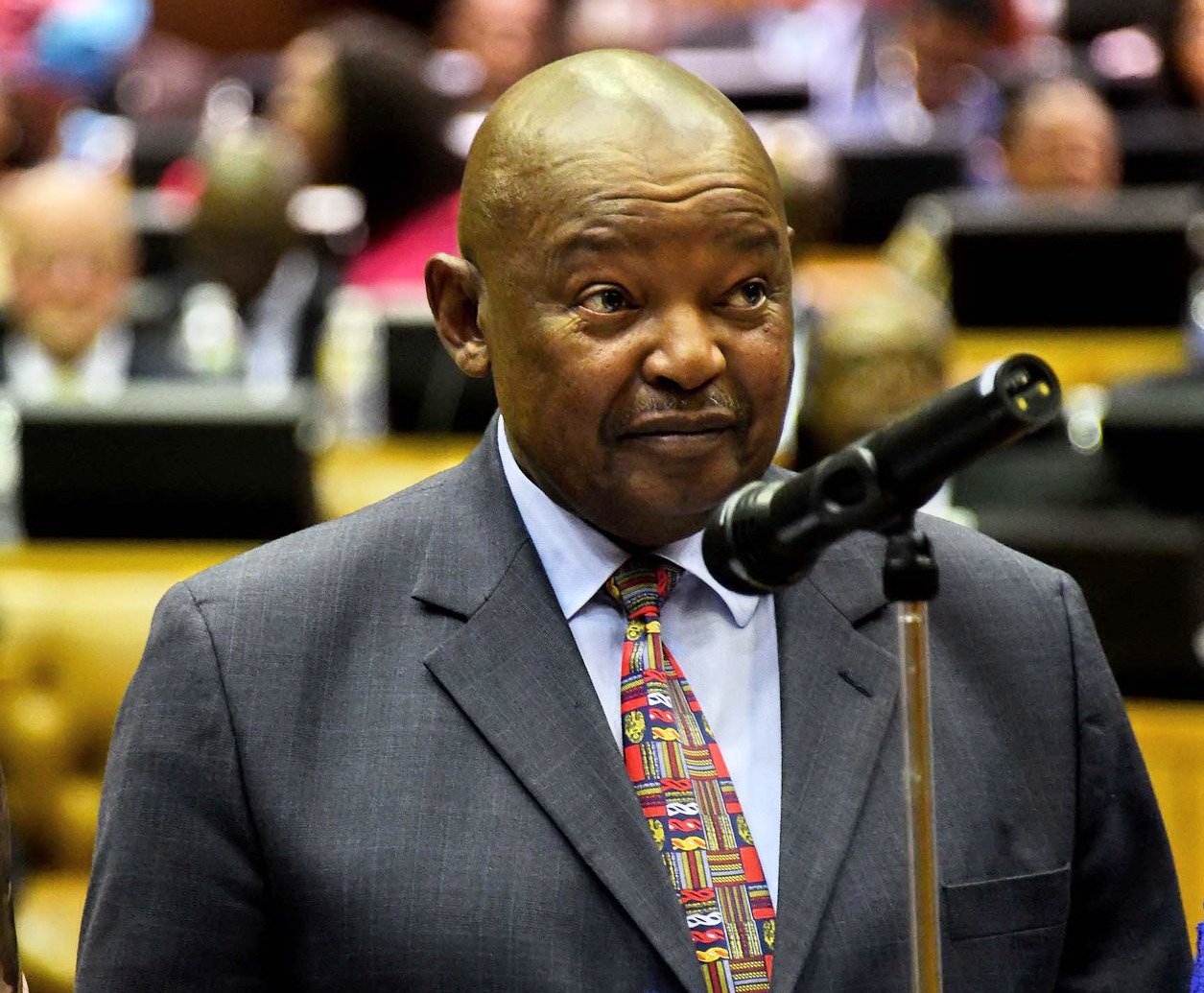

The wider South African defence fraternity will remember Mosiuoa Lekota as the Cabinet Minister who committed the country to the Strategic Defence Procurement Packages (SDPP) in December 1999.
Lekota, a seasoned activist and one-time African National Congress (ANC) executive member as well as being a provincial premier, Member of Parliament (MP) and Cabinet Minister, died early today (Wednesday, 4 March) aged 77. He was hospitalised in Johannesburg and had been ill for some time. He exited the ANC to form his own political party – COPE (Congress of the People) – in 2008 and was no longer an active politician standing down from public life in 2024, due to ill-health.
He was democratic South Africa’s second defence minister following Joe Modise who initiated the acquisition of new equipment for the SA Air Force (SAAF) in the form of 26 Swedish Gripen jet fighters, 24 Hawk Mk 120 lead-in fighter trainers and 30 Agusta A109 light utility helicopters (LUHs) with the SA Navy (SAN) regaining its blue water status with four Valour Class frigates and three Type 209 diesel-electric Heroine Class submarines. Four Super Lynx maritime helicopters, operated by 22 Squadron, were a late addition to the total SDPP.
Lekota was defence minister from mid-1999 until September 2008 and signed contracts with the German frigate and submarine consortiums as well as the Swedish aerospace group, Saab, British Aerospace and what was Agusta at Armscor in the twelfth month of 1999. He was the incumbent when the then Cabinet created a military veterans’ department as a standalone component of the Department of Defence (DoD) in 2009.
He gained the nickname “Terror” for his approach to football but told reporters while holding the defence portfolio he preferred either Mosiuoa or Patrick when he was defence minister. He is survived by his wife, Cynthia, and six children. At the time of publication no details of funeral or memorial services for the Free State born Lekota had yet been made public.
“South Africa has lost a patriot, a freedom fighter, and a servant of the people whose life story is closely intertwined with the country’s journey of struggle and the realisation of democracy,” said President Cyril Ramaphosa on Wednesday. “We honour him especially for his principled dedication to non-racialism during our struggle and in a liberated South Africa.”
Democratic Alliance (DA) leader John Steenhuisen said Lekota was a patriot and a man of substance. “One need not always have agreed with him to appreciate his dedication to our country’s success. From his activism on the ground to Robben Island to democratic politics, he dedicated all he had to give to the service of the South African people. He contributed immensely in our democratic Parliament, and remained a steadfast advocate for constitutionalism, accountability, and the rule of law.”
“His commitment to principled politics and his willingness to stand firm in defence of democratic values earned him respect across the political spectrum. South Africa has lost a seasoned leader whose voice and experience played an important role in shaping our country’s democratic discourse,” Steenhuisen said.
“His presence in the National Assembly reflected both his depth of experience and his unwavering commitment to constitutional values. South Africa has lost a statesman whose voice, insight, and historical perspective enriched our public discourse,” Inkatha Freedom Party (IFP) Chief Whip in the National Assembly Nhlanhla Hadebe said.
Born on 13 August 1948 in Kroonstad in the Free State, Lekota dedicated his youth and adult life to the struggle against apartheid. He was a member and organiser of the South African Students’ Organisation and was prosecuted by the apartheid regime, leading to his imprisonment on Robben Island in 1974.
He spent eight years behind bars alongside struggle icons, including Nelson Mandela, before his release in 1982. Upon regaining his freedom, Lekota resumed activism and became a leading figure in the United Democratic Front (UDF), a broad non-racial coalition of more than 400 grassroots organisations formed in 1983 to oppose the apartheid government’s Tricameral Parliament.
His involvement in the UDF led to his conviction in 1988 during the four-year Delmas Treason Trial, where the State attempted to link non-violent resistance to unrest in the Vaal. Although he was sentenced to 12 years’ imprisonment, his conviction and those of his co-accused were overturned in 1989.
In the democratic era, Lekota served as the first Premier of the Free State from 1994 to 1996 and went on to become the inaugural Chairperson of the National Council of Provinces from 1997 to 1999. He was appointed Minister of Defence in 1999, a portfolio he held until 2008.
He also served as National Chairperson of the African National Congress before co-founding the Congress of the People in 2008.