
Crack South African police investigation unit – the Hawks – has made five arrests in connection with the recruitment of South Africans for the Russia-Ukraine war.
Four suspects were arrested at OR Tambo International Airport on Friday 28 November, the Hawks said in a statement, on suspicion of contravening the Regulation of Foreign Military Assistance Act. The arrests followed a tip-off from OR Tambo police regarding four men who were en route to Russia via the United Arab Emirates. The individuals were intercepted and removed from the boarding gate after being flagged as suspicious, and subsequently referred to the Hawks’ Crimes Against the State (CATS) section. A preliminary investigation revealed that a South African female had allegedly been facilitating the travel and recruitment of these individuals into the Russian Federation military, the Hawks said.
The Hawks confirmed on Sunday that a fifth suspect has been arrested and will join the four others in appearing at the Kempton Park Magistrates’ Court on Monday. “Another individual has been arrested by the Hawks’ Crimes against the State section in relation to an ongoing investigation into how several South Africans were facilitated into involvement in the Russia-Ukraine war,” the Hawks said.
One of the suspects is Nonkululeko Mantula, a senior SAfm broadcaster.
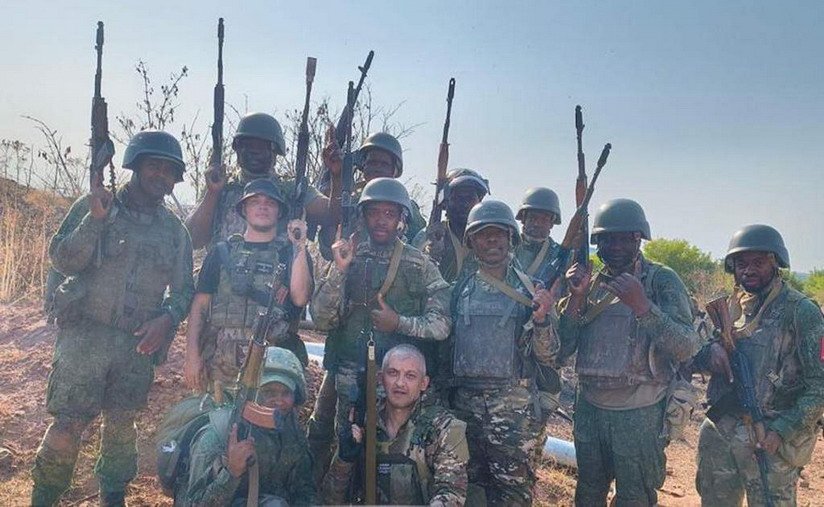
The arrests come after reports of 17 young men apparently being stuck in Ukraine’s Donbas region after they were seemingly recruited for either mercenary or bodyguard training. The men, some South African media have it, were coerced into leaving for paramilitary training ahead of becoming bodyguards in the Umkhonto weSizwe Party (MKP).
Duduzile Zuma-Sambudla, daughter of former President Jacob Zuma, resigned from her position as an MK Party MP amid allegations of involvement in recruiting South Africans to join Russian forces. MK Party spokesperson Nhlamulo Ndhlela stressed that the allegations are a personal matter for Zuma-Sambudla and not linked to the party, saying investigations should run their course without dragging the organisation in.
Last Sunday Zuma’s daughter Nkosazana Bonganini Zuma-Mncube opened a criminal case against her sister over the alleged recruitment of the 17 men without their consent. Zuma-Mncube also laid a fraud charge against Blessing Khoza for his apparent involvement in the saga.
Early in November President Cyril Ramaphosa reacting to what was said to be “a distress call” from the 17 men, had it there would be an investigation and assistance given to help them return to South Africa.
A family member of one still stuck in the Donbas region was reported by IOL as saying he was part of the group that went for a 12-month training course but ended up on the frontlines of the Russia/Ukraine war.
The men claimed they travelled to Russia in July for what they were told would be military training, only to be made to sign infantry contracts written in Russian.
The Regulation of Foreign Military Assistance Act of 1998 prohibits mercenary activity and regulates South Africans providing military assistance to foreign countries. The Hawks continue to investigate matters of foreign mercenary recruitment, and the Democratic Alliance (DA) has formally laid criminal charges against Zuma-Sambudla in terms of the Regulation of Foreign Military Assistance Act.
“This follows new evidence received by the DA, including around 100 WhatsApp messages from a group allegedly administered by Zuma-Sambudla. These messages show clear coordination in luring at least 22 men to Russia under the guise of ‘personal development’, ‘security training’, and even promises of Russian or Canadian citizenship, DA Spokesperson on Defence & Military Veterans Chris Hattingh said on 27 November.
According to information gathered, once the men arrived in Russia, their passports and clothing were burned, their phones confiscated, and communication with families gradually cut off until it ceased entirely. “This directly contradicts every promise made to them and constitutes clear indicators of trafficking and coercion.”
Of the 22 men who initially travelled, 19 remain in Russia — including 17 South Africans — now reportedly deployed in a “red zone” in North Donetsk as part of Russian forces. Three were returned early due to family connections, Hattingh said.
Defence analyst Dean Wingrin noted that foreign military assistance is broadly defined, including advice, training, recruitment, logistic/intelligence support, personnel, medical services, procurement of equipment, etc. and South African courts have jurisdiction over prohibited assistance for acts occurred outside South Africa.
“However, convictions under the Act is tricky, few prosecutions have succeeded, and many ended in plea bargains. Gathering evidence of unauthorised military assistance abroad is hard, and proving ‘knowledge’ (that someone knowingly provided prohibited assistance) is challenging.”
The MK men who have found themselves on the Ukrainian frontlines, having allegedly gone to Russia for VIP protection training, may not have had knowledge or intent to actually fight and thus a conviction is doubtful, according to Wingrin.
“There may, however, be a stronger case against MK MP Duduzile Zuma-Sambudla and other organisers of the Russian visit if knowledge of the intent for the men to sign military contracts can be proved,” he said. Other charges could be laid against the organisers in terms of the Prevention and Combating of Trafficking in Persons Act (PACOTIP). This Act defines trafficking broadly: delivering, recruiting, transporting, selling, leasing, or receiving a person, within or across borders, by means such as coercion, fraud, abuse of vulnerability, abduction, abuse of power, or payment, for the purpose of exploitation.
“Whilst there have been some prosecution successes, the number of convictions remains fairly low relative to the scale of trafficking, and as with Regulation of Foreign Military Assistance Act, there are significant challenges. Getting a conviction will be difficult. It requires experienced investigators and specialist prosecutorial skills in the NPA, and obtaining evidence and proving knowledge or intent will be difficult. Prosecutors have to prove not just the movement of persons, but also means (e.g. coercion) and purpose (exploitation). That raises the bar for investigation and proof,” Wingrin said.
“The law may be strong on paper, but real-world enforcement may be an issue.”
Update: After appearing in the Kempton Park Magistrate’s Court on Monday, Nonkululeko Mantula, 39, Thulani Mazibuko, 24, Xolani Ntuli, 47, Siphamandla Tshabalala, 23, and Sifiso Mabena, 21, were remanded in custody and will appear back in court on 8 December for a formal bail application.