– Advertisement –
A coalition of climate experts, media scholars, development organisations, and environmental advocates gathered in Lagos this week for one reason: to stop the spread of deadly climate misinformation before it causes more harm.
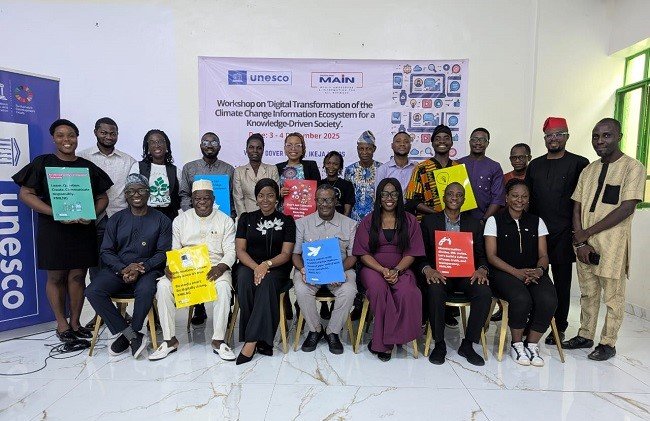
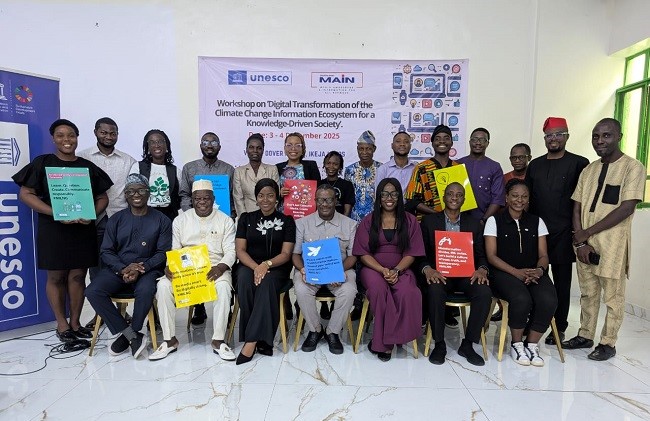
At a time when false climate narratives travel faster than facts, the Media Awareness and Information for All Network (MAIN) and UNESCO Abuja launched a groundbreaking workshop designed to cleanse the climate information ecosystem and empower Nigerians to decode, debunk, and defend against misleading content.
Speaking passionately on the sidelines of the workshop, Professor Jide Jimoh, Chairman of MAIN and Dean of Communication and Media Studies at Lagos State University (LASU), warned that the greatest threat to climate action today is not only environmental chaos – but information chaos.
In his words: “Climate change is dangerous, but what is even more dangerous is the misinformation surrounding it.”
He noted that digital platforms have amplified falsehoods, conspiracy theories, and distortions that: “Confuse the public, Delay policy action, Endanger lives and Undermine trust in science.”
According to him, the workshop aims to produce a new generation of fact-driven climate communicators, activists, NGOs, academics, and fact-checkers who will “walk the talk” and take practical steps to sanitise Nigeria’s digital climate space.
Representing the UNESCO Abuja Office, Yachat Nuhu delivered a sobering message on behalf of Dr. Jean-Paul Ngome Abiaga.
UNESCO highlighted that Africa is at a dangerous crossroads: while digital technologies connect people at unprecedented speed, those same technologies have become breeding grounds for dangerous myths, manipulated content, and climate conspiracy theories.
“Harmful narratives weaken our ability to respond to climate change,” she noted.
“Without strong media and information literacy skills, communities remain vulnerable.”
UNESCO reaffirmed its commitment to equipping journalists, institutions, and communities with the tools to: “Verify climate information, Counter harmful narratives, Use digital technologies ethically and Strengthen community resilience.”
The workshop also featured a goodwill message from Dr. Goke Rauf, Rector of DS Adegbenro ICT Polytechnic, who recalled the severe heatwave Nigerians suffered recently.
“That heat was a rude awakening. But it may not be the last. Nigeria must prepare,” Dr. Rauf warned.
He stressed the critical need to deploy AI, IoT, and big data to track emissions, strengthen early warning systems, and fight climate misinformation.
Dr. Rauf praised MAIN and UNESCO for responding strategically at a time when Nigeria needs clarity, not confusion.
The Nigeria Environmental Society (NES), represented by Mr. Emmanuel Chidiebere, added that climate literacy is no longer optional – it is a survival necessity.
Chairman Taofeeq Adeosun emphasized that bridging scientific data with community awareness is central to building a climate-resilient Nigeria.
“Accurate climate information has become a public good. This workshop strengthens Nigeria’s capacity to respond intelligently and proactively,” he said.
The two-day event afforded participants to collaborate on: Digital tools for combating misinformation, Climate-focused fact-checking strategies, Practical community education methods, Media and Information Literacy (MIL) frameworks, and Leveraging AI and emerging technologies for climate resilience.
The workshop marks a significant milestone in Nigeria’s journey toward building a knowledge-driven society, where digital innovation supports – not sabotages – public understanding of climate change.
As the event wrapped up in Lagos, one theme echoed louder than all others: “Climate misinformation is not just false – it is dangerous. And stopping it is now everybody’s responsibility.”
The organisers hope that the workshop will spark new collaborations and inspire Nigerians to become guardians of truth in a digital era brimming with distortion.
By Ajibola Adedoye