Fernando Botero, the Colombian painter and sculptor known for his highly stylised and whimsically rotund figures, has died at 91. His daughter Lina Botero confirmed on Colombian radio that her father died of pneumonia-related complications, and that the artist was in Monaco at the time of his death.
“Fernando Botero has died, the painter of our traditions and defects, the painter of our virtues. The painter of our violence and our peace,” The president of Colombia, Gustavo Petro, posted on X, formerly known as Twitter. Though the artist went on to spend most of his life throughout Europe and the United States, his childhood in Colombia and the political events and class struggles of his homeland remained central to his work.
Botero was born in Medellín, Colombia in 1932. The second of three sons, his father was a salesman who died of a heart attack when Botero was only four, and his mother was a seamstress. His uncle enrolled a young Botero in bullfighting school, but on the day the instructors were to bring out a real bull after practising on imaginary ones, Botero—along with the majority of his classmates—left and never returned. (As an adult, matadors and the sport of bullfighting would become central motifs in his work.)
Again with the help of his uncle, Botero then enrolled in a Jesuit school, but when he handed in an essay titled “Pablo Picasso and Nonconformity in Art” he was expelled for the promotion of secular artistic ideals. Botero began working as an illustrator and a set designer before moving in 1951 to the Colombian capital Bogotá. After having his first solo exhibition in Bogotá in 1952, Botero travelled to Madrid to study at the Royal Academy of Fine Arts of San Fernando, before relocating to Paris and then to Florence, where he studied the Renaissance masters and trained in fresco painting.
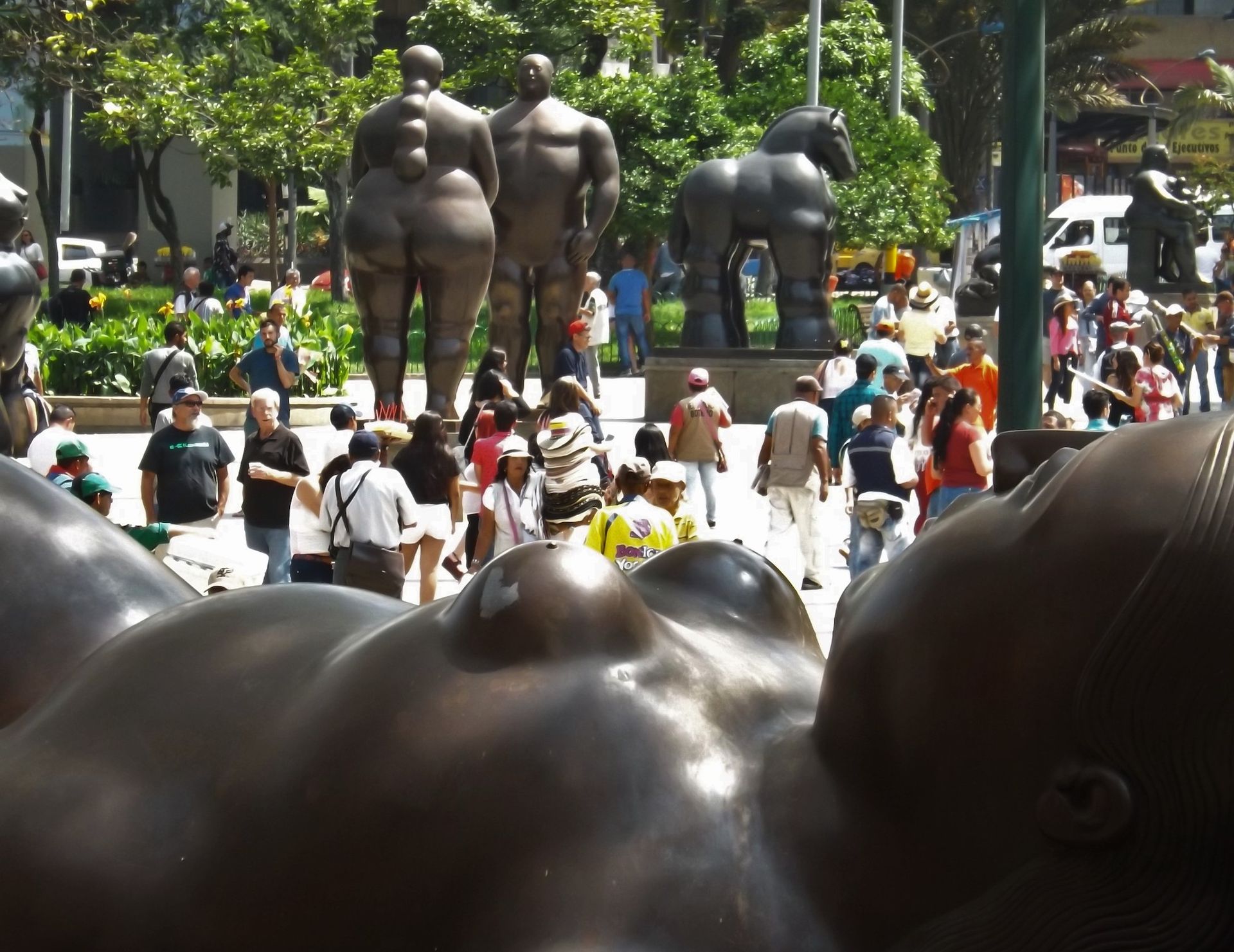
Botero Plaza in Medellín features nearly two dozen large-scale sculptures by Botero Photo by young shanahan, via Flickr
He relocated many times throughout the mid and late 1950s, between Europe, Mexico and Colombia, and during this time developed his highly identifiable style. In 1960, Botero moved to New York, but he struggled to be taken seriously in an environment in which the dominant modes were Pop Art and Abstract Expressionism. A chance encounter with Museum of Modern Art curator Dorothy Miller, who was in his building to visit a different artist, helped him gain footing. She saw his work Mona Lisa, Age Twelve (1959) and purchased it for the museum.
“They hung it in a great position, and it received tremendous comment,” Botero said in a 1985 interview with Artforum. “After that my work was seen a little, but my first big gallery show was not until 1972. This was the last time I received serious critical response from the New York press. From then on when I did shows there was complete silence. It was like I was a leper. One critic in particular came to see my work and had to stand in front of it without looking because he said it made him sick. From the public I got the opposite attention.”
This gulf between Botero’s commercial and critical success has often been attributed to the supposed accessibility of his work; art critics, who often prize themselves on insider lingo and a foundation of inherently obtuse knowledge, frequently saw little to celebrate in Botero’s seemingly fanciful figures, who appealed to those with and without art historical educations.
“My popularity has to do with the divorce between modern art, where everything is obscure, and the viewer who often feels he needs a professor to tell them whether it’s good or not,” Botero told The Los Angeles Times in 2012. “I believe a painting has to talk directly to the viewer, with composition, colour and design, without a professor to explain it.”
Despite this perceived mass appeal, the artist never avoided difficult subject matter. In 2005, he famously made a suite of paintings depicting acts of torture carried out by American soldiers at the Abu Ghraib prison in Iraq. He also frequently made paintings depicting the political turmoil of his home country, including portrayals of an imagined assassination of Pablo Escobar.
“This is a hope of mine that it will be a testimonial to a terrible moment, a time of insanity in this country,” Botero said of these paintings in 2004. “They are works that will hang in a museum, so people can see their history.”
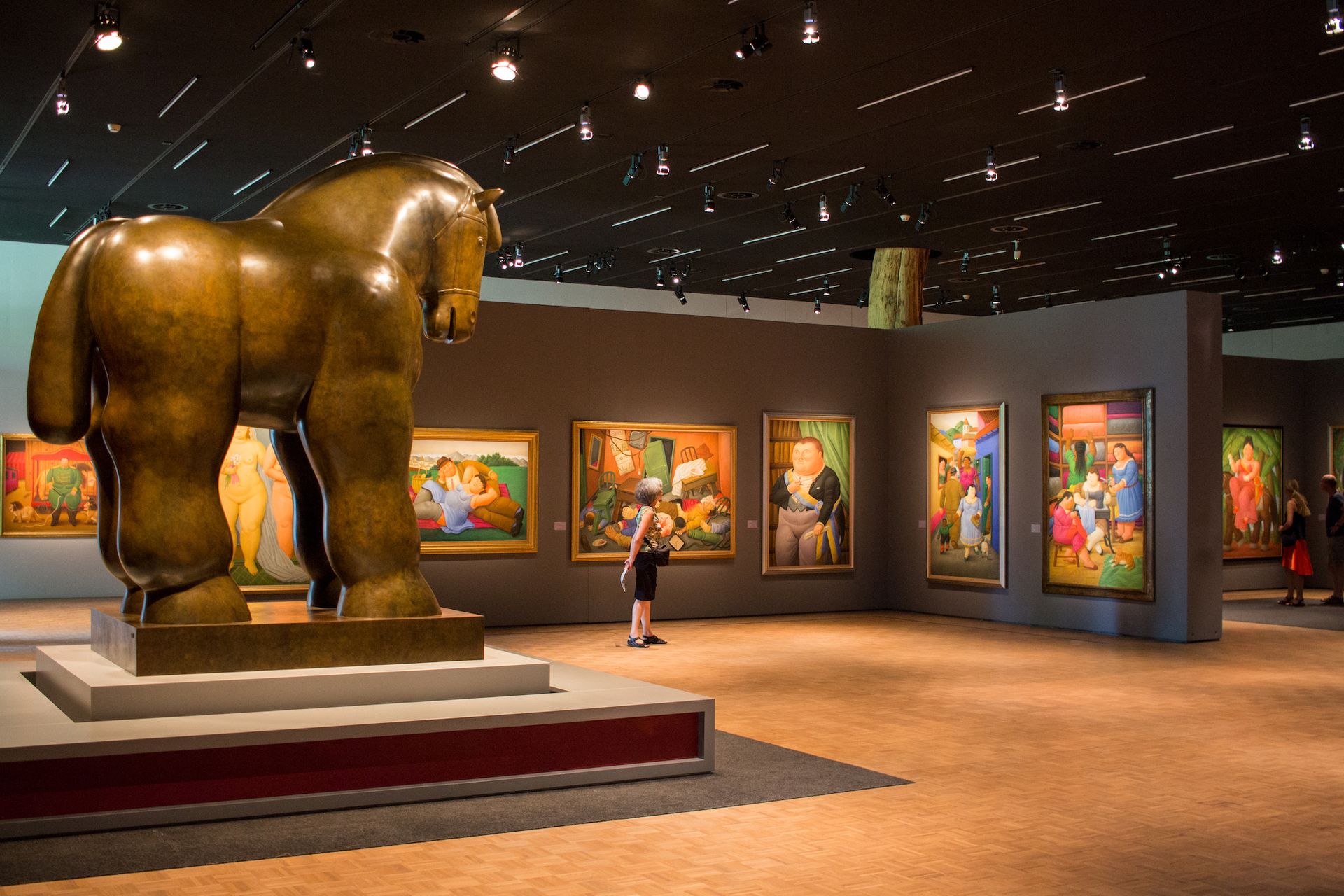
Installation view of Botero: Celebrate Life!, a Botero retrospective at Kunsthal Rotterdam in 2016 Photo by Hans Splinter, via Flickr
Even in his more quotidian paintings and sculptures, such as those depicting street and domestic scenes, Botero maintained a keen awareness and a joyful, quixotic hand to depict scenes often rife with issues of class and inequity without shying away from how such moments might contain as much sorrow and oppression as they do love and generosity.
Botero was married three times in his life, and he and his third wife, the Greek artist Sophia Vari, remained together from their marriage in 1978 until her death this past May. He is survived by his three children from his first marriage and many grandchildren, while his son Pedro from his second marriage was killed in a car crash in the 1970s when he was only five years old; Botero was in the car as well and was injured. In 2000, the Botero Museum opened in Bogotá, which contains over a hundred works by the artist as well as scores of works from his personal collection.