


Vanessa Collocott runs a free-range Pekin duck enterprise in Curry’s Post, KwaZulu-Natal. She explains that with a seven-week production cycle, disciplined management, and secure restaurant markets, duck farming provides steady cash flow and a viable diversification option for small-scale farmers.


– ADVERTISEMENT –
On her 20ha smallholding, The Blue Orange Farm, Collocott has carved out a profitable niche raising free-range Pekin ducks for meat. She says the decision to start duck farming was driven by the need for quicker returns compared with traditional small-stock farming.
“At the time, my main enterprise was goat farming. We had a Boer goat stud, but it wasn’t generating consistent monthly income.
“We needed something with a fast turnaround, and ducks give you that. You’re turning around a bird in seven weeks, as opposed to sheep or goats where you’re working on a year-long cycle,” she explains.
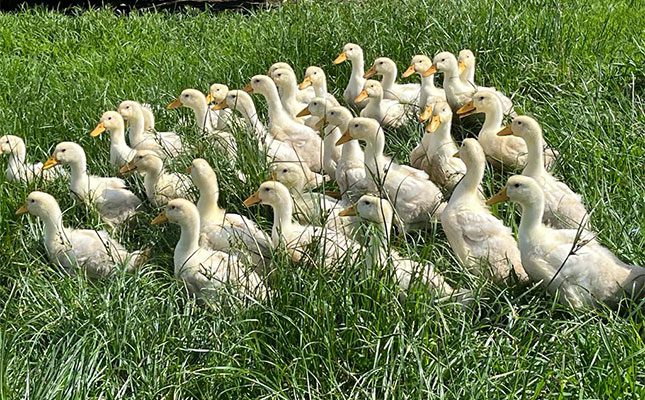
The Pekin is a globally dominant meat duck breed that originated in China. It is widely regarded as the most efficient commercial meat duck due to its rapid growth rate, good feed conversion, and desirable carcass characteristics.
“They are designed for meat production. They grow fast, they’re uniform, and the market knows them as a table bird. That’s why we farm them exclusively to Pekins,” adds Collocott.
Her decision to farm ducks was also influenced by the relative scarcity of duck producers in South Africa.
“There aren’t a lot of duck farmers out there. That lack of saturation creates opportunity, especially if you can supply a consistent, good-quality product.”
Production cycle
Collocott buys day-old ducklings from Kent Farming in Birnamwood and runs them through a tightly managed production cycle. Under optimal conditions, Pekin ducks can be slaughtered from as early as 44 days old, although most are marketed by day 49.
“From day one to day 44, you can technically slaughter if you’ve fed them correctly. You shouldn’t keep a duck beyond 49 days; after that, they stop putting on weight efficiently, and you’re just feeding them to maintain body mass, which eats into your margins,” she says.
This strict adherence to slaughter age is critical to maintaining profitability.
Brooding and early management
While ducks are generally hardy, the first three weeks of life are the most critical, as the ducklings require protection from cold, excess moisture, and predators.
“They need to be kept warm and dry initially. We use infrared lights for brooding, because warmth is essential during the first four or five days,” adds Collocott.
After the initial brooding phase, ducklings rapidly become more resilient.
“By day five, I switch off heat lamps, and the water is no longer heated. Ducks generate a lot of body heat, so if the area isn’t too big or draughty, they will keep each other warm.”
She adds that once this early window has passed, duckling mortalities are extremely low: “After that, there really shouldn’t be losses.”
Daily management and feeding strategy
One of the advantages of free-range duck production is its relatively low labour requirement compared with intensive poultry systems. Once ducks are established and feathered, daily management becomes fairly straightforward.
“Ducks are very easy to grow. It’s intensive in the sense that they’re confined and managed, but they aren’t not high-maintenance. If they’re free-range and out on pasture, the key things are feed, water, and shelter from heat,” explains Collocott.
Unlike chickens, ducks are largely unfazed by wet weather. “They love rain. Wet conditions aren’t an issue once they’re fully feathered. Heat, however, can be a problem, so shade and
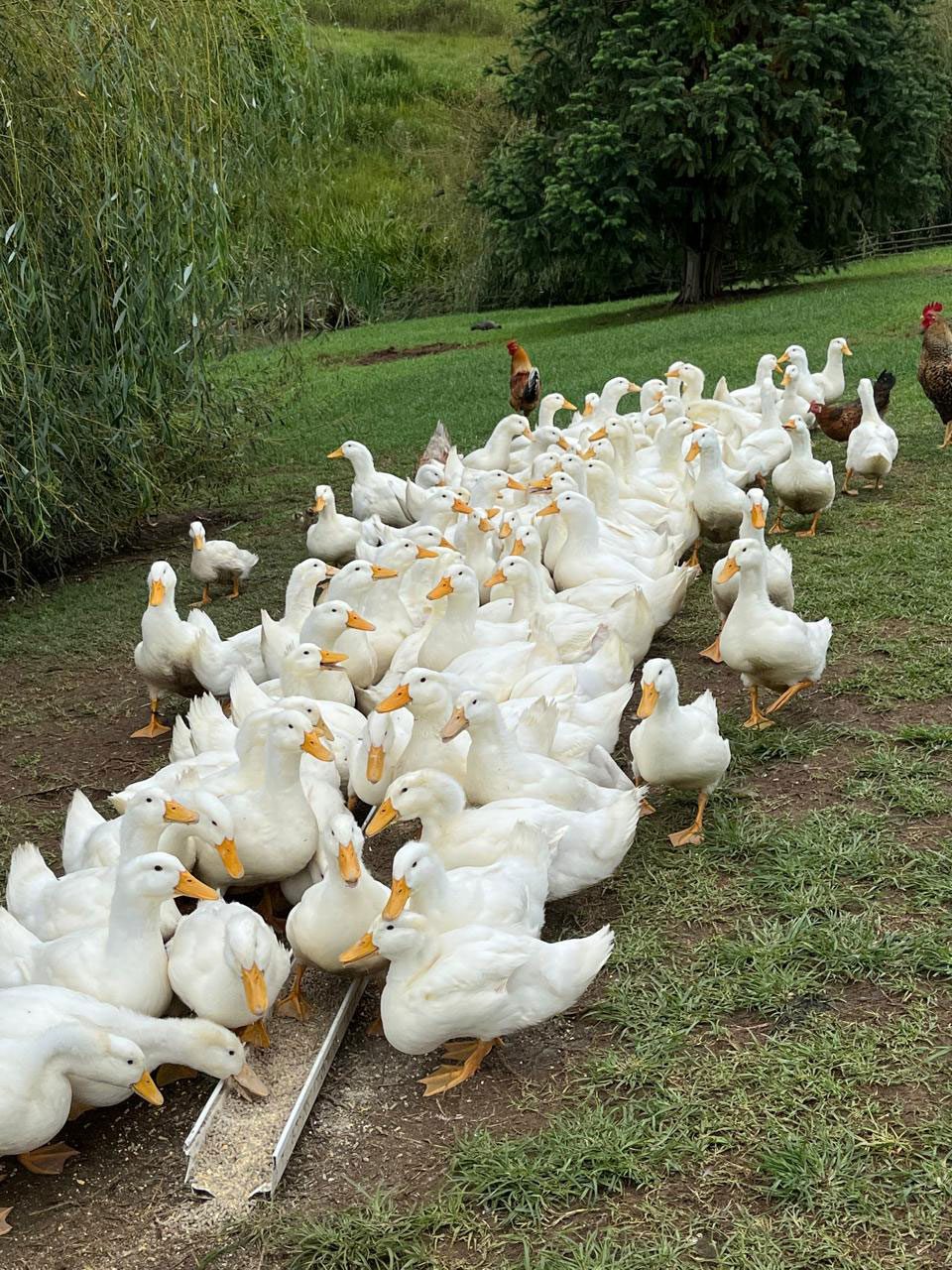
airflow are important.”
Pekin ducks are known for their high feed intake, a factor that must be carefully planned for when budgeting.
Collocott’s feeding programme is structured across three phases:
- Starter crumble: 1kg per duckling
- Grower pellets: 1kg per bird
- Finisher pellets: 6kg to 7kg per bird
“In total, a duck will consume between 8,5kg and 10kg of feed [before it goes to market],” she adds.
Water management and hygiene
Ducks need constant access to clean water for drinking and for washing their nostrils and eyes, but they are notorious for fouling it.
“When they’re small, they use raised drinkers. As they grow, we raise the drinkers higher so they can only dip their beaks in,” says Collocott.
This limits spillage and prevents the birds from climbing into the water containers, which would quickly contaminate them.
During the brooding phase, Collocott uses a combination of sawdust and pine shavings as bedding to manage moisture.
“You have to lift the drinkers as they grow. Their little feet carry water everywhere, so if the drinkers are too low, the bedding gets wet very quickly,” she explains.
The decision to limit production to 80 to 100 ducklings per batch is directly linked to hygiene control.
“I know exactly what my farm’s capacity is, and I can keep things clean at that level. Once you push beyond that, cleanliness becomes harder to manage, and that’s when health issues start creeping in,” she warns.
Once the ducks are moved to pasture, regular rotation keeps waste under control and fertilises the grass, while preventing the build-up of pathogens.
“Ducks love to swim and mess in water, so you have to design your system to give them what they need without creating hygiene problems,” adds Collocott.
Market demand
Demand for duck meat in South Africa remains largely niche, driven by restaurants, specialty butchers, and consumers seeking alternatives to chicken, and Collocott says demand peaks around the festive season.
For smallholders seeking diversification, she says duck farming offers a realistic option, provided producers understand the economics and commit to disciplined management.
“You need to know your numbers. Feed costs, slaughter timing, and mortality control are everything,” she advises.
With the right systems in place, free-range Pekin duck production can deliver steady cash flow, low labour demands, and access to an underserved market.
“It’s not complicated, but you have to do it properly, and you have to respect the production cycle,” she says.
Despite the technical simplicity of duck production, Collocott says market access remains the most decisive factor in determining whether a duck enterprise will succeed or fail.
“I supply mostly local customers and a lot of top-end restaurants, and before COVID-19, I was also sending a fair volume of ducks to the Cape through a distributor,” she says.
At its peak, the business was moving approximately 500 ducks a month, but that changed almost overnight when the hospitality industry shut down in 2020 during the height of the pandemic.
“When COVID-19 hit, I went from doing about 500 ducks a month to literally nothing. All the restaurants closed, and that’s the main market for duck,” she says.
Unlike chicken, duck meat isn’t a staple protein for most households, and demand is highly seasonal.
For this reason, Collocott cautions aspiring producers against relying on informal or household sales alone.
“My advice is to make sure you have a market before you start. You will never sell enough ducks if you only target the home market. You have to work with restaurants, wholesalers, or distributors who can move volume consistently,” she explains.
For more information email Vanessa Collocott at [email protected].
Get trusted farming news from Farmers Weekly in Google Top Stories.
➕ Add Farmers Weekly to Google
✔ Takes 10 seconds · ✔ Remove anytime


