International auditing systems such as GlobalGAP may soon introduce maximum water-use limits for fresh produce farmers.


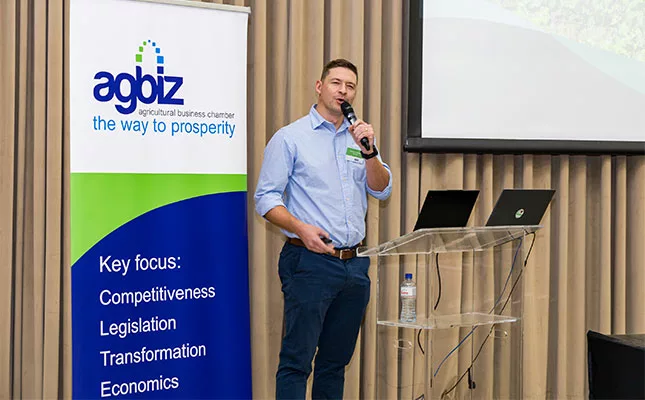
Photo: AGBIZ
Water use is one of the few on-farm practices not yet measured by international farm audit body GlobalGAP, Michael Esmeraldo, managing director of irrigation supplier Netafim Southern and East Africa, said at the Agbiz Media Day held on 23 October at Elsenburg Agricultural Training Institute near Stellenbosch, Western Cape.
“My forecast is that within the next [five to 10 years], [GlobalGAP is] going to give an upper limit on the amount of water that can be used to grow a certain crop. For example, if you want to grow citrus for export, you will probably not be allowed to use more than 750mmm to 800mm [of water], otherwise it would not be considered sustainable and efficient water use,” he explained.
Esmeraldo said if consumers insisted on having a water-efficient product on the shelves, that’s what farmers would need to produce.
“And we already know through extensive research over many years that you don’t need that much water to produce the same crop; you only need a certain amount,” he added.
In addition, he said South African irrigation practices were generally far more advanced than those in most other parts of the world.
“Because it is so dry [in South Africa], we needed to make plans much earlier than the rest of the world, and today we can count ourselves lucky that we made those choices,” he explained.
Esmeraldo shared data showing that drip irrigation, by far the most efficient mode of irrigation, accounted for 18% of irrigation in South Africa, compared with 5% to 6% internationally. Flood irrigation accounted for 14% in South Africa and 35% to 40% internationally.
Advantages of drip irrigation over sprinklers
He cited research done by the World Wide Fund for Nature, which showed the advantages of drip irrigation over sprinkler irrigation in terms of the water use of several high-value permanent crops.
For wine grapes, sprinkler irrigation required 41ℓ more water to produce a kilogram of yield than drip irrigation; for table grapes, the difference was 39ℓ, for pome fruit 21ℓ, stone fruit 20ℓ, citrus 19ℓ, and almonds 117ℓ.
Converted to on-farm savings for a 50ha farm, this translated into tens of thousands of cubic metres of water savings per season.
Esmeraldo said that thanks to the technology available to farmers today, it had never been easier to use water efficiently.
“Evapotranspiration can be determined very accurately if you have an on-farm weather station. I know farmers who even have a weather station in every block to make sure that they are as efficient as possible,” he added.
In addition, he considered soil moisture probes essential, as they measured water movement in the soil. “Where drip irrigation sometimes can become difficult to manage, and we see this every day, is when people irrigate and they don’t see the water because it’s all in the subsoil.”
This led to the risk of over-irrigation, as irrigation water penetrated deeper than the plant roots, an issue that could be mitigated with soil moisture probes.
He said dendrometers, which measured the expansion and shrinkage of tree trunks – a proxy for water movement within the plant, and therefore its water use – were also a welcome addition to the technology available to commercial farmers today, having traditionally only been accessible to researchers.
One caveat he added about technology use was that “too much data also confuses people”, and that it was essential for farmers to invest in a platform capable of collating all the available on-farm data to help them interpret and make sense of the data.
Financing and accountability
Esmeraldo said that with smallholder farmers in particular, there was a need to finance or subsidise the transition to more efficient irrigation modalities.
“I think banks need to start offering accessible finance for sustainable water-use technologies. As far as I know, it’s not currently available, and I’d be very happy if I’m wrong on this.
“At the moment, if a farmer wants to buy irrigation [equipment], banks will finance a centre pivot because it’s a tangible asset. So, if the farmer defaults on their payments, the bank can [repossess] the pivot, sell it to someone else, and recoup some of their money.
“When it comes to drip irrigation, it doesn’t really have a second-hand value. But if we want farmers to adopt water-wise technologies, they’re going to need financing. And they don’t need preferential terms or [environmental, social, and governance] financing; they can just get normal financing at the standard interest rate,” he explained.
Esmeraldo concluded that most water losses that occur in irrigation systems were due to leaking pipes and poor maintenance, rather than inadequate irrigation practices. He added that farmers should be held accountable when they exceeded their allocated quotas, as there were generally few consequences when this happened.