– Advertisement –
Synopsis
Climate change and natural climate variability are the major causes of weather extremes such as heavy rainfall. There have been reports from multiple ecological zones in Nigeria, indicating rainfall events in December 2025 through February 2026. These situations hint at an increasing crisis of rainfall variability that is imposing an increasingly severe humanitarian, economic, and ecological toll on one of Africa’s most populous nations.
Regional climate variability is driven by anomalies in the large-scale ocean and atmospheric circulations that modify regional atmospheric transport (Schwing et al., 2010). A result of this increased climate variability is the increased flooding events experienced in recent times.
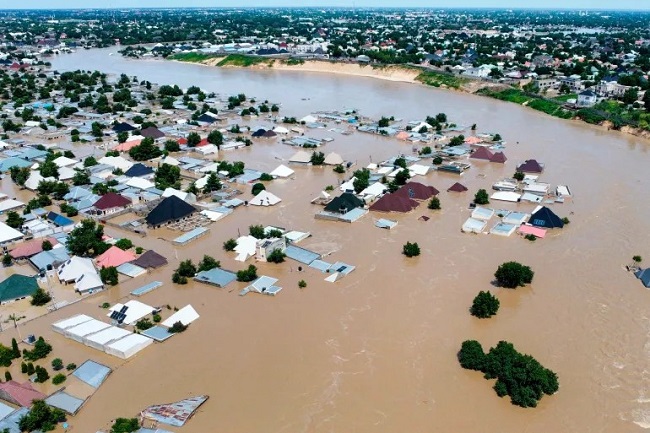
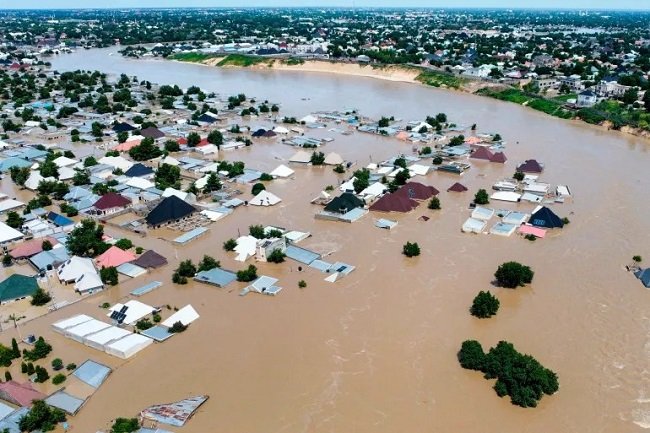
Flooding is the most frequent, most lethal, and most economically destructive natural hazard in Nigeria, its frequency and severity are increasing measurably under anthropogenic climate change. Nigeria ranks 60th on the 2025 World Risk Index among 193 nations, with flood exposure scores ranging from 40.97 to 100.00 at sub-national level.
As Africa’s most populous nation with a population exceeding 220 million, the stakes of inadequate flood management are extraordinary: floods destroy livelihoods, contaminate water supplies, trigger disease outbreaks, devastate agricultural output that accounts for over 31% of GDP, and deepen the poverty of communities already living on the margins.
The scientific evidence linking this escalating hazard to climate change is now robust and formally quantified. The World Weather Attribution (WWA) network – an international consortium of climate scientists using probabilistic attribution methods – confirmed in October 2024 that human-driven climate change made seasonal downpours across the Niger and Lake Chad basins 5-20% more intense, directly contributing to the humanitarian catastrophe that killed 1,200 Nigerians and displaced 1.2 million in 2024.
WWA researcher Joyce Kimutai noted that “Africa has contributed a tiny amount of carbon emissions globally but is being hit the hardest by extreme weather”. At the current trajectory of global warming, “spells of heavy summer rainfall” in the Niger and Lake Chad basins could become annual events if global temperatures reach 2°C above pre-industrial levels – a threshold that climate models project could be crossed as early as the 2050s.
This article provides a comprehensive scientific analysis of Nigeria’s flooding and rainfall variability crisis, integrating attribution science, long-term observational data, and disaster impact assessments to examine the causes, manifestations, and consequences of extreme flooding, and to propose evidence-based responses aligned with the Sendai Framework for Disaster Risk Reduction 2015–2030 and the United Nations Sustainable Development Goals.
Rainfall Variability and Intensification
Nigeria is a country in West Africa that is characterised by a wide variety of ecoregions. shares borders with Cameroon, Chad, Niger, Benin, and the Atlantic Ocean. There are two major rainfall seasons in Nigeria – the dry season (typically from November to March) and the rainy season (typically from April to October). The north and south seasonal migration of the Inter-tropical Convergence Zone (ITCZ) following changes in the region of maximum diabatic heating in addition to sea surface temperature anomalies (SSTa) at the adjacent oceans are among the principal factors that control the seasonal rainfall variability in Nigeria.
The south-eastern states receive the highest annual precipitation (>3,000 mm/year) due to moisture-laden airstreams from the Atlantic and orographic effects of the Cameroon Highlands, while the north-east receives the least (<500 mm/year) under the influence of dry north-easterly Harmattan winds from the Sahara. Within this spatial framework, however, the critical trend of the past four decades is not merely towards greater total precipitation, but towards greater within-season variability, with rainfall increasingly concentrated in shorter, more intense bursts interleaved with extended dry spells.
The attribution of specific extreme rainfall events to anthropogenic climate change has advanced substantially through probabilistic event attribution (PEA) methods. The fundamental approach compares the probability of an event occurring in the observed climate with its probability in a counterfactual climate reconstructed without human influence, using ensembles of climate model simulations.
For Nigeria and the wider Niger-Lake Chad basin, WWA’s 2022 attribution study found that climate change, driven primarily by fossil fuel combustion increasing atmospheric CO₂ and associated radiative forcing had made similar heavy rainfall events no longer rare: an event return period that was once once-in-10-years now occurs on a recurrence interval of approximately 3-5 years in the current 1.3°C warmer world.
Borno State provides a particularly well-documented case study. Long-term meteorological records show that between 1961 and 1990, peak August precipitation reached 193.51 mm; by the 1991-2020 baseline, temperatures had increased from a January mean of 22.78°C to an April mean of 33.07°C, while precipitation patterns show a clear shift towards more intense short-duration events, precisely the conditions that overwhelmed drainage systems and contributed to the catastrophic September 2024 flooding.
The August-September 2024 rainfall across Borno triggered the collapse of the Alau Dam, affecting over 200,000 people, causing 230 deaths, and displacing an estimated 600,000 residents of Maiduguri the largest city in north-eastern Nigeria.
Compound Drivers: Climate Change, Infrastructure Failure and Government Deficits
Nigeria’s flooding crisis cannot be understood through the climate signal alone; it is a compound hazard in which climate-intensified rainfall interacts with infrastructure, governance, and land-use factors to produce catastrophic outcomes. Dam operations, both within Nigeria and in upstream countries constitute a major proximate driver of catastrophic flooding. The most egregious transboundary example is the Lagdo Dam in northern Cameroon, whose water releases during peak discharge periods have repeatedly triggered devastating floods in the downstream Niger and Benue river basins in Nigeria.
The 2012 floods – Nigeria’s worst in over 40 years, affecting more than 7 million people, displacing 2.1 million, and destroying over 5,900 houses across 32 states – were directly attributed to the combination of heavy rainfall and Lagdo Dam releases.
Within Nigeria, the Jebba Hydroelectric Power Station dam on the Niger River has caused at least six flooding events in downstream Mokwa communities – including the fatal April 2025 event that killed 13 people and destroyed over 10,000 hectares of paddy farms, just six weeks before the catastrophic May 2025 flash flood.
The pattern of repeated flooding from the same dam constitutes a governance failure as much as a natural disaster: communities and dam operators coexist within the same regulatory framework yet release management protocols evidently fail to protect downstream settlements from predictable, seasonal inundation.
Beyond dam operations, land-use change is a critical amplifier of flood risk. Nigeria has experienced significant deforestation, losing approximately 11% of its forest cover between 2000 and 2020 which reduces the natural capacity of catchments to infiltrate and retain rainfall, increasing surface runoff velocity and peak discharge volumes. In upstream areas feeding the Niger River basin, agricultural expansion, fuelwood collection, and charcoal production have stripped riparian vegetation that previously buffered floodwaters.
Rapid and largely unplanned urbanisation compounds the deforestation effect by replacing permeable natural surfaces with impermeable concrete and asphalt, dramatically increasing the speed and volume of stormwater reaching drainage systems. The Nigeria Hydrological Services Agency (NIHSA) classified major areas of Lagos State including Agege, Alimosho, Ikorodu, Lagos Island, and Eti-Osa, as high flood risk in 2025, acknowledging a measurable increase in rainfall frequency and intensity in the southern region.
Lagos, with an estimated population of 15-21 million and among the fastest-growing megacities in the world, epitomises the collision of climate intensification and urban governance failure: inadequate storm drainage designed for historical precipitation norms, uncontrolled floodplain development, drainage channels blocked by solid waste, and a built environment covering surfaces that once naturally attenuated runoff. Similar dynamics have been documented in Port Harcourt, Ibadan, Kano, and Abuja, each city experiencing worsening urban flooding as drainage infrastructure fails to keep pace with population growth and climate change.
The public health consequences of Nigeria’s flooding crisis are severe, multi-dimensional, and disproportionately borne by children, women, the elderly, and people with disabilities. Flooding directly disrupts water supply and sanitation infrastructure, contaminating drinking water sources with faecal matter, sewage, and chemical pollutants which create conditions for rapid outbreak propagation of cholera, diarrhoea, typhoid fever, and hepatitis A.
Flooded environments additionally create ideal breeding conditions for Aedes aegypti and Anopheles mosquitoes, the respective vectors for dengue/Zika/yellow fever and malaria by generating stagnant water pools in abandoned containers, depression pools, and partially inundated structures. Studies in Ajegunle, Lagos, found that waterborne diseases including diarrhoea, cholera, dysentery, and typhoid were the dominant post-flood health burden, killing mainly children in affected neighbourhoods.
Early Warning, and the Adaptation Imperative
Nigeria has developed a multi-agency flood early warning architecture involving the Nigerian Meteorological Agency (NiMet), the Nigeria Hydrological Services Agency (NIHSA), and the National Emergency Management Agency (NEMA), supplemented since 2025 by community-based flood forecasting pilots. In 2025, NEMA issued multiple advance warnings for Niger State including Mokwa citing it as one of 30 states at high flood risk and warning that 15 million Nigerians faced high flood risk across 1,200 communities. These warnings were disseminated through radio, television, social media, and community town criers.
Yet the May 2025 Mokwa disaster that claimed an estimated 500 lives despite advance warnings exposes the critical gap between hazard forecasting and disaster prevention: early warning systems, however technically capable, cannot protect communities that lack the physical infrastructure, economic resources, or institutional authority to act on warnings effectively.
Addressing Nigeria’s flooding crisis demands a paradigm shift from reactive emergency response to proactive, evidence-based climate adaptation, a transition explicitly called for by both NIHSA’s 2025 Flood Outlook and the Sendai Framework for Disaster Risk Reduction 2015-2030.
Conclusion
Nigeria’s flooding and rainfall variability crisis is not an anomaly or a manageable annual inconvenience: it is a scientifically documented and accelerating climate emergency. The attribution science is clear, human-caused climate change has made extreme rainfall in the Niger and Lake Chad basins 5-20% more intense, transforming once-rare 10-year events into near-annual occurrences. Long-term observational data document a statistically significant intensification of extreme precipitation across south-western and north-central Nigeria.
Crucially, climate change does not act alone: it interacts with and amplifies the consequences of inadequate drainage infrastructure, unregulated floodplain development, transboundary dam management failures, deforestation, urban sprawl, and a governance architecture that remains structurally oriented towards response rather than prevention.
Addressing this crisis therefore requires simultaneous action on multiple fronts: climate mitigation to limit further warming in line with SDG 13; adaptation investment in infrastructure, early warning, and green nature-based solutions; binding transboundary water governance; and structural poverty reduction to lower the vulnerability of the communities that suffer most when floodwaters rise.
Nigeria possesses the technical expertise and the financial capacity to implement these solutions.
By Okali Kelechi David, Programme Officer, Monitoring and Evaluation, Nigerian Environmental Study Action Team (NEST), Ibadan