

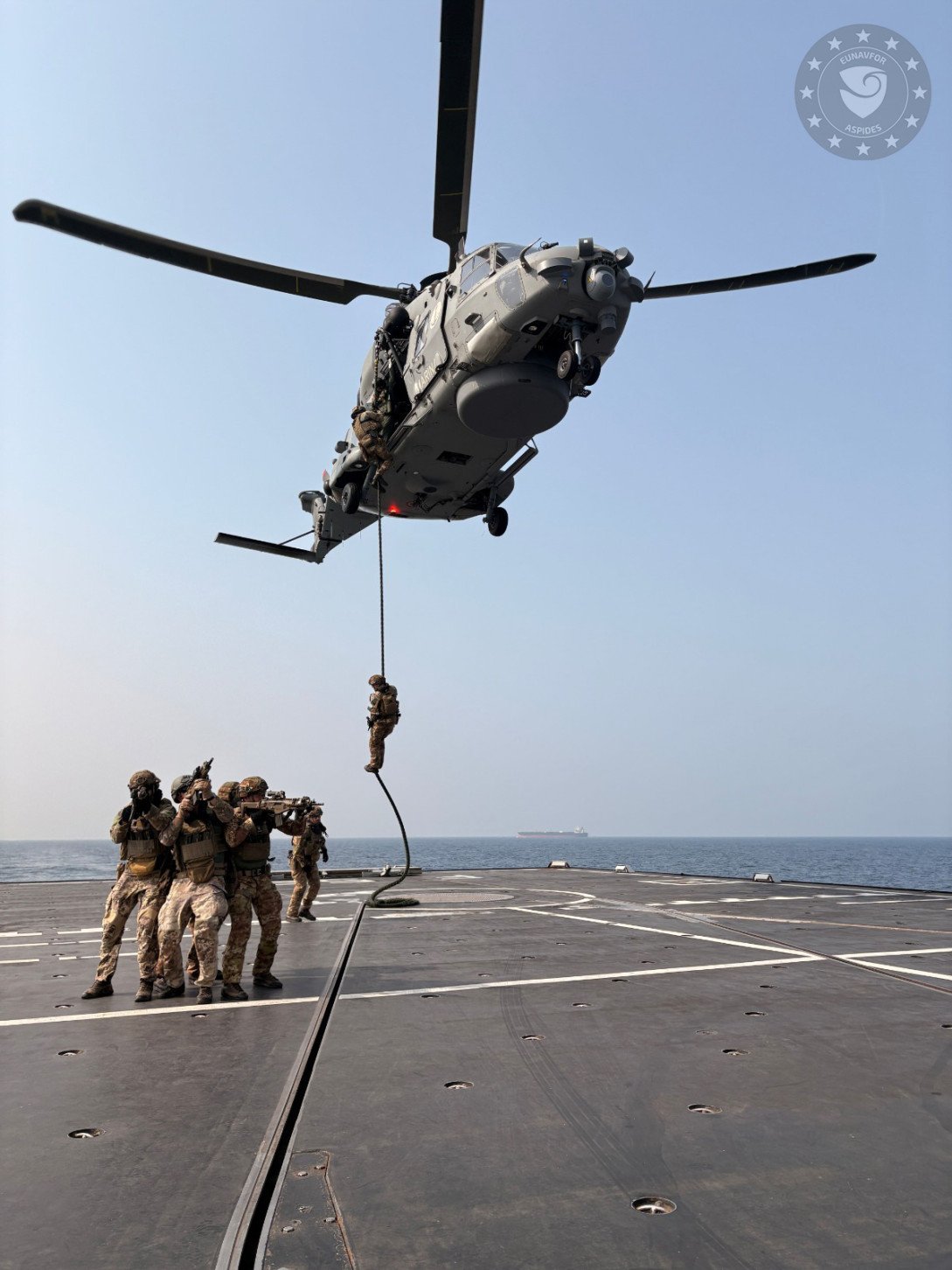

The European Union (EU) maritime operation safeguarding freedom of navigation in the Red Sea and adjacent waters – Aspides – is extended until 28 February 2027.
The operation name means “to shield” and is an ancient Greek word symbolising defence and protection.
The decision to extend Aspides operational life from the initial two years when it was formally established as a European bloc mission in February 2024 was made public on Monday, 23 February, in an EU Council statement. The decision follows a strategic review of the Larissa, Greece, headquartered operation.
The extension will be funded by €15 million to cover common costs of the three naval unit operation with a further review set to take place ahead of the new Aspides mandate ending on 28 February 2027. The extension decision, a statement has it, reflects the EU’s continued commitment to maritime security, regional stability and protecting global trade flows.
The operation contributes to safeguarding freedom of navigation in the Red Sea and surrounding waters in response to ongoing threats against merchant and commercial vessels emphasised by United Nations Security Council (UNSC) resolution 2722 demanding cessation of Houthi attacks on commercial and merchant shipping.
Aspides provides defensive maritime security, protects vessels and supports stability on key maritime routes in accordance with international law. Its mandate confines it to the maritime environment with its airborne and naval assets deployed. It builds on the EU strategic compass for security and defence consolidating the bloc’s response to crises in co-operation with what are termed “like-minded international partners”.
Current Aspides flagship and force headquarters is the Marina Militare (Italian Navy) frigate ITS Luigi Rizzo (F595) which this month saw an intensive training exercise to sharpen operational readiness and situation awareness.
Aspides’ area of operations (AoO) includes the Bab al-Mandab and Hormuz straits, the Red Sea, the Gulf of Aden, the Arabian Sea and the Gulf of Oman.
Aspides’ command recently highlighted that in the 23 months it has been operational, over 1 570 vessels have been supported. It operates with three naval vessels supplied by countries including Greece, Italy, and Spain, and says it continues regularly training and preparations to maintain operational readiness.


