Butterflies are regarded as less efficient pollinators than bees. However, in some instances, their services have even greater value.


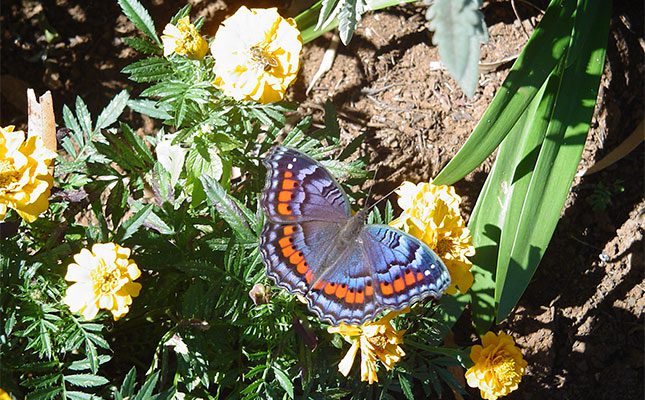
Photo: Wikimedia Commons
The survival of human beings and all land-based ecosystems depends on pollinators. According to scientists, pollinators support the reproduction of 76% of the world’s leading food crops, while 87.5% of flowering plants are pollinated by vertebrates like birds and bats, and/or invertebrates like insects.
These creatures also support genetic diversity through cross-pollination, resulting in plant populations that are stronger and more resilient to diseases, pests, and climate change.
Insects are the most diverse and abundant group of pollinators, comprising more than 20 000 bee species, over 230 000 butterfly and moth species, as well as wasps and beetles. Bees are highly effective pollinators due to specific adaptations that allow them to carry more pollen than other insects can.
Butterflies, by comparison, are less efficient pollinators, visiting flowers less frequently and depositing less pollen, as their long legs and slender bodies often don’t make direct contact with flowers. Even so, butterflies remain essential pollinators.
According to professors at the University of Maryland in the US: “Lepidopterans [an order of winged insects that includes butterflies and moths] are vital contributors to the pollination of wild plants and domesticated crops, and though their efficiency at crop pollination does not reach the level of bees in most systems, there are instances in which their services are of greater value.”
Many flowers, including orchids, rely specifically on butterflies for pollination. These insects are also important in agricultural systems.
“A survey of pollinators associated with macadamia [nuts] in north-eastern Brazil found that macadamia yields mainly benefitted from pollination by butterflies rather than bees. Consequently, butterflies were responsible for more than 50% of floral visits to macadamia flowers. Moreover, their pollination of some vegetable crops contributes strongly to seed production,” the professors say.
These crops include those in the carrot, sunflower, legume, and Brassica families, such as celery, lettuce, artichokes, cabbage, broccoli, peas, and beans. While pollination does not produce the edible parts of these crops, seed production is ensured for the next crop.
Butterflies also pollinate fruit trees, such as apples and citrus, contributing to good harvests; herbs like lavender, rosemary, and basil; and South Africa’s fynbos species like proteas.
Proteas are ecologically and economically valuable, contributing significantly to the cut flower industry, and South Africa remains a leading global producer of these flowers. Many protea species, however, are classified as vulnerable, near threatened, or critically endangered due to several factors, including habitat loss and invasive species.
Butterflies and pollinators in general play a crucial role in the survival of endangered plant species. Some species are dependent on specific pollinators to ensure fertilisation and successful reproduction.
Without these pollinators, the risk of these plant species going extinct increases, and in areas where bees are less abundant, the role of butterflies is even more important.
Beyond pollination, butterflies contribute to biodiversity by:
- Pollinating wild flowers, including species that other pollinators may ignore, such as those with red flowers (bees apparently cannot discern the colour red, while butterflies can);
- Covering larger areas than bees can;
- Contributing to the growth of more plants through pollination, resulting in more food sources and habitats for other organisms and helping ecosystems thrive; and
- Contributing to the food chain as prey for birds, spiders, reptiles, and other insects.
The result is a balanced, more resilient environment.
Unfortunately, butterfly numbers are in sharp decline globally. Europe has seen major losses, while the decline in the US has been declared “catastrophic”. The causes include habitat loss, climate change, changes in land use and the subsequent encroachment of alien species, and chemical pollution.
South Africa is home to an estimated 660 species of butterflies, more than half of which are endemic to the country. However, three species are extinct, with a further 60 species and subspecies threatened, according to the Southern African Butterfly Conservation Assessment project. Most of the threatened species are resident in grassland and fynbos biomes.
KwaZulu-Natal is a butterfly hotspot, and the province has established three reserves specifically for the protection of threatened species: Uvemvane Nature Reserve, Wahroonga Farm, and iNkonjane Nature Reserve.
The latter protects the critically endangered Pennington’s protea butterfly (Capys penningtoni), which is only found in the greater Mkhomazi River Valley. The female lays her eggs exclusively on the common sugarbush protea (Protea repens), making the plant critical to the survival of the species.
Non-profit organisations are also active in protecting butterflies. Conservation of Butterflies in South Africa (CBISA) engages in research and field studies to locate and record species and prevent their destruction. The South African Butterfly Breeding Association, a CBISA project, focuses on responsible breeding and the establishment of butterfly sanctuaries.
The University of Maryland professors suggest the following practical approaches to supporting pollinators:
- Planting various colourful flowering plants in urban areas and near arable lands;
- Companion planting, which is planting alongside crops to make the arable land more attractive to pollinators, leading to improved pollination services and crop yields; and
- Preserving public spaces like roadsides, embankments, and parks to support large populations of pollinators. “Studies found that bee and butterfly species richness and abundance were higher in railway embankments than in grasslands,” according to the professors.
Butterflies offer much more than aesthetic value. With their fragility making them sensitive to even the smallest changes in their surroundings, they are important bioindicators of environmental health. This makes them invaluable to research, particularly in determining the impact of climate change.
And, while often overlooked as pollinators, butterflies’ contribution is essential and deserves greater recognition, especially as pollinator populations around the world continue to decline.