

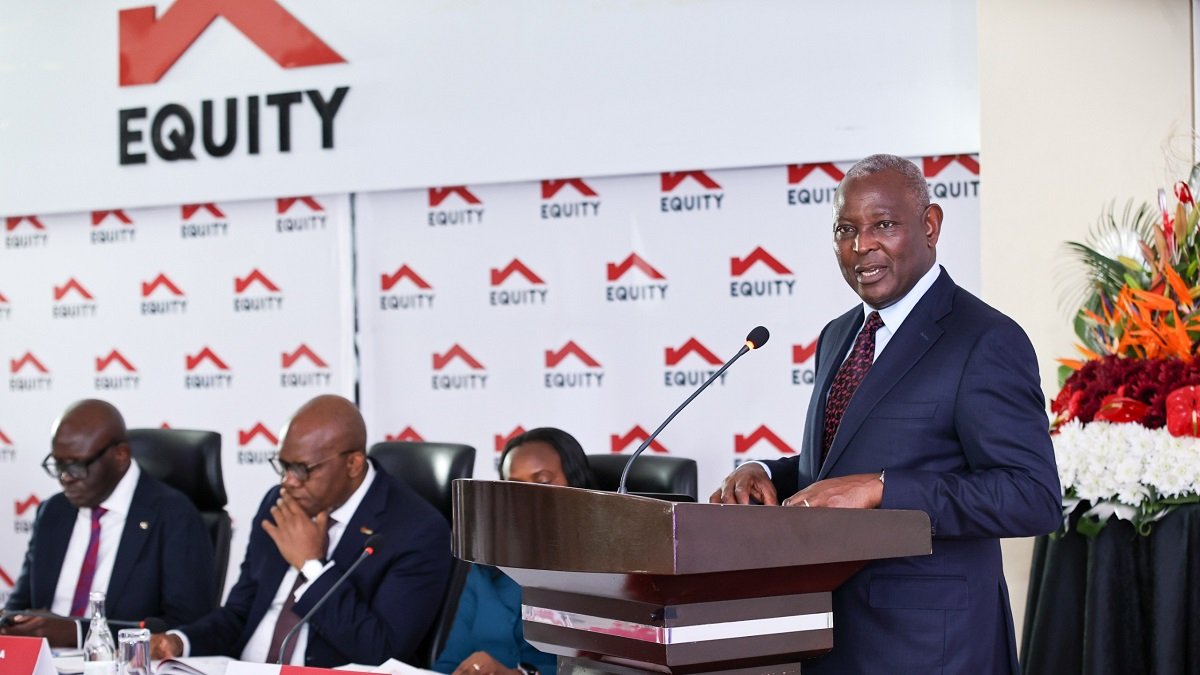
- Equity Group’s record $581.6 million (KSh75.5 billion) net profit for fiscal year 2025 underscores success of diversification strategy as DRC, Uganda and Tanzania post triple-digit growth.
Equity Group has delivered the most profitable year in Kenyan corporate history, with regional subsidiaries now accounting for nearly half of the lender’s banking profits, a landmark validation of its long-standing bet on pan-African expansion.
The Nairobi-based financial services group reported a 55 per cent surge in profit after tax to KSh75.5 billion for the financial year ended December 2025, propelled by robust double-digit growth across its East African operations and a dramatic turnaround in its newer markets.
“The 2025 performance reflects the success of our deliberate transformation into a diversified, regional financial services group,” Group CEO Dr. James Mwangi said. “Importantly, our regional subsidiaries now contribute about half of our banking profitability, demonstrating the value of our pan-African footprint and the resilience that comes from diversification.”
The Group’s balance sheet expanded 9 per cent to KSh1.97 trillion, supported by an 8 per cent increase in net loans to KSh882.5 billion and a customer base that now stands at 22.4 million accounts across its footprint.
On the back of the strong results, directors recommended a dividend of KSh5.75 per share, a 35.3 per cent increase from the prior year, translating to a total payout of KSh21.7 billion.
Equity Group’s Regional Engine Fires on All Cylinders
Equity’s regional banking subsidiaries delivered a combined 53 per cent growth in profit after tax, reaching KSh36.3 billion and accounting for 48 per cent of the Group’s banking profitability. The contribution underscores the diminishing reliance on the Kenyan home market, which nonetheless delivered stellar growth of its own.
The Democratic Republic of Congo emerged as the standout performer among regional operations, with profit after tax jumping 58 per cent to KSh24.7 billion. The subsidiary, which operates under the Equity BCDC brand, expanded its loan book by 17 per cent, capitalising on the DRC’s position as one of Africa’s fastest-growing economies, buoyed by a sustained minerals boom and high copper and cobalt prices.
Tanzania delivered the strongest growth, with profit after tax surging 125 per cent to KSh2.7 billion, accompanied by a 75 per cent increase in shareholders’ funds and 61 per cent loan book expansion. The results suggest Equity’s Tanzanian operation has reached critical scale after years of careful cultivation.
Uganda, long considered a challenging market for Kenyan lenders, produced a remarkable turnaround. Profit after tax jumped 500 per cent to KSh3.6 billion, driven by operational efficiencies and market share gains. Rwanda’s operation delivered profit after tax of KSh5.4 billion, with total assets up 5 per cent and loans expanding 22 per cent.
Home Market Strength Endures
While regional operations grabbed headlines with their growth rates, Equity Bank Kenya Limited delivered a formidable performance of its own. Profit after tax rose 63 per cent to KSh39.2 billion, driven by a 28 per cent increase in net interest income and a 37 per cent reduction in interest expense, a testament to the subsidiary’s efficient funding base and pricing power.
The Kenyan operation’s return on assets strengthened to 3.9 per cent from 2.4 per cent, while return on equity climbed to 26.8 per cent from 20.2 per cent. Shareholders’ funds grew 11 per cent to KSh136.2 billion.
Notably, Equity’s dominance in small business lending was recognised at the Kenya Bankers Association Sustainable Finance Initiative Awards, where it was named Best Bank for MSME Financing, accounting for 45 per cent of all bank lending to SMEs nationally.
Diversification Beyond Banking Pays Dividends
The Group’s insurance arm emerged as a significant contributor to the overall result, demonstrating the success of Equity’s strategy to capture a larger share of customers’ financial services wallet. Equity Insurance Group reported a 75 per cent increase in gross written premiums to KSh9.17 billion, driving profit before tax growth of 36 per cent to KSh2.0 billion.
The performance was underpinned by recently acquired licences across life, general, and health insurance. Equity Life Assurance, now serving 6.9 million customers with 19.2 million policies issued since inception, delivered profit before tax of KSh1.77 billion.
Equity General Insurance, in its first full year of operations, reported gross written premiums of KSh1.79 billion and profit before tax of KSh199 million. Equity Health Insurance, operational for just four months, posted gross written premiums of KSh20 million and profit before tax of KSh40 million.
Efficiency Gains and Digital Acceleration
Underpinning the Group’s profit surge was a sharp improvement in operational efficiency. The cost-to-income ratio fell to 51.0 per cent from 58.2 per cent in the prior year, driven by continued migration to self-service channels, productivity gains, and tighter cost discipline supported by Group-wide shared services.
The digital shift is now near-total: over 98 per cent of customer transactions were conducted outside branches, with 88.4 per cent processed through digital channels. The Group’s investment in customer-centric digital infrastructure appears to be paying off, reducing the cost-to-serve while improving accessibility for its 22.4 million customers.
Asset quality also improved, with loan loss provisions declining 28 per cent and NPL coverage strengthening to 67.7 per cent. The cost of risk moderated to 1.7 per cent, reflecting tighter underwriting standards and a more stable operating environment across most markets.
Equity Group: Vision 2030
Mwangi framed the 2025 results not as a destination but as a waypoint on a longer journey. The Group is executing its Africa Recovery and Resilience Plan (ARRP), a strategic framework that aims to position Equity in 15 countries serving 100 million customers by 2030.
“Our focus is to build a future-ready institution that is scalable, secure and impact-led,” Mwangi said. “Through our Africa Recovery and Resilience Plan, we are investing in next-generation digital and AI-enabled capabilities that enhance customer experience, strengthen risk management and lower the cost-to-serve, while extending access to affordable credit, insurance and investment solutions.”
The evolution, he added, extends beyond traditional banking: “As we progress toward our 2030 ambitions, we are evolving beyond traditional banking into a Transformation Finance Institution that mobilizes capital, connects ecosystems and accelerates inclusive, sustainable prosperity across Africa.”
Social Impact as Core Strategy
Beyond the financial metrics, the Group highlighted its cumulative social impact investments of approximately KSh99.5 billion ($771 million) during FY2025. Through the Equity Group Foundation, the lender supported 1,115 scholars with global university scholarships, trained nearly one million entrepreneurs, and enabled over 500,000 MSMEs to access KSh401 billion in credit.
The Foundation’s climate initiatives have empowered 3.8 million farmers with climate-smart agriculture skills, distributed over half a million clean energy solutions, and planted 44.6 million trees. Its Equity Afya healthcare network now comprises 150 centres, serving 4.6 million patients with affordable, quality care.
Read also: The Best Dividend-Paying Shares on the Nairobi Securities Exchange (NSE) for Q2 2026
Navigating Global Headwinds
The Group’s confidence in continued regional expansion is bolstered by favourable macroeconomic tailwinds across its markets. Eleven of the world’s 20 fastest-growing economies in 2025 are in Africa, including South Sudan, Rwanda, and Uganda. A commodities super-cycle is lifting growth in DRC, Tanzania, and Uganda, with high prices for gold, copper, and coffee combining with lower oil and wheat import costs to support East African economies.
While geopolitical risks have risen due to the Iran conflict, the Group expects any impact to be temporary. Oil prices briefly spiked to about $100 but are projected to ease to the mid-$60s after a ceasefire, helping stabilise trade and inflation across the region.
For Equity Group, the 2025 results provide powerful validation of a strategy that many questioned when it first embarked on regional expansion over a decade ago. With its home market now complemented by a diversified portfolio of high-growth African subsidiaries, and with insurance and digital businesses gaining momentum, the lender has positioned itself as one of the continent’s most formidable financial services groups. The question now is not whether Equity can sustain its growth, but how far its pan-African ambitions can reach.
(1USD = KES129)


