

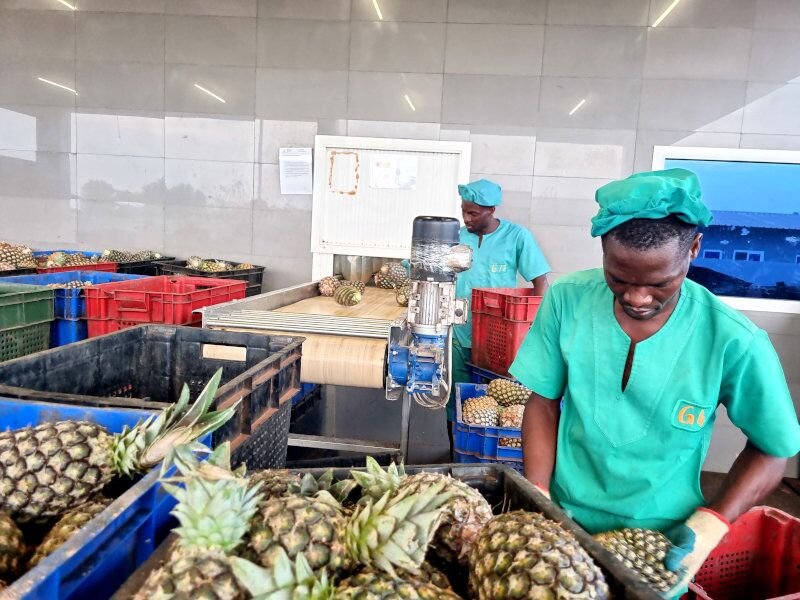

The Jus Délice pineapple juice factory in Togo.
From exporting organic pineapple juice to Europe to growing a dried fruit snacks brand in Nigeria, these six entrepreneurs are capitalising on opportunities in Africa’s fruit industry.
1. Establishing a dried fruit business in Kenya
Burton & Bamber, the firm behind Kenyan dried fruit brand Sweetunda, was co-founded in 2015 by British-born Jonathan Bamber. While the creation of a product is a journey in itself, distributing it to consumers presents an entirely different challenge. Bamber recalls the early days when Sweetunda, with its unadorned packaging, secured its first retail space in a modest vegetable shop in Nairobi. Coinciding with Sweetunda’s launch, French supermarket chain Carrefour made its Kenyan debut. Landing a spot on Carrefour’s shelves proved a pivotal moment for the brand’s growth, followed by listings in smaller chains such as Chandarana Foodplus and Zucchini Greengrocers.
“My background is as a British diplomat and in international development. I had no retail experience. But what I do know is how to talk to people, and that’s what I did,” Bamber explains. “And I literally went to meet everyone involved in the process: [from the] listings guys to store owners. And we learned how to get our products on the shelves.” Read the full article
2. Exporting pineapple juice from West Africa to Europe
Togo-based Jus Délice produces pure organic pineapple juice, supplying it in bulk to European clients, from where it’s distributed to individual juice brands. Gustav Bakoundah, the co-founder of Jus Délice, was educated in finance but has consistently been involved in agriculture. In 2012, he initiated a company named Label d’Or, which sources and exports pineapples and other organic crops cultivated by Togolese smallholder farmers. Over time, Bakoundah aspired to add more value to the pineapples locally rather than merely exporting them in raw form. He embarked on researching products that could be manufactured from pineapples, contemplating dried fruit before settling on juice. However, he had no interest in launching his own retail brand. The protracted payment terms common among retailers were unattractive to him, leading him to decide on a business-to-business approach. Read the full article
3. Entrepreneurs turn Zambia’s wild fruit into a growing juice business
In 2017, Frazer Handondo and his wife took an entrepreneurial leap by founding Forest Africa Zambia, an agro-processing firm with a dedicated factory in Chilanga, Zambia. The company embarked on a mission to harness Zambia’s indigenous and unique wild fruits, transforming them into juices and other processed products. With access to fruits like the baobab, African medlar, monkey bread, wild loquat, and governor’s plum, the potential for value-added processing seemed ripe for exploration.
Getting Forest Africa off the ground was no small feat. Initial progress was slow, but by 2019, the firm became operational, turning the wild bounty into a marketable commodity. A crucial element of Forest Africa’s success has been forging robust relationships with rural communities that had access to the required fruit trees, thus ensuring a consistent raw material supply. Forest Africa now produces 15,000 litres of juice monthly, reaching over 200 retail shops across Zambia’s Lusaka, Southern, and Copperbelt provinces. Read the full article
4. Entrepreneurs seize opportunity in Egypt’s fruit and veg market
FreshSource Global, established in 2018, operates as an Egyptian B2B agricultural supply chain platform, specialising in the procurement of fresh produce directly from farmers. The company then delivers these goods to various business clients, including restaurants, retailers, hotels, and food manufacturers. Orders are placed through an online platform, and by managing the entire supply chain, FreshSource can provide its clients with competitive prices and a reliable supply.
The company provides a variety of perishable crops, with the top ones being citrus, followed by bananas, potatoes, onions and tomatoes. These crops undergo a grading process, wherein their destination is determined by quality. For instance, the lowest grade might be earmarked for jam and juice manufacturers, while the highest grade finds its way to luxury hotel groups. Read the full article
5. Nigeria: Packaging African breadfruit for modern consumers
Several entrepreneurs in Africa have recognised the opportunity to commercialise and formalise traditional food items. For example, Chichi Eriobu, the founder and CEO of Phronesis Foods, identified a market gap for producing packaged African breadfruit products, catering to consumers in Nigeria and beyond. African breadfruit, locally referred to as ukwa in the Igbo language, is an edible fruit predominantly cultivated and consumed in southeastern Nigeria. The seeds of this fruit are particularly prized for their high nutritional value. At present, Phronesis Foods offers a lineup of four ukwa products, including dried ukwa, roasted ukwa snacks, ukwa poundo, and ukwa flour. Read the full article
6. Entrepreneur navigates uncharted waters to grow dried fruit snacks brand in Nigeria
In 2012, Affiong Williams, after a 12-year residence in South Africa, returned to Nigeria to explore the potential for dried fruit snacks in the local market. Using fruit imported from South Africa, she packaged samples and distributed them to prospective customers. At that time, this snack category was relatively uncharted in Nigeria, with no other local producers manufacturing it on a large scale. Despite an initial set of challenges, the ReelFruit brand has found success and is now distributed in hundreds of stores, as well as in a few export markets. In 2021, ReelFruit secured $3 million in Series A funding, earmarked for the construction of new processing facilities and for expanding sales into the US and other global markets. Read the full article


