
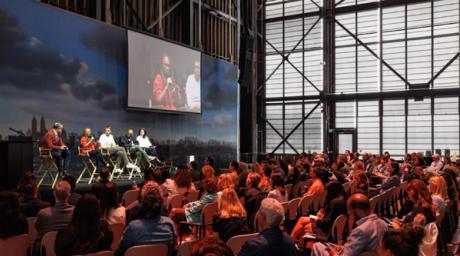
In California the creative economy is one of its most vital, but in 2023 it shrunk by about 8% according to the latest Otis College Report on the Creative Economy, released on 6 June. The report was presented in person and online from a stage at Sony Pictures Studios in Culver City, a venue tied to the most powerful drivers of the state’s creative economy—film, television and music. These sectors strongly impacted the creative economy’s overall decline, especially due to last year’s strikes by actor and writer unions.
“The past 12 months have been a relatively tough period for the creative economy in the state,” says Taner Osman, one of the founders of the company responsible for the report, Westwood Economics and Planning Associates, “but it’s worth reminding ourselves that California is still the national, if not global leader, in the creative economy.”
Since 2007 the report, commissioned by Otis College of Art and Design, has provided a statistics-backed snapshot of California’s creative economy. The report puts the number of people employed in the state’s creative economy last year at 849,000, so the loss of 8% represents around 71,000 jobs, while the entire country experienced a decline of 4% in employment in this sector. Another reason for the decline is that film and television production has been gradually moving to other states in search of reduced costs and different locations.
Several important changes to the formatting and delivery of the report have been made, Osman adds, including the availability of an online dashboard with periodic updates and the ability to create different charts using their data. Through the dashboard, for example, one can look at the numbers by county or by sector over time.
Another important change is how they are splitting up sectors of the creative economy from the former six to nine sectors in this edition. The four that are unchanged are “Architecture and Related Services”, “Creative Goods and Products”, “Fashion” and “Fine and Performing Arts”. Meanwhile “Entertainment” has been split into “Film, TV and Sound” and “Managers, Independent Artists and Performers,” while “Media and Digital Media” is now split into “New Media”, “Traditional Media” and “Advertising”.
All sectors but one experienced a decline in employment last year. The report’s authors explained that this was due to a combination of factors. “Architecture suffered as the commercial real estate industry continued its hangover from the pandemic,” the report states in a summary section, “while the advertising industry fell victim to a belt-tightening environment in corporate America, particularly at the end of 2022 and the beginning of 2023.”
The only sector that experienced a bump in employment was “Fine and Performing Arts”—from 49,746 workers in 2022 to 53,975 in 2023—due to more jobs at museums and art schools. “In the data we are reporting museums were leading the way,” Patrick Adler, a partner at West Economics, tells The Art Newspaper. “We’ve got new museums opening, it could be as simple as that.” He adds, “This is the most state-supported sector, and that’s the one that during this crisis period is really holding up.”
In Los Angeles alone, museums are building, expanding and staffing up—construction projects are underway or in the pipeline at the Natural History Museum, the Los Angeles County Museum of Art, the Institute of Contemporary Art, the Broad and the Lucas Museum of Narrative Art. The latest edition of the Getty-organised PST Art, Art & Science Collide, launches in September at museums and art spaces across the southern part of the state.
According to the report, “the creative economy comprises a set of industries for which the primary output (or product) has symbolic value. These industries comprise a group of activities through which ideas are transformed into cultural and creative goods and services.” Under that broad definition, around 849,000 Californians were directly employed by the creative economy in 2023 and another 639,000 were employed in industries supporting that economy. Adding those two numbers suggests that around one in every ten jobs in the state are part of the creative economy, a hefty share made heftier by how well compensated those employed directly in the creative economy tend to be—earning an average of $192,000 a year. (Of course, that number is inflated due to certain individuals such as studio executives and star actors making extremely high salaries.)
After the presentation on 6 June, a moderator and four panellists from different parts of the creative economy held a wide-ranging discussion about life in the trenches. Despite a certain trend towards decentralisation, most agreed that the existence of the metropolis was still important. “Artists like to be together,” said Kristin Sakoda, director of Los Angeles County’s Department of Arts and Culture. “Artists like to collaborate.”
Amy Homma, the recently appointed director and president of the Academy Museum of Motion Pictures and panellist for the museum sector, concurred. “It’s a very exciting time for Los Angeles and the museum landscape,” she said. “It gives more opportunities for artists to be shown. Museums continue to be a hub and a networking and convening space.” She added: “Ten, 20 years ago people went to museums and just wanted to read and be passive, but there’s been a shift and now people want to engage, to have a conversation.”