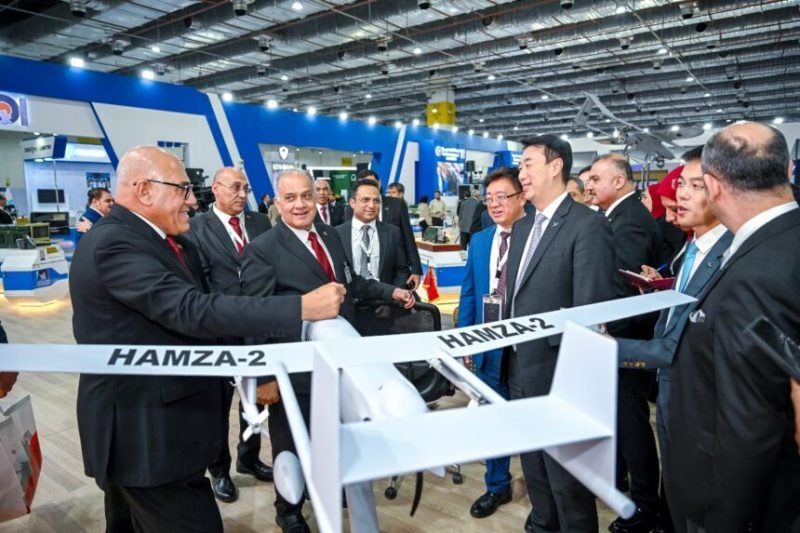
Egypt’s Arab Organisation for Industrialisation (AOI) has formalised a series of agreements at EDEX 2025, marking a distinct shift from procurement to localised production. The organisation signed multiple Memoranda of Understanding (MoUs) with defence entities from China, the UAE, France, and Pakistan, focusing on unmanned aerial vehicles (UAVs), engine overhauls, and offensive guided systems.
These agreements indicate a broader strategy by Cairo to position its domestic factories—specifically the Aircraft and Engine Factories—as regional hubs capable of servicing not just the Egyptian Armed Forces, but also allied nations in the Middle East and Africa. AOI Chairman Major General Mokhtar Abdel Latif stated the deals are part of a directive to “deepen local manufacturing” and leverage existing industrial capacity.
Localised UAV Production with China
In a move to expand its unmanned systems portfolio, the AOI signed a partnership with Chinese defence firm Shadow Wings. The agreement focuses on the transfer of technology (ToT) to localise the production of advanced defence systems, specifically targeting UAV platforms.

Major General Abdel Latif confirmed that the AOI Aircraft Factory, headed by Major General Mohamed Awad, will serve as the primary facility for this cooperation. The Aircraft Factory has historically assembled training aircraft and parts for the K-8E program, making it well-suited for airframe composite manufacturing and systems integration.
Representatives from Shadow Wings described the deal as a “starting point” for broader collaboration. While specific model numbers remain undisclosed, the move aligns with recent trends where Chinese firms offer aggressive technology transfer packages to North African partners, allowing Egypt to produce loitering munitions or surveillance drones domestically rather than relying solely on off-the-shelf imports.
AOI and Norinco
Egypt’s Arab Organisation for Industrialisation (AOI) has signed a memorandum of understanding with Chinese defence giant Norinco to localise the manufacturing of defence systems, the organisation said during the EDEX 2025 exhibition.
The agreement, signed between the AOI’s Aircraft Factory and Norinco, aims to transfer technology and deepen domestic production by utilising the factory’s advanced manufacturing capabilities, according to AOI Chaiperson Major General Mokhtar Abdel Latif.
Abdel Latif said the organisation aims to become a hub for partnership and expertise exchange with Norinco to meet the defence needs of Egypt and allied nations.
Norinco officials described the agreement as a starting point for further cooperation in advanced defence industries, emphasising the AOI’s role as Egypt’s industrial backbone.
AMMROC Deal Targets High-Level MRO
Perhaps the most technically comprehensive agreement of the exhibition involves the UAE’s Advanced Military Maintenance, Repair, and Overhaul Centre (AMMROC). The Abu Dhabi-based entity, known for its work on C-130 Hercules and F-16 platforms, signed three separate MoUs with the AOI, effectively integrating Egyptian facilities into a regional supply chain.

1. Fixed-Wing and UAV Structures
The first MoU tasks the AOI Aircraft Factory with manufacturing components and structures for fixed-wing jets and unmanned systems. This agreement goes beyond simple fabrication; it aims to align Egyptian production lines with AMMROC’s existing programs. This suggests AOI may soon act as a Tier 2 supplier for AMMROC’s global client base, producing airframe sub-assemblies and conducting inspection activities to international aerospace standards.
2. Digital Manufacturing and Engine Tech
A second agreement involves the AOI Engines Factory and the Digital Manufacturing Centre. This partnership focuses on the “hot section” of aerospace propulsion. The MoU covers the overhaul and repair of rotating and static engine components, nacelles, and shafts. Notably, the agreement includes the application of advanced thermal and surface treatments—critical processes for extending the service life of turbine blades and vanes operating under high thermal stress.
3. Rotary-Wing Sustainment at Helwan
The third MoU links AMMROC with the Helwan Factory for Advanced Industries to develop maintenance capabilities for helicopters. Given AMMROC’s certification as a Sikorsky-authorised centre for Black Hawk blade repair, this partnership likely aims to support Egypt’s diverse rotary fleet, which includes Apaches, Black Hawks, and Mi-17s. The agreement covers structural work, fairings, and the establishment of specialised workshops to modify platforms currently operated or supported by AMMROC.
Sustaining the Alpha Jet Fleet
Despite the induction of newer training platforms, Egypt continues to invest in its legacy fleet. The AOI signed a cooperation agreement with French company Sofema to overhaul the SNECMA Turbomeca Larzac engines that power the Egyptian Air Force’s Alpha Jet fleet. This new agreement is a follow-up to an earlier milestone where AOI received a supplier certificate from the French world-leading aircraft engine manufacturer Safran Aircraft Engines.

The Alpha Jet, a twin-engine light attack and advanced trainer aircraft, relies on the Larzac 04 turbofan, which produces approximately 13 to 14 kN of thrust. As these airframes age, maintaining the engines requires specialised tooling and parts availability that can be difficult to source.
Sofema, specialising in military aerospace sustainment and legacy parts management, will work with the AOI Aircraft Engine Factory to perform these overhauls locally. This ensures the continued airworthiness of the Alpha Jet for pilot training and light support roles. AOI Chairperson Abdel Latif noted this cooperation utilises the factory’s existing test cells and technical workforce, further validating the facility as a regional MRO provider for the Larzac platform.
Offensive Capabilities with Pakistan’s GIDS
While the European and Emirati deals focus on sustainment, the agreement with Pakistan’s Global Industrial and Defence Solutions (GIDS) appears to target offensive firepower. The AOI signed an MoU with the state-owned conglomerate to explore the co-production of “offensive combat capabilities.”

The agreement stands out for its potential to introduce new guided munitions to the Egyptian inventory. GIDS produces the Shahpar-2 MALE (Medium Altitude Long Endurance) UAV and the Fatah series of guided multiple launch rocket systems (GMLRS). The Shahpar-2, capable of carrying laser-guided air-to-ground missiles like the “Burq,” represents the type of armed reconnaissance capability Egypt seeks to localise.
The deal sets a framework for manufacturing these systems within AOI factories. By partnering with GIDS, Egypt diversifies its source of precision-guided munitions, reducing reliance on traditional Western or Eastern suppliers for critical strike capabilities.
Upgrading Egypt’s technical baseline
The agreements signed at EDEX 2025 demonstrate a cohesive industrial strategy. Rather than simply purchasing equipment, the AOI is leveraging its industrial base to secure high-value workshare. By securing component manufacturing with AMMROC, engine MRO with Sofema, and weapon system co-production with GIDS and Shadow Wings, Egypt is effectively distributing its defence industrial risk while upgrading its technical baseline.