

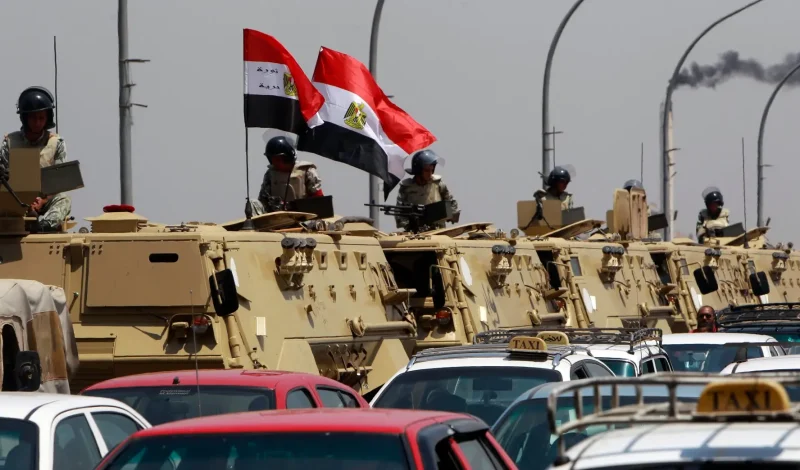
Egypt has ramped up its military posture in the Sinai Peninsula, deploying around 40,000 troops to the region amid escalating concerns over potential spillover from the Gaza conflict. This move marks a sharp increase in forces along the border with Gaza, where tensions have simmered for months as Israel pursues its objectives against Hamas. The deployment, which exceeds the limits set by the 1979 peace treaty between Egypt and Israel, says about Cairo’s determination to safeguard its sovereignty while sending a clear signal to its neighbour.
The Egyptian military’s actions stem from fears that Israel’s planned operations in Gaza could trigger a mass exodus of Palestinians into North Sinai. Reports indicate that Cairo views such a scenario as a direct threat to its territorial integrity. By bolstering its presence, Egypt aims to convey two key points: a firm opposition to any breach of its borders and a rejection of proposals that would resolve the humanitarian crisis in Gaza by encroaching on Egyptian land. This stance reflects long-standing sensitivities in the region, where ideas of relocating Palestinians to Sinai have periodically surfaced but always met with strong resistance from Egyptian authorities.
Under the 1979 treaty, Egypt is restricted to a certain number of troops in Sinai to maintain a demilitarised buffer zone; the current figure of 40,000 nearly doubles that cap, highlighting the gravity of the situation. The army now operates at its highest alert level in recent memory, a state triggered by direct instructions from President Abdel Fattah el-Sisi. As commander-in-chief, Sisi convened sessions with the Supreme Council of the Armed Forces and the National Security Council to authorise the reinforcements. These meetings focused on countering Israel’s expressed intent to eradicate Hamas infrastructure in Gaza, which Egyptian officials worry could involve displacing large populations toward the border.
Troops have spread out across North Sinai, with concentrations in strategic areas such as Zone C, which lies directly next to the Gaza Strip. This positioning allows for rapid response to any incursions while securing key entry points. Egypt formally notified Israel of the buildup, but the communication drew objections from Israeli counterparts regarding the scale of the forces and their placement in zones designated as restricted under the treaty. Despite these complaints, Egyptian sources emphasise that the mobilisation serves purely defensive purposes. They have also warned that any aggression against Egyptian soil would prompt a decisive counteraction, reinforcing the message that Cairo will not tolerate violations.
The hardware involved in this deployment adds weight to Egypt’s readiness. Armoured vehicles, air defence batteries, special operations units, and M60 main battle tanks now fortify positions around cities like Rafah and Sheikh Zuweid, as well as villages such as al-Joura near the frontier. These assets provide a layered defence capable of addressing threats from ground incursions to aerial intrusions. Liaison officers from Egypt have assured their Israeli colleagues that these measures aim solely at border security amid the heightened instability, framing the buildup as a precautionary step rather than an offensive posture.
This latest escalation echoes previous Egyptian responses to regional pressures. For instance, back in November 2023, the army positioned M60A3 Patton tanks and YPR-765 infantry fighting vehicles near the Rafah crossing, driven by similar anxieties over a potential influx of refugees from Gaza. That earlier deployment set a precedent for how Cairo handles border threats, prioritising deterrence through visible military strength. Today, the expanded presence builds on that approach, adapting to the evolving dynamics of the conflict.
Adding to the rhetoric, North Sinai Governor Khaled Megawer delivered a stark admonition last month against any Israeli advances toward Egyptian territory. Addressing reporters at the Rafah crossing, Megawer, a veteran with experience as an army general and former head of military intelligence, stated that intruders would face an unforeseen and forceful retaliation. His words came against the backdrop of mounting worries that Israel’s control over Gaza might precipitate a displacement crisis, forcing Palestinians across the border in large numbers.
Since the onset of hostilities in Gaza, accounts have emerged of efforts to relocate hundreds of thousands of residents from the enclave. North Sinai has repeatedly been mentioned as a potential refuge, a notion that traces back decades but remains unacceptable to Egypt. Cairo regards it as a non-negotiable boundary, fearing it could undermine national security and alter the demographic landscape of the peninsula. This position gained fresh attention earlier this year when former US President Donald Trump publicly floated the idea of Egypt and Jordan absorbing displaced Palestinians, a suggestion that drew swift rebukes from regional leaders.
Egypt’s role in the broader geopolitical context further complicates the situation. The country receives substantial military assistance from the United States as part of the peace treaty framework, which bolsters its armed forces and cements ties with Washington. At the same time, Cairo maintains a pivotal mediation function in Gaza affairs, facilitating talks and aid flows that enhance its influence both regionally and globally. Balancing these interests requires careful navigation, especially as the troop surge tests the limits of the treaty without outright rupture.
The Sinai Peninsula itself presents unique challenges for military operations. Its vast, arid terrain demands specialised units adept at desert warfare, and the current deployment leverages Egypt’s experience in countering insurgencies in the area over the past decade. Special forces, in particular, bring expertise in rapid deployment and intelligence gathering, essential for monitoring border activities. Air defence systems add a protective umbrella against potential drone or missile threats, while the M60 tanks offer heavy firepower for ground engagements if needed.


