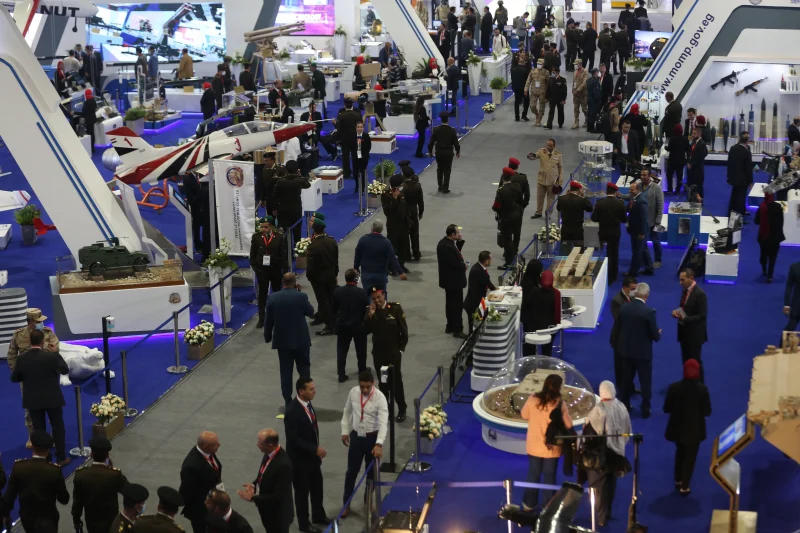
The Egypt Defence Expo (EDEX 2025) opened its doors on December 1 at the Egypt International Exhibition Centre in Cairo, marking a pivotal moment for the region’s security architecture. Now in its fourth edition, the biennial event serves as a barometer for the shifting geopolitical alliances and industrial capabilities across the Middle East and Africa. Running through December 4, the exhibition features over 450 companies from more than 80 nations, drawing an estimated 40,000 industry professionals and military officials.
This year’s edition is notable not just for the hardware on display, but for the organisational structure behind the scenes. For the first time since its inception in 2018, EDEX is being managed entirely by Egyptian entities without the involvement of a foreign event-management firm. A dedicated committee formed from the Ministry of Military Production, the Armed Forces, and the Arab Organisation for Industrialisation (AOI) has taken the reins. This transition reflects a broader strategic goal for Cairo: achieving sovereignty not just in equipment manufacturing, but in the soft power capabilities required to host major international logistics events.
The central theme of EDEX 2025 is the localisation of defence technology. Egypt has aggressively pursued a policy of reducing reliance on imports, a strategy visibly manifested in the 260 locally produced items showcased this week.
A distinct feature of the 2025 show is the formal integration of civilian manufacturing into the defence supply chain. The Federation of Egyptian Industries is participating for the first time, following rigorous assessments of civilian factories’ ability to produce dual-use components. This civil-military fusion aims to optimise national industrial capacity, allowing the Ministry of Military Production to focus on high-end sensitive technologies while civilian partners handle standardised components.
While Egypt focuses on domestic growth, the international floor plan tells a story of diplomatic realignment. Türkiye has emerged as the dominant foreign presence at EDEX 2025. Following years of frigid relations between Cairo and Ankara, the normalisation of ties has resulted in a massive Turkish footprint.
According to exhibitor data, Türkiye holds the top spot for participation, fielding 81 companies. This presence spans the full spectrum of the defence sector, from small specialised manufacturers to major heavy industry players like Istanbul Naval Shipyard (ITK) and electronics giant Aselsan. This contrasts with the 2023 edition, where Türkiye ranked second. The sheer volume of Turkish exhibitors—surpassing all other foreign delegations—signals Ankara’s intent to cement itself as a primary supplier for African and Arab militaries.
Global Exhibitor Dynamics
The exhibitor rankings offer a clear view of the current multipolar defence market. While Türkiye leads the international pack, Egypt maintains the second-largest presence with 46 domestic companies. China follows in third place with 30 firms, reflecting Beijing’s sustained push into the African security market with cost-effective land and aerial systems.
The United States holds the fourth position with 23 firms, maintaining its traditional role as a high-end strategic partner, while the Republic of Korea stands fifth with 20 companies. South Korea’s strong showing correlates with recent major procurement successes in Egypt, including the contract for K9 howitzers and potential interest in the FA-50 light combat aircraft.
Russia also maintains a high-profile presence through Rosoboronexport. Despite global sanctions, Moscow is using EDEX 2025 to market combat-proven systems like the Ka-52 scout-attack helicopter and the T-90MS main battle tank, targeting African clients looking for rugged, non-Western alternatives.
For African and Middle Eastern delegations, EDEX provides a critical opportunity to view rapid advancements in unmanned systems, artificial intelligence, and asymmetric warfare tools. The proliferation of drone technology and the countermeasures required to defeat them are central themes on the exhibition floor.
Beyond the immediate sales, the event facilitates long-term strategic links. By bringing together the Ministry of Military Production and global primes, Cairo aims to move beyond simple “off-the-shelf” purchases toward co-production agreements. This model, already seen in agreements with South Korea and France, allows Egypt to absorb technical know-how and eventually export Egyptian-made products to neighbouring states.