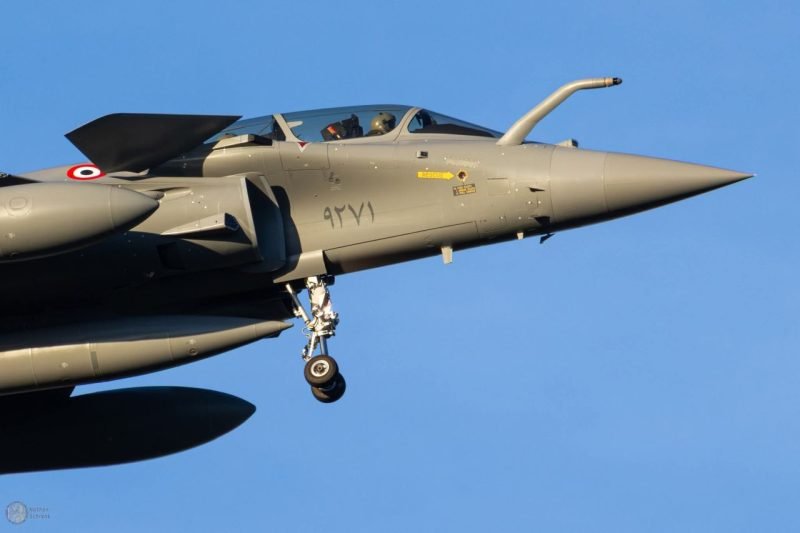
Egypt’s Air Force took delivery of its second batch of Dassault Rafale F3R fighter jets in early October 2025, marking a resumption of transfers after an eight-year pause. The batch includes three aircraft: two single-seat EM variants (EM10 and EM11) and one two-seat DM (DM21), which completed flight tests in France before ferrying to Gebel El Basur Air Base. This step forward in the 2021 contract underscores Cairo’s commitment to modernizing its tactical aviation amid regional security demands in North Africa and the Eastern Mediterranean.
The procurement journey started on February 16, 2015, when Egypt inked a $5.9 billion deal with France for 24 Rafale jets, a FREMM-class frigate, and supporting munitions. Deliveries accelerated rapidly; three two-seat DM aircraft arrived in July 2015, diverted from French stocks to enable operations by the Suez Canal expansion’s opening in August. Subsequent tranches followed, with the first single-seat EM in April 2017 and three more EMs in November, yielding 14 jets operational by year’s end. An option for 12 additional units went unexercised, leaving the fleet at 24 until the latest order.

A 2021 agreement added 30 F3R-standard aircraft for €3.75 billion, financed via a 10-year French-backed loan covering 85 percent of costs. It bundled €200 million in MBDA missiles and Safran Electronics & Defense gear, offsetting a cancelled Su-35 buy from Russia. Production hit a snag with one airframe lost during testing, prompting Dassault to build a replacement and raise the total to 55 units, though operational strength caps at 54. Transfers began late 2024 with EM09, progressed to DM18 and DM19 evaluations in April 2025, and now continue in groups through 2026, coordinated by Dassault, Safran, and Egyptian crews.
The Rafale F3R embodies the latest evolution in this multirole platform, certified fully operational by France’s Direction Générale de l’Armement on March 8, 2021. Measuring 15.3 meters long with a 10.9-meter wingspan and 5.3-meter height, it weighs 10 tonnes empty and up to 24.5 tonnes at takeoff. Twin Snecma M88-2 turbofans deliver 50 kilonewtons of thrust each in afterburner, pushing top speed to Mach 1.8 at 750 knots and a ceiling of 50,000 feet. Internal fuel totals 4.7 tonnes, expandable to 11.4 tonnes with external tanks across 14 hardpoints, five of which handle heavy loads or drop tanks.
France’s upgrade path integrated key enhancements for contested airspace. The Thales RBE2 active electronically scanned array radar offers multi-target tracking with low-probability-of-intercept modes, fusing data from electro-optical sensors for quicker threat assessment. The Spectra electronic warfare suite counters radar-guided missiles through jamming and decoys, while reinforced anti-jamming shields protect GPS-dependent navigation. An automatic ground collision avoidance system and upgraded diagnostics cut maintenance downtime by streamlining fault isolation. In-flight refuelling via the NARANG pod supports extended missions, validated with A400M tankers and buddy operations from E-2D Hawkeyes. These features trade some payload for sensor density, prioritising network-centric warfare where real-time data sharing trumps raw firepower in peer fights.
Armament versatility defines the F3R’s edge. Air-to-air options centre on the MBDA Meteor beyond-visual-range missile, with a 100-plus-kilometre no-escape zone via ramjet propulsion, paired with MICA infrared and electromagnetic variants for dogfights. Ground-attack loads feature SCALP/Storm Shadow cruise missiles for standoff strikes, laser-guided AASM Hammer bombs for dynamic targeting, and GBU-series kits. Maritime roles draw on AM39 Exocet anti-ship weapons, while a 30mm GIAT 30M791 cannon provides close support at 2,500 rounds per minute. Pods like TALIOS enable laser designation and moving-target tracking day or night, and AREOS handles reconnaissance. The fly-by-wire delta-canard airframe ensures agility across envelopes, from low-level ingress to high-altitude intercepts, with cockpit HOTAS controls and multifunction displays easing pilot workload under night-vision aids.
Egypt’s 203rd Tactical Fighter Wing mans the fleet at Gebel El Basur, splitting duties between the 34th and 36th Squadrons. Pilots logged the type’s first combat hours in May 2017, striking Islamic State positions in eastern Libya with precision munitions. By March 2023, the initial 24 jets had amassed 10,000 flight hours, a milestone for any export operator. The force integrates Rafales into mixed formations with F-16s and MiG-29s, leveraging the jet’s modular avionics for joint operations. A €300 million maintenance pact with France looms, covering sustainment through the decade and easing logistics strains from desert conditions that accelerate wear on engines and composites. No fresh aircraft or naval pacts surfaced during French President Macron’s April 2025 Cairo visit, verified as of October 12, 2025.
Upon 2026 completion, Egypt claims the largest non-French Rafale roster at 54 airframes, all F3R-aligned for seamless upgrades. Dassault’s Mérignac line sustains output, syncing Egyptian needs with French F4 introductions since 2022. That standard adds helmet-mounted cues, MICA NG missiles, and predictive analytics, promising plug-in compatibility without full overhauls. Trade-offs emerge in fleet diversity; Rafales excel in precision but demand skilled maintainers, contrasting cheaper legacy types.