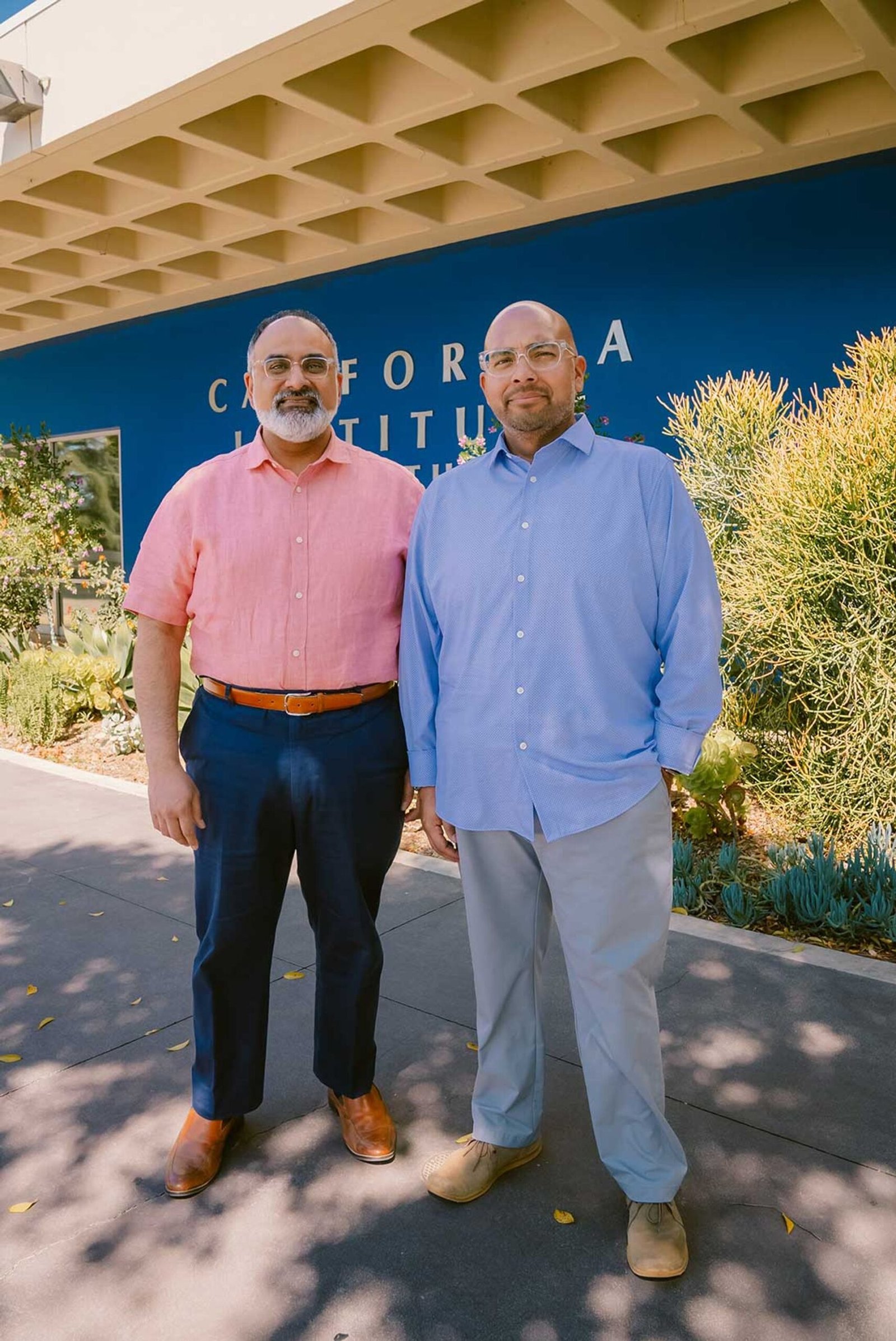


Facing declining enrolment and the imminent prospect of closing its doors for good, the Vermont College of Fine Arts in Montpelier has struck a deal with the California Institute of the Arts (CalArts) in Los Angeles that will allow it to use the CalArts facilities for its on-campus coursework. The arrangement will begin in the next academic year, starting this autumn.
The college, which offers no undergraduate courses, runs low-residency MFA programmes in film-making, music composition, graphic design, visual art, writing, and writing for young adults, with nine-day on-campus residencies taking place twice a year—in January and during the summer. The residential portions do not take place in Montpelier because the college does not have fully equipped studios in which artists can work; they are held at other college campuses around the country, such as Colorado College in Colorado Springs and Susquehanna University in Selinsgrove, Pennsylvania. Under the new arrangement with CalArts, Vermont College of Fine Arts will continue to administer its programmes from Montpelier while the short-term residencies will now take place on the CalArts campus.
Both institutions describe the arrangement as an “affiliation” or “partnership” rather than a takeover or rescue of a small, struggling New England school by the more prestigious art institute in Valencia, California. These are just words, and they all apply.
The decision to set up the arrangement between two schools in opposite corners of the continental US was arrived at quickly. It provided a lifeline for one college and extra income for the other at a time when administrators at both had been thinking a lot about money.
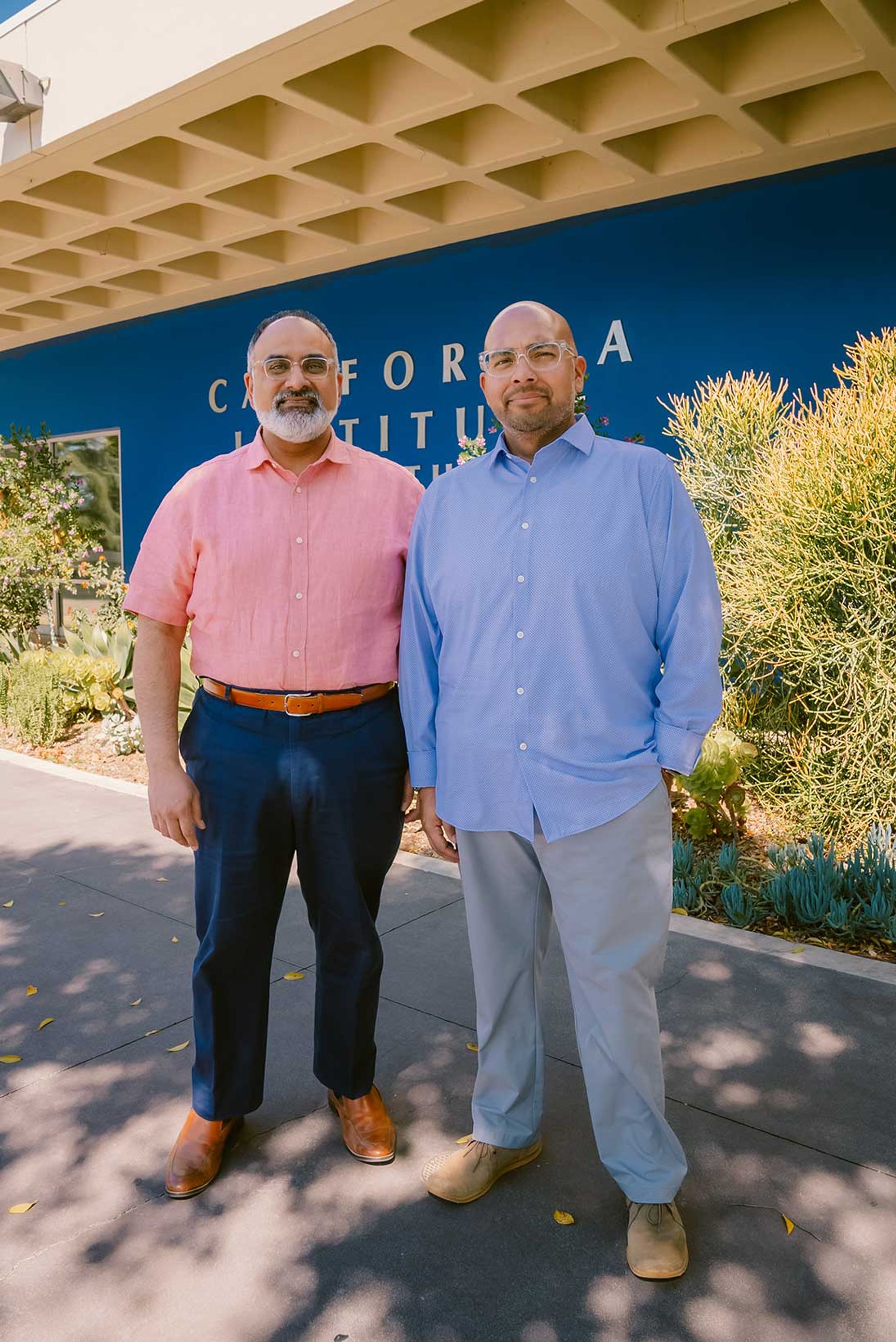
Fine-art friends: the CalArts president Ravi Rajan with his Vermont College of Fine Arts peer Andrew Ramsammy
Photo: © CalArts
At Vermont College, efforts were made to find a substantial donor or white knight to keep the school afloat. Then in 2022 came “the sale of our campus, which had been underutilised because we are low-residency”, says Andrew Ramsammy, the interim president of the college. The sale and some proposals for how the actual residencies would work going forward were presented to faculty without any consultation with or input from staff.
“It was a fraught time,” says Michael Minelli, an artist and faculty member in Vermont College’s visual art programme. “There were a lot of unhappy people and a lot of pushback.”
When in 2023 a prospective donor in California cancelled a meeting with the then college president Leslie Ward, she contacted CalArts president Ravi Rajan for a tour of the campus and proposed the idea of affiliating the college with CalArts. Rajan “was very much interested in wanting to do that and to be a partner in that whole process”, Ramsammy says.
Strategic synergy
Among the reasons for Rajan’s interest was that in 2020 CalArts had published a “strategic framework” that included a desire “to increase non-tuition revenue sources” and specifically identified “the potential of extended studies” for which a low-residency programme seemed ideal. For CalArts, Vermont College’s twice-yearly nine-day residencies represent the epitome of passive income: it receives a portion of the MFA students’ tuition fee for on-campus residencies that take place during “interstitial times for our semester”, Rajan says—in other words, when the CalArts campus is otherwise unused.
CalArts had no low-residency programme, and its association with Vermont College allows it to inherit one that is already fully developed. The arrangement between the two insitutions means Vermont College “has found a home that is mission-aligned and that is beneficial to both campuses”, Minelli says. Also, since he lives and works in Los Angeles, “it makes things a lot easier for me”.
The 3,000-mile gap between the two institutions poses no burden on MFA students, Ramsammy says, because “the majority of our students don’t come from Vermont. They actually come from across the US, and we have several international students as well.” He adds: “Most of our faculty also don’t reside in Montpelier. They spend the majority of their time with our students doing a lot of virtual work, online work, and doing that communication through Zoom.”
The college’s disparate on-campus residencies met at different places at different weeks of the year. “None of them ran concurrently, which obviously from an operation perspective was inefficient,” Ramsammy says, referring to the school’s existing structure as a “nomadic transition period” during which the school has been selling off parts of its Montpelier campus. Its new CalArts campus home means that its programmes can be coordinated “to two residencies a year where all six programmes are meeting at the same time” at “a space that actually can house all six programmes at the same time”.
What will remain in Vermont are the college’s administrative offices, which will be pared down, as lay-offs of 11 positions are to take place. “If you don’t have facilities, you don’t need facilities staff,” Rajan says. “The CalArts facility staff will be providing that support.” Vermont College’s faculty will remain associated with its MFA programmes.
Vermont College started out in the 1830s as a seminary, changing locations several times. It became a junior college in 1941 and a four-year college in 1958, and was taken over first by Norwich University in 1972 and then by Union Institute and University in 2001. It broke away to become the Vermont College of Fine Arts in 2008, offering low-residency programmes. That long and winding road suggests the school has been trying to stay a step ahead of insolvency for years, never fully able to thrive.
Under the new arrangement with CalArts, Vermont College of Fine Arts will retain its name and its accreditation with the New England Commission of Higher Education. Rajan says that accreditation requires the college “to maintain and hold a set of faculty who uphold a set of standards, who define a curriculum. And those are all things that are scrutinised by the regional accreditors.” CalArts is a member of the Association of Independent Colleges of Art and Design, and is accredited by the Western Association of Schools and Colleges Senior College and University Commission.
Numerous community, liberal arts and technical colleges have closed permanently or have been taken over by larger institutions around the country in recent decades. The New England Commission of Higher Education at present accredits over 200 colleges and universities in six states; in recent decades, it alone has lost 127 institutions through closures and mergers, including the Art Institute of Boston (which merged with Lesley College in 1998), Lyme Academy College of Fine Arts (acquired by the University of New Haven in 2015), New Hampshire Institute of Art (merged with New England College in 2019, with the Manchester campus closed in 2023), the School of the Museum of Fine Arts, Boston (acquired by Tufts University in 2016), and the New England Institute of Art (closed in 2017), while the progressive Goddard College in Plainfield, Vermont, has recently announced it will be closing after the current spring term and plans to sell its campus.