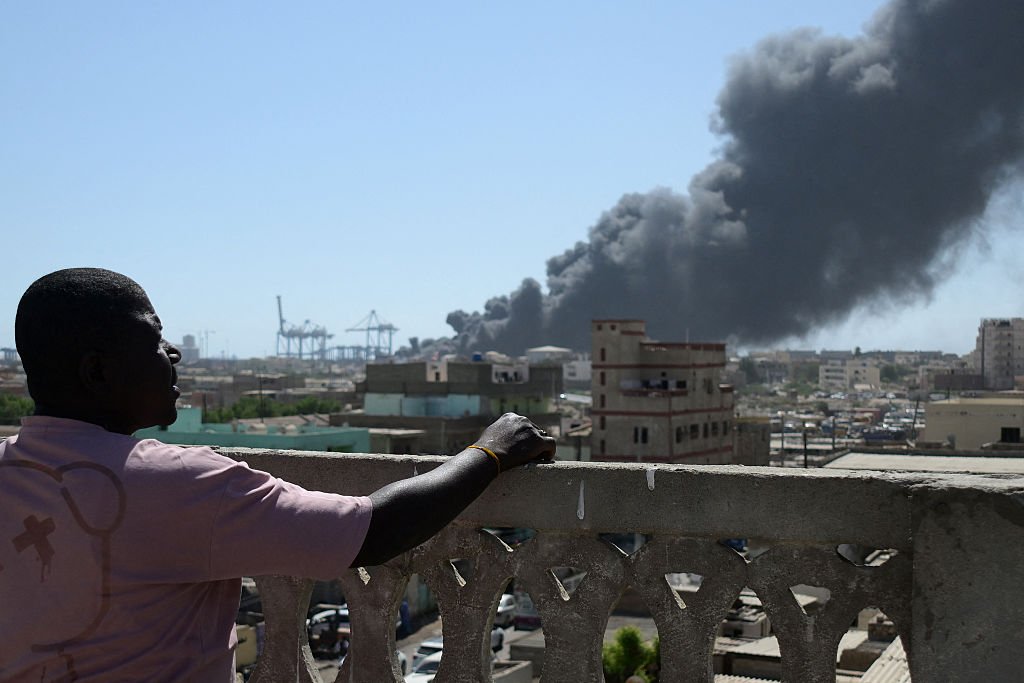
Sudan’s Rapid Support Forces (RSF) militia launched a drone attack May 4 against military and civilian facilities in Port Sudan, a strategic location used by the Sudanese Armed Forces (SAF). The drones, reportedly a Chinese copy of the Shahed-136 Iranian one-way attack drone, damaged infrastructure such as fuel depots, killed at least 12 people and injured 30.
The attack highlights a broader concern: Many African ports are vulnerable to drone strikes by state and nonstate actors.
As drones become more common on battlefields across the continent, the likelihood of attacks against maritime infrastructure grows. Drones are already being used against ports and coastal facilities in other parts of the world. From 2016 to 2022, Houthi drone strikes targeted Saudi coastal refineries and desalination plants. Russian drones have repeatedly targeted Ukraine’s grain terminals in the port city of Odessa.
Ports Are Vital and Exposed
African ports drive economic activity, enable humanitarian access, and are hubs for military power and political influence. Historically, threats to African ports came from piracy, illegal fishing and smuggling. Now, drone strikes have emerged as a disruptive new risk. Maritime facilities are uniquely vulnerable to drone attacks due to their open layouts, difficult-to-defend perimeters and high concentration of critical infrastructure. These features make ports easy targets for low-cost, high-impact attacks.
Drone strikes against a commercial port can harm national and regional economies. For instance, landlocked Ethiopia heavily depends on a few ports in neighboring countries to receive imported goods. An attack on one of those ports can delay vessels carrying critical goods and disrupt the economy. Conversely, if companies cannot access a port to ship their goods for export, it can increase costs across the supply chain. The risk is particularly acute for nations such as Angola and Algeria that rely on natural resource exports for revenue.
The attack on Port Sudan shows how far-reaching the damage can be. Drone strikes damaged fuel depots, the city’s main container terminal and the international airport. At relatively low cost, the RSF used drones to puncture Sudan’s conflict-driven economy and spread hostilities into previously stable regions. The attack displaced people and spiked fuel prices.
Nonstate actors worldwide recognize the disruptive power of drones for asymmetric warfare. In Yemen, the Houthis used drones to attack government ports and coastal infrastructure. In Myanmar, Arakan Army rebels reportedly assassinated a general defending the port of Rakhine.
The appeal of these attacks to insurgents is clear. Drone attacks on a port are relatively cheap, have enormous propaganda value and force the state to invest resources in counter-unmanned aerial system (C-UAS) capabilities. Despite the growing drone threat, Africa’s security frameworks remain largely reactive and focused on ship-based threats.
Preparing for the Threat
The first step in changing this is to acknowledge the problem. The International Ship and Port Facility Security (ISPS) Code, which governs port security globally, acknowledges threats such as cyberattacks but still lacks specific provisions for unmanned aerial threats. Updates to the best management practices guidelines for maritime security now acknowledge the risks posed by drones, but similar language still needs to be integrated into national port and naval strategies. The lag leaves critical infrastructure exposed, and a shift from reactive to proactive measures is overdue. African coastal states must integrate drone threat scenarios into security planning, invest in surveillance and detection systems, and collaborate regionally to share intelligence.
Port defenses often are unsuited for this kind of threat. In many cases, ports rely on basic perimeter security and lack dedicated systems to counter drones. When Port Sudan was struck, the SAF managed to intercept some drones using traditional anti-aircraft systems, which can be effective, but are resource intensive. At the higher end, air defense systems can cost millions of dollars to procure and operate. The good news is that militaries and security services might not need the most advanced air defense systems for ports if the only imminent aerial threat is from drones. The low altitude and speed of most drones means that less expensive C-UAS systems are effective.
Specialized C-UAS technology such as jammers or directed energy weapons are improving, but the types needed to protect an entire port remain out of reach for many African countries. The problem is twofold: Defenders need the ability to detect and classify drones, then the means to down them safely. Companies like Thales make dedicated C-UAS systems for detecting and neutralizing drones, but few such systems are deployed in Africa’s ports. Some countries have commercial drone jammers, making it possible to protect key chokepoints but not the entire facility. Few African defense companies produce dedicated C-UAS systems, and importing them is expensive.
The rapid pace of drone innovation adds to the problem. Jamming is the preferred method of downing drones off the battlefield, but it is not always effective against autonomous drones or those using fiber-optic wires for guidance. Ensuring that ports are secure could mean tracking what capabilities attackers have and proactively adopting new countermeasures. What emerges is a perpetual arms race in which innovation begets countermeasures, which spark counter-innovation. The drone war isn’t about permanent victory; it’s about adapting to threats before it is too late. In this race, hesitation means defeat.
Port Sudan might have been the first major drone attack on an African port, but it won’t be the last. Without a collective and forward-looking approach, many more facilities will be at risk. Regional collaboration, policy adaptation, training and investment in cost-effective defenses can enable port authorities, militaries and law enforcement agencies to keep their facilities, their economies and their people safe in a rapidly changing environment.
About the authors: Ebunoluwa George Ojo-Ami is a lead intelligence analyst with Agwe Global Ltd specializing in the Gulf of Guinea, with expertise in drones and maritime security. Marcel Plichta is a Ph.D. candidate at the University of St Andrews and an intelligence instructor for Grey Dynamics. His research focuses on the use of force by small states and drones in modern warfare.