The Democratic Republic of the Congo’s armed forces are in the process of receiving a substantial shipment of armoured vehicles from the United Arab Emirates, with more than 100 units already on their way from the International Golden Group, a prominent Emirati defence supplier. This acquisition comes at a time when the Congolese military faces ongoing challenges in the eastern part of the country, where rebel groups such as the M23 continue to pose threats through guerrilla tactics and improvised explosive devices. Some of these new vehicles have already seen action on the front lines against the M23, providing much-needed protection for troops operating in hazardous terrain marked by mines and ambushes.
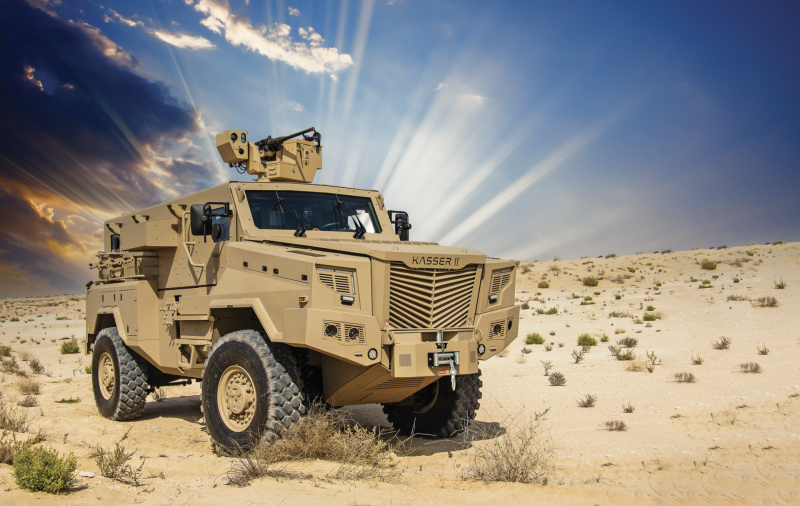
Among the vehicles being delivered is the Kasser II, a mine-resistant ambush-protected vehicle designed to offer robust defence against the kinds of dangers prevalent in conflict zones like eastern Congo. Manufactured under the auspices of the International Golden Group in the UAE, the Kasser II has been tailored for multirole operations, serving as an armoured combat carrier that can transport personnel safely while withstanding blasts from mines and improvised explosive devices, as well as fire from small arms. The Congolese government has placed orders for around 160 of these vehicles in a deal valued at approximately $70 million, with some equipped with heavier armaments such as 20 mm cannons and 12.7 mm machine guns to enhance their combat effectiveness. Initial deliveries included about 50 units, but further shipments have arrived, including a batch of 30 that docked at the port of Matadi in Kongo-Central province in May 2025. These are being distributed to key areas, including central locations like Kisangani and Kindu, as well as the volatile eastern front lines where the need for such protection is most acute.
The Kasser II made its public debut at the International Defence Exhibition and Conference in Abu Dhabi in February 2021, where it was showcased on the International Golden Group’s stand. This event highlighted the vehicle’s capabilities to potential buyers, including African nations seeking to modernise their militaries. Weighing 16.1 tonnes when unladen and up to 17.2 tonnes in combat configuration, the Kasser II is powered by a Cummins 8.9-litre turbocharged diesel engine that delivers 400 horsepower, paired with an Allison SP3200 transmission. This setup allows it to reach speeds of up to 110 kilometres per hour on paved roads, making it agile enough for rapid deployments despite its heavy armour. Dimensionally, it measures 7.05 metres in length, 2.64 metres in width, and 2.81 metres in height, providing ample space inside for a crew that includes a commander, driver, and gunner, along with up to six passengers—or a total of eleven without a weapon station, or nine when one is installed.
Protection is a core feature of the Kasser II, with ballistic armour rated at B7+ level to guard against bullets and fragments, and mine resistance meeting STANAG 4569 Level 4a and 4b standards, which means it can survive substantial underbody explosions. The vehicle incorporates a lightweight remote weapon station as standard, typically fitted with a 14.5 mm KPVT machine gun, though adapters allow for flexibility with other options like 12.7 mm or 7.62 mm machine guns, or even a 40 mm automatic grenade launcher. This adaptability makes it suitable for various missions, from troop transport to fire support in engagements.
Interestingly, the Kasser II bears a visual resemblance to the Reva V, an armoured vehicle produced by the South African firm Integrated Convoy Protection. However, it is officially a product of M4 Industries, an Abu Dhabi-based company that was relatively unknown before the vehicle’s unveiling. Representatives from Integrated Convoy Protection have chosen not to address questions about the similarities. Further insights suggest that the Kasser II is essentially a modified version of the Turkish BMC Kirpi II mine-resistant ambush-protected vehicle, with superficial changes to suit Emirati marketing and export needs. The International Golden Group, which handles the supply of foreign-manufactured equipment to UAE forces and international clients, has positioned the Kasser II as a reliable option for nations dealing with asymmetric warfare.
In the Democratic Republic of the Congo, the Kasser II is primarily operated by the Republican Guard, the elite unit tasked with protecting key government figures and installations, though other military units have also received them. A video shared on the social media platform X in July 2025 captured at least nine of these brown-coloured vehicles in action during a parade in Kinshasa back in March of that year. The footage shows the armoured vehicles rolling through urban streets, some manned by soldiers, with a 7.62 mm machine gun mounted on an unprotected turret atop one of them. Notably, the video includes overlaid text in French referring to the vehicles as “Cougar MRAP,” which appears to be a misidentification, as the design and context align more closely with the Kasser II. This could stem from visual similarities between various MRAP models, but expert analysis confirms these as the Emirati-supplied units. Such parades not only demonstrate military readiness but also serve to boost morale among troops and the public amid protracted conflicts.
The Congolese military’s push to acquire more armoured vehicles extends beyond the International Golden Group, with increased orders from other Emirati firms like The Armored Group and NIMR. This buildup occurs even as peace talks aimed at resolving the eastern conflicts continue, raising questions about the balance between diplomacy and military preparation. The acquisitions may also tie into broader economic dealings, such as the uncertain sale of the Musonoï East mining site to Abu Dhabi interests, which could facilitate defence procurements through resource-backed agreements.
Beyond the Congo, the Kasser II has found buyers in other African countries, including Togo, which paraded its newly acquired units during its independence day celebrations on 27 April 2025. This makes Togo the third known operator of the vehicle, likely following the UAE and perhaps Yemen, where similar models have been delivered. In Togo, the vehicles are expected to support counter-terrorism efforts, reflecting a growing trend among African states to invest in Emirati defence technology for internal security and border protection.
Overall, the introduction of the Kasser II into the Congolese arsenal represents a practical step towards enhancing troop survivability in one of Africa’s most unstable regions.