Russia’s ongoing war in Ukraine and questions about the American commitment to NATO have cast a spotlight on European efforts to safeguard security on the continent. But today, the major hurdles confronting Europe are no longer defense spending and industrial capacity. At both the national and multinational levels, Europeans have clearly stepped up funding, while military industrial output has surged and looks likely to continue. Instead, the major challenge impeding European security independence today is the fragmentation of its defense industry. In fact, this is not a new problem, but overcoming it will require European leaders to boldly exploit the dual security crises posed by Russia’s war and U.S. waivering.
For nearly 25 years, European defense spending, on average, declined. From the end of the Cold War until Russia’s 2014 invasion of Ukraine, most European countries cut defense spending. As a result, military capacity and capabilities also declined across Europe. Those trends bottomed out in 2014, and since then, average European defense spending has risen.
This accelerated dramatically starting in 2022, after Russia unleashed its second, larger, and far more brutal invasion of Ukraine. Most recently, European doubts about America’s commitment have spurred additional investments. For example, the United Kingdom announced a defense-budget increase, to be paid for in part by cutting foreign-development assistance. The European Union has proposed to relax fiscal rules that constrain members’ defense spending, to offer €150 billion in low-interest loans for multinational procurement projects, and to expand European Investment Bank lending for defense projects. Germany’s outgoing and incoming governments changed the country’s constitution to exempt defense spending from strict debt rules and created a €500 billion fund for infrastructure that will have clear benefits for military mobility across the heart of Europe. And France, Belgium, Latvia, Denmark, Estonia, and Sweden have all announced defense-budget increases over the last several months. Existing trends and these recent announcements make it clear that resourcing isn’t Europe’s big problem when it comes to military power.
Defense industrial capacity isn’t the main problem either, even as Europeans face the multiple demand signals of supplying Ukraine’s wartime needs, replenishing their own depleted military stocks, and providing sufficient capabilities to fulfill new NATO war plans. Over the last few years, leading European defense manufacturers have added significant productive capacity. In 2023, the European defense industry grew by nearly 17 percent, and defense sector employment rose by nearly 9 percent. MBDA, a multinational missile manufacturer, has more than doubled productive capacity since 2021, added 2,500 employees last year, and intends to hire 2,600 more this year. German defense contractor Rheinmetall built a new ammunition plant in 13 months and is building additional plants in Germany, Hungary, Lithuania, Romania, and Ukraine. Chemring Nobel and Eurenco, Europe’s leading producers of gunpowder, have each doubled productive capacity since 2022. Air defense manufacturer Diehl Defence has increased its workforce from 2,800 to 4,400 since 2021 and increased productive capacity for missile-defense systems. In sum, although more productive capacity would be helpful, given the record-breaking backlog of orders, and concerns remain over the availability of raw materials and qualified workers, trends in European defense industry appear very positive.
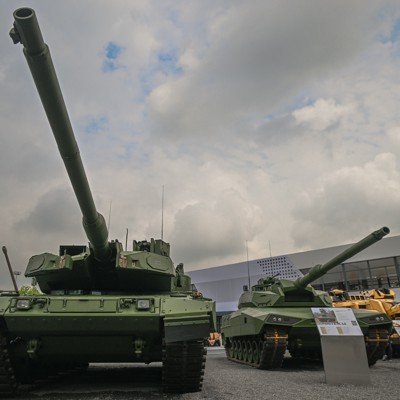
Instead, the main challenge confronting Europe today is the persistent atomization of its defense industry. Six European countries—seven if you count Türkiye—manufacture main battle tanks like the U.S. M1 Abrams tank. Eleven (including Türkiye) build infantry fighting vehicles, like the U.S. M2 Bradley. Ten (again, including Türkiye) manufacture naval surface combatants, including destroyers, frigates, and corvettes. This fragmentation prevents economies of scale, inhibits capability development, and frustrates military interoperability.
Rationalization of European defense industry would make every Euro spent on defense go farther by driving down cost-per-unit, enabling European militaries to more easily increase their capacity. It would also dramatically improve operational effectiveness by facilitating commonality in equipment among European countries. And it would facilitate the ability of Europe’s largest defense players—France, Germany, Italy, the UK, Türkiye, and Poland—to fill gaps created by any diminished American role far better than turning the EU into an independent defense actor.
Reducing or even eliminating this atomization has long been an obvious objective, but the question of how has plagued decision makers for decades. Ironically, the more money European governments have spent on defense, the less likely their defense industries have appeared incentivized to consolidate. At the same time, given the preferences of politicians to favor procurement bids from their country’s manufacturers, atomization hasn’t resulted in the degree of competition necessary to drive down prices. With the massive increase in military procurement orders to date and with an eye toward those coming down the pike, a multi-pronged approach is likely necessary to incentivize consolidation.
The key should be to incentivize the emergence of key military capability champions across the continent. For example, German firms Krauss-Maffei Wegmann and Rheinmetall seem the logical choice to build Europe’s main battle tanks, France-based Airbus ought to lead on helicopters, the UK’s BAE could provide the self-propelled artillery systems, Italy’s Fincantieri is a solid choice for naval surface combatants, and Germany’s ThyssenKrupp Marine Systems may be the best choice for submarines.
Achieving this goal will require difficult decisions by European leaders, including a willingness to see the emergence of national champions at the expense of some smaller defense industry players. It will require the EU to tie defense loans and grants to multinational procurement contracts signed with those same national champions. And it will require NATO to specify more clearly the precise capabilities necessary to fulfill the requirements of its war plans. None of this is easy, but the international security crises confronting Europe demands it.
John R. Deni is a research professor at the U.S. Army War College’s Strategic Studies Institute, a nonresident senior fellow at the Atlantic Council, and a nonresident senior fellow at the NATO Defense College. The views expressed are his own.