African governments are scrambling for dollars, and that’s creating a new dividing line for investors.
Amid a deepening shortage of hard currency on the continent, governments are turning to bartering, currency devaluations, central bank exchange controls, and help from the International Monetary Fund and Middle East to shore up their balance sheets.
ADVERTISEMENT
CONTINUE READING BELOW
Investors are rewarding nations whose efforts to boost dollar liquidity are paying off. But they’re punishing those that can’t guarantee access to the currency they need to invest and repatriate returns, and are steering clear of countries without adequate reserves to cover import costs or debt repayments. African currencies are the worst performers in the world this year, with about a dozen sliding at least 15% against the dollar.
“Dollar holdings are part of the value proposition,” said Benedict Craven, country risk manager at the Economist Intelligence Unit. “Will investors be able to trade using foreign exchange from official sources? Will they be able to expatriate their dividends abroad? These questions are separating where investment is going.”
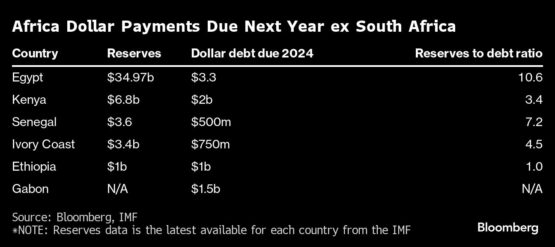
The dollar squeeze has played out most obviously in local currencies. Eurobond issuers who were forced to devalue this year include Egypt, Nigeria and Angola. Dwindling capital inflows have also seen the likes of Kenya’s shilling and Zambia’s kwacha weaken to record lows versus the greenback. The former has sizable dollar-debt repayments due next year, while the latter is in default on its eurobonds.
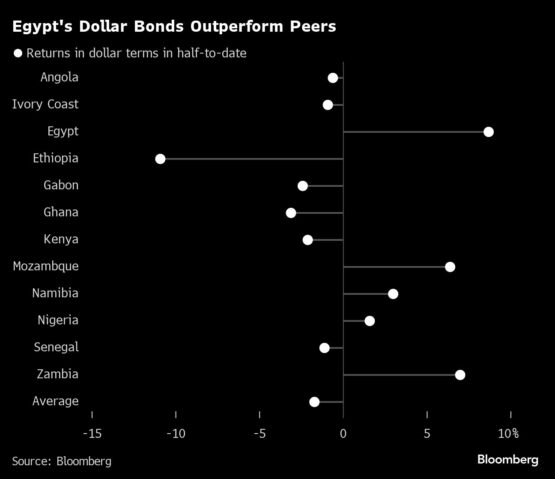
Kenya’s dollar bonds have handed investors losses of 2.1% since the beginning of July, when US Treasury rates started rising as the “higher-for-longer” interest-rate narrative took hold. That compares with the 1.7% average loss for emerging and frontier peers in a Bloomberg sovereign dollar bond index. Nairobi’s benchmark stock index has slumped 32% in 2023, the most among 92 global markets tracked by Bloomberg, while the shilling has declined 19%.
In Zambia, Mozambique and Nigeria, the inability to access foreign financing has forced governments to ramp up domestic issuance in shallow markets, pushing up the cost of borrowing. African sovereigns have been locked out of international debt capital markets since April 2022.
Nigeria’s longest-dated naira bond is trading at a record 18% yield. But higher domestic yields aren’t attracting foreign buyers, who worry about depreciating local currencies and difficulties in repatriating returns. In Zambia, for example, foreign holdings of domestic debt fell from 29% at the end of 2021 to around 22% currently, partly due to the restructuring process as well as liquidity issues.
IMF Rescue
In some cases, the IMF is coming to the rescue. It said last week it will expand financing to Kenya by $938 million to bolster its reserves, ahead of a $2 billion eurobond maturity in June. That sent yields on the 2024 notes tumbling almost 200 basis points in four days through Friday — though they remain well above 14%.
“The general perception is when a country trades above 10% in USD yields they are not able to issue in the USD market,” said Lars Krabbe, a portfolio manager at Coeli Frontier Markets AB. “This is of course not good for the general investment environment and debt sustainability in these countries and makes them highly dependent on concessional funding” such as IMF loans, he said.
On the other hand, countries with less pressing foreign-exchange needs are becoming more appealing.
“Countries with less punishing dollar-denominated loan amounts and bond repayments, and large stocks of foreign reserves, are most attractive,” said David Omojomolo, Africa economist at Capital Economics. “And more so those that have made large FX adjustments already.”
Egypt is one. Citigroup strategists were the latest to turn bullish on the North African nation’s dollar debt, as sales of state assets pick up and the government appears on track to meet targets set by the IMF. The central bank is close to securing as much as $5 billion in new deposits from Saudi Arabia and the United Arab Emirates, al-Borsa reported last month.
ADVERTISEMENT
CONTINUE READING BELOW
Egypt’s eurobonds have handed investors returns of 8.7% in the second half of this year in dollar terms, compared to a loss for the average developing-nation peers in a Bloomberg sovereign credit index.
For Kaan Nazli, portfolio manager at Neuberger Berman Asset Management, investors are likely to prioritise sovereign issuers that had better access to alternative sources of financing, such as Ivory Coast and Senegal.
“Ivory Coast, for example, was able to rely on blended finance deals at reasonable cost over the last year,” he said.
The West African nation also secured an IMF loan, while its currency, the CFA franc, is pegged to the euro, leaving it less exposed to fluctuations. Regional peer Senegal is attracting investments to public-private partnerships in climate finance.
Losses in both Senegal and Ivory Coast’s eurobonds have been less severe than Kenya’s and narrower than the average since July. Month-to-date, their performance has exceeded peers.
Meanwhile, the dollar shortage is also hurting consumers and local businesses as import costs soar, fueling inflation.
In Nigeria, prices of prescription drugs for conditions such as hypertension and diabetes have tripled in the past year. One of Zimbabwe’s biggest retailers, OK Zimbabwe, said sales volumes are now below break-even point due to rising costs and an exchange rate which has driven customers to the informal sector. And in Malawi, the price of corn, a food staple, has more than doubled over the past year.
“The problem is there’s only so much you can do if you don’t have a vast trove of dollar reserves,” said Sonu Varghese, global macro strategist at Carson Group. “For investors, the risk that these countries remain on the verge of crisis hasn’t gone away.”
© 2023 Bloomberg