


From growls to pulses to booms, whales, fish and crustaceans all produce sounds. In fact, more than 800 species of fish are capable of making noises for a variety of functions such as courtship and mating, defending their turf or responding to threats. Each of these species has a characteristic waveform that is unique to their “calls.” As such, detecting structures in these signals can be used to identify the sounds of different species.
Classifying sounds produced by fish will help to understand how they respond to environmental changes and anthropogenic disturbances, such as ocean noise and fishing activity, as well as environmental changes associated with warming waters due to climate change or red tides that now frequently occur on the west coast of Florida.
Passive acoustics is a measuring method used to detect sounds or vibrations created by marine mammals in the wild. Although this technology has helped to shed light on fish habitat preference as well as their movements, no studies have yet been able to illustrate their detailed behavior.
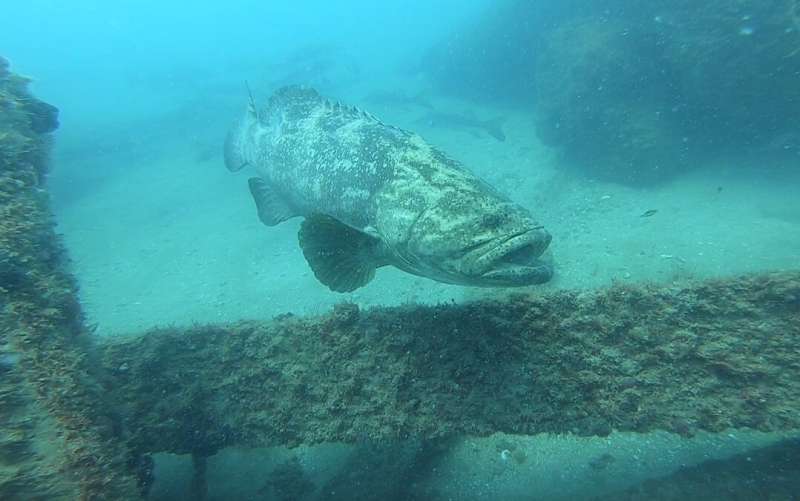
Selecting the gregarious Goliath grouper (Epinephelus itajara) for their study, researchers from Florida Atlantic University implemented and deployed a novel automated detector and localization model to find underwater marine organisms using their low-frequency pulse sounds. Pulses associated with fish sounds can be categorized in terms of the number of pulses, pulse period, frequency, oscillogram shape, or a descriptive name or onomatopoeic word like a growl, pulse train or boom.
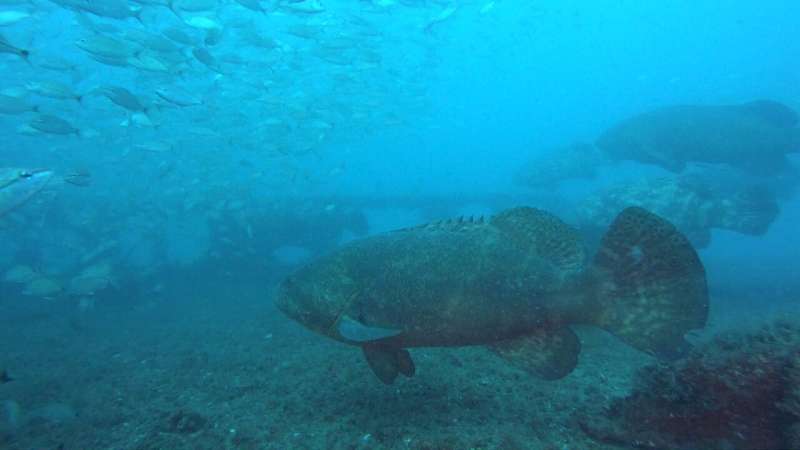
The Goliath grouper is one of the largest grouper species reaching up to 800 pounds. They produce low frequency (peak of 60 hertz) loud “booms” using their swim bladder and surrounding muscles. These booms display a “polycyclic” waveform, which rapidly increases in amplitude for up to one or two wave cycles and then declines exponentially.
For the study, researchers recorded Goliath grouper sounds at an artificial reef in the Gulf of Mexico, where the fine scale distribution of fish around their habitat was studied. They assessed their presence by measuring acoustic activity and how fish were distributed relative to their habitat. Researchers deployed a battery-powered six-element acoustic array at the artificial reef, which continuously recorded for three days. The six-element acoustic array was set with three hydrophones on the reef structure and three hydrophones on the ocean floor.
Using time difference of arrival (TDOA), a sound source localization model based on staggered matched filtering was designed. It uses a two-stage approach, first, to identify the sound and, second, to localize it. In the first stage, researchers employed a noise adaptive matched filter designed to detect and determine the timing of the sound pulses recorded by the hydrophones. In the second stage, the detected sound pulses were fed to a TDOA localization algorithm to compute the locations of the sound source.
Results of the study, published in Journal of the Acoustical Society of America, showed this model can be used to automatically process large amounts of acoustic data and provides detailed movements of marine organisms that produce low-frequency sound pulses. The model can be applied to track a group of marine organisms and their related activities, such as feeding for marine mammals or invertebrates, or in response to predators or mating partners, or any other disturbances within their habitat.
“Localizing Goliath grouper calls around their habitat can provide us with the opportunity to learn about their fine-scale activity patterns over a range of space and time, ambient noise and various environmental conditions,” said Hanqi Zhuang, Ph.D., co-author, chair and professor in FAU’s Department of Electrical Engineering and Computer Science within the College of Engineering and Computer Science. “The localization method we used also is applicable to similar sound pulses emitted by whales, dolphins, lobsters, crabs and other crustaceans.”
Researchers used the automated call localization approach to map the distribution of Goliath grouper calls at the artificial reef where the array was deployed at two specific times of the day. Study findings revealed that sounds were most frequently produced between 1 and 3 a.m. Midday distribution showed a cluster of fish located near the center and to the north and east of the artificial reef. During the night, the cluster of fish calls were more centered near the reef and to the southwest of it.
“Goliath grouper calls can be uniquely identified by matched filtering, which uses a generic template of the pulse to be identified. This model, through its specific design, also mitigates the multipath effect in identifying and timing their calls,” said Laurent Chérubin, Ph.D., co-author and an research professor at FAU Harbor Branch. “This non-invasive, automated approach efficiently processes large acoustic datasets to continuously map the evolution of the sound source spatial distribution with relatively high precision.”
More information:
Ali Salem Altaher et al, Detection and localization of Goliath grouper using their low-frequency pulse sounds, The Journal of the Acoustical Society of America (2023). DOI: 10.1121/10.0017804
Provided by
Florida Atlantic University
Citation:
Detecting gregarious Goliath groupers using their low-frequency pulse sounds (2023, June 28)
retrieved 28 June 2023
from https://phys.org/news/2023-06-gregarious-goliath-groupers-low-frequency-pulse.html
This document is subject to copyright. Apart from any fair dealing for the purpose of private study or research, no
part may be reproduced without the written permission. The content is provided for information purposes only.


