


Artificial intelligence is accelerating at breakneck speed, with larger models dominating the scene—more parameters, more data, more power. But here is the real question: Do we really need bigger to be better? We challenged that assumption by asking a different question: How can organizations mine real-time customer sentiment without renting out a GPU farm? Every tweet and review carries actionable insights, but running massive language models on each input comes with steep computational and financial costs.


In our recent study published in Procedia Computer Science, we asked whether leaner architectures could deliver comparable accuracy while slashing training and inference time. We discovered that fine-tuned sentence transformers paired with lightweight classifiers not only match the performance of large language models—sometimes even exceeding it—but also run comfortably on commodity hardware. This approach could reshape the economics of sentiment analysis.
Our approach
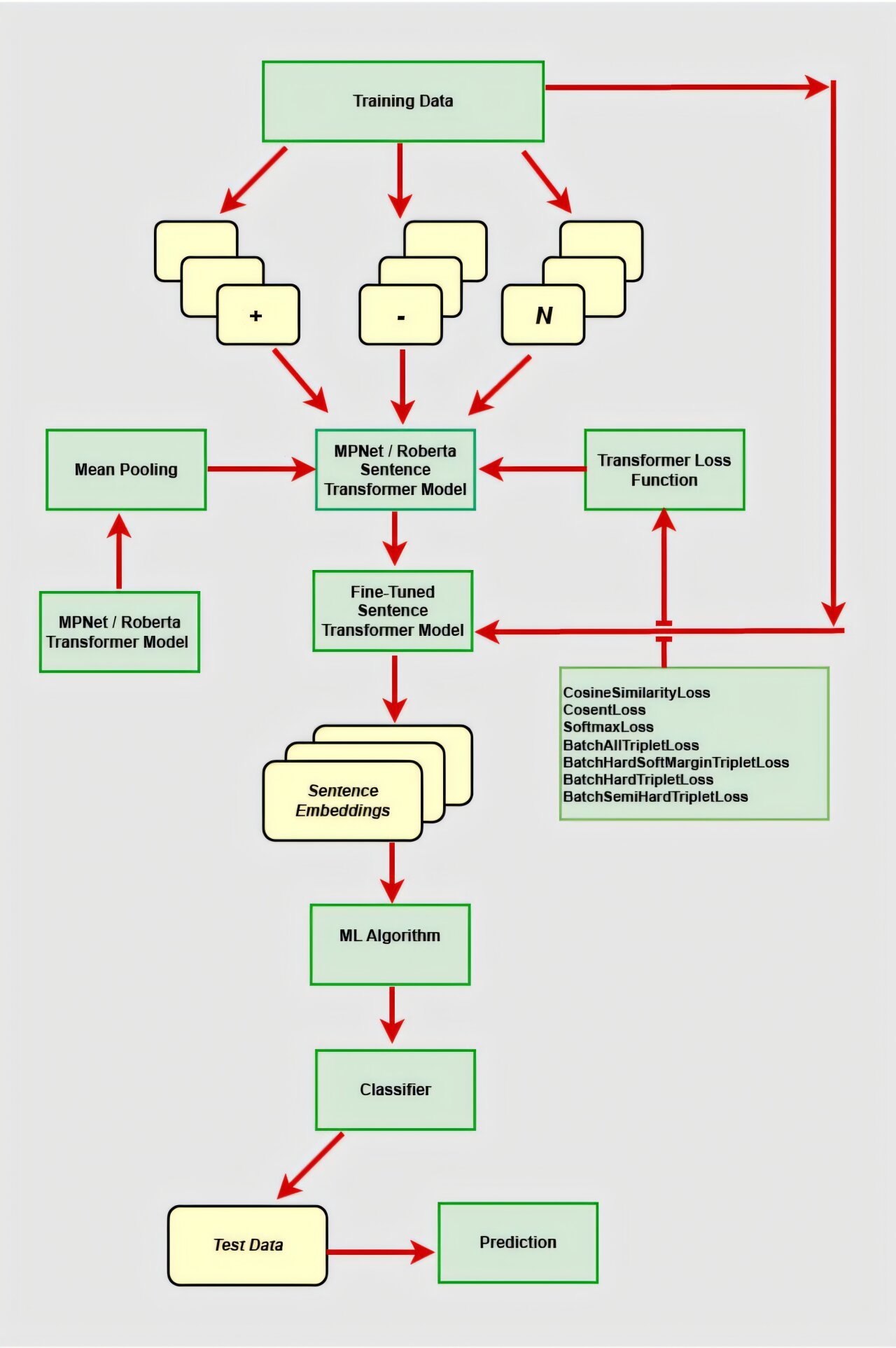
We built our pipeline on two powerful yet efficient transformer backbones—MPNet and RoBERTa-Large. First, we convert each input sentence into a fixed-length vector by mean-pooling over its token embeddings. This transforms text into a semantically rich representation without the overhead of token-by-token processing. Next, we fine-tune these sentence transformers directly on labeled sentiment data.
By applying supervised loss functions, CosineSimilarity and CoSENT to align pairs of same-sentiment sentences, SoftmaxLoss to sharpen class boundaries, and variants of triplet loss (BatchAll, BatchHard, SoftMargin, SemiHard) to push dissimilar sentiments apart—we sculpt the embedding space so that positive, neutral and negative examples naturally cluster.
With our fine-tuned embeddings in hand, we treat sentiment classification as a classical machine-learning problem. We feed the vectors into mature classifiers—XGBoost (eXtreme Gradient Boosting), LightGBM (Light Gradient Boosting Machine), and SVM (Support Vector Machines)—each optimized on the training set for accuracy, precision, recall, and F-score.
By decoupling heavy transformer fine-tuning from fast, tabular classification, we minimize end-to-end training time and reduce runtime memory requirements. Our modular design will let researchers swap in their preferred classifier without reengineering the core embedding pipeline.
Benchmarking performance
To validate the pipeline, we evaluated it on four public datasets. On the three-class Twitter US Airline Sentiment dataset (TAS), our best model—RoBERTa-Large with CosineSimilarity fine-tuning plus XGBoost—reached 88.4% accuracy and improved minority-class recall by nine points. On the balanced IMDb movie-review set, the same transformer—loss function configuration coupled with SVM hit 95.9%. We then tested generalization without additional tuning: the TAS-trained model scored 88.5% on Apple tweets, and the IMDb-trained model achieved 94.8% on Yelp reviews.
Comparisons with large language models
We benchmarked our approach against Meta-Llama-3-8B in both zero-shot and QLoRA (Quantized Low-Rank Adapter) fine-tuned settings. In zero-shot mode, Llama-3-8B managed only about 50% accuracy—essentially random guessing—on both tasks. After QLoRA fine-tuning Meta-Llama-3-8B achieved 85.9% accuracy on the Airline test set and 97.1% on IMDb.
While Llama-3-8B edged our model by 1.2 points on IMDb, it required seven hours of GPU time on an NVIDIA A100 and nearly three hours of inference to process the test sets. By contrast, our full pipeline trained end-to-end in under four hours and completed inference in minutes on the same hardware configuration. On the Airline task, we not only outperformed Llama-3-8B by 2.5 points but also trained eleven times faster.
These results underscore that carefully fine-tuned sentence transformers plus lightweight classifiers can rival parameter-heavy LLMs—at a fraction of the computational and financial cost.
Democratization of AI
By confining expensive computation to a single fine-tuning step and leveraging mature ML (Machine Learning) libraries for classification, we enable researchers and developers with limited hardware to deploy state-of-the-art sentiment analysis. Whether we are scaling up customer feedback analytics or building nimble NLP systems for real-world deployment, this research shows how open-source tools and clever engineering can democratize sentiment analysis using artificial intelligence.
Even better, we built in a direct solution for skewed sentiment distributions—no extra data augmentation required—so the system naturally balances minority classes and delivers reliable, scalable performance in real-world settings. Our open-source repository makes replication and domain adaptation straightforward.
Conclusion
High-performance sentiment analysis need not be the exclusive province of massive large language models. Through targeted fine-tuning of sentence transformers and judicious use of lightweight classifiers, we have unlocked fast, accurate and generalizable pipelines that run on everyday hardware. Looking ahead, we will extend this framework to topic modeling and topic summarization, providing organizations not only with sentiment scores but also with concise real-time insights into emerging customer concerns—thus truly democratizing AI-powered sentiment analytics.
So what does this mean for AI’s future? Smarter, efficient models that make high-performance sentiment analysis accessible, whether for customer insights, real-time moderation, or ethical AI.
This story is part of Science X Dialog, where researchers can report findings from their published research articles. Visit this page for information about Science X Dialog and how to participate.
More information:
Agni Siddhanta et al, Sentiment Showdown – Sentence Transformers stand their ground against Language Models: Case of Sentiment Classification using Sentence Embeddings, Procedia Computer Science (2025). DOI: 10.1016/j.procs.2025.03.161
Agni Siddhanta is a renowned data scientist specializing in machine learning and AI. He holds a MS in Analytics from Georgia State University, USA. Agni has had significant roles at organizations like LexisNexis Risk Solutions and Mott MacDonald. His recent work on fine-tuned sentence transformers for sentiment classification—published in Procedia Computer Science after acceptance at the 3rd International Workshop on Human-Centric Innovation and Computational Intelligence 2025—demonstrates his talent for blending cutting-edge technology with human-centric insights. Agni also contributed to the academic community as a reviewer for NeurIPS 2024 and the HEAL workshop at CHI 2025, and as a technical committee member for The 18th International Conference on Advanced Computer Theory and Engineering (ICACTE 2025). His industry leadership and scholarly engagement underscore his commitment to advancing AI research and deploying scalable, accessible solutions.
Citation:
Democratizing AI-powered sentiment analysis (2025, July 21)
retrieved 21 July 2025
from https://techxplore.com/news/2025-07-democratizing-ai-powered-sentiment-analysis.html
This document is subject to copyright. Apart from any fair dealing for the purpose of private study or research, no
part may be reproduced without the written permission. The content is provided for information purposes only.



