

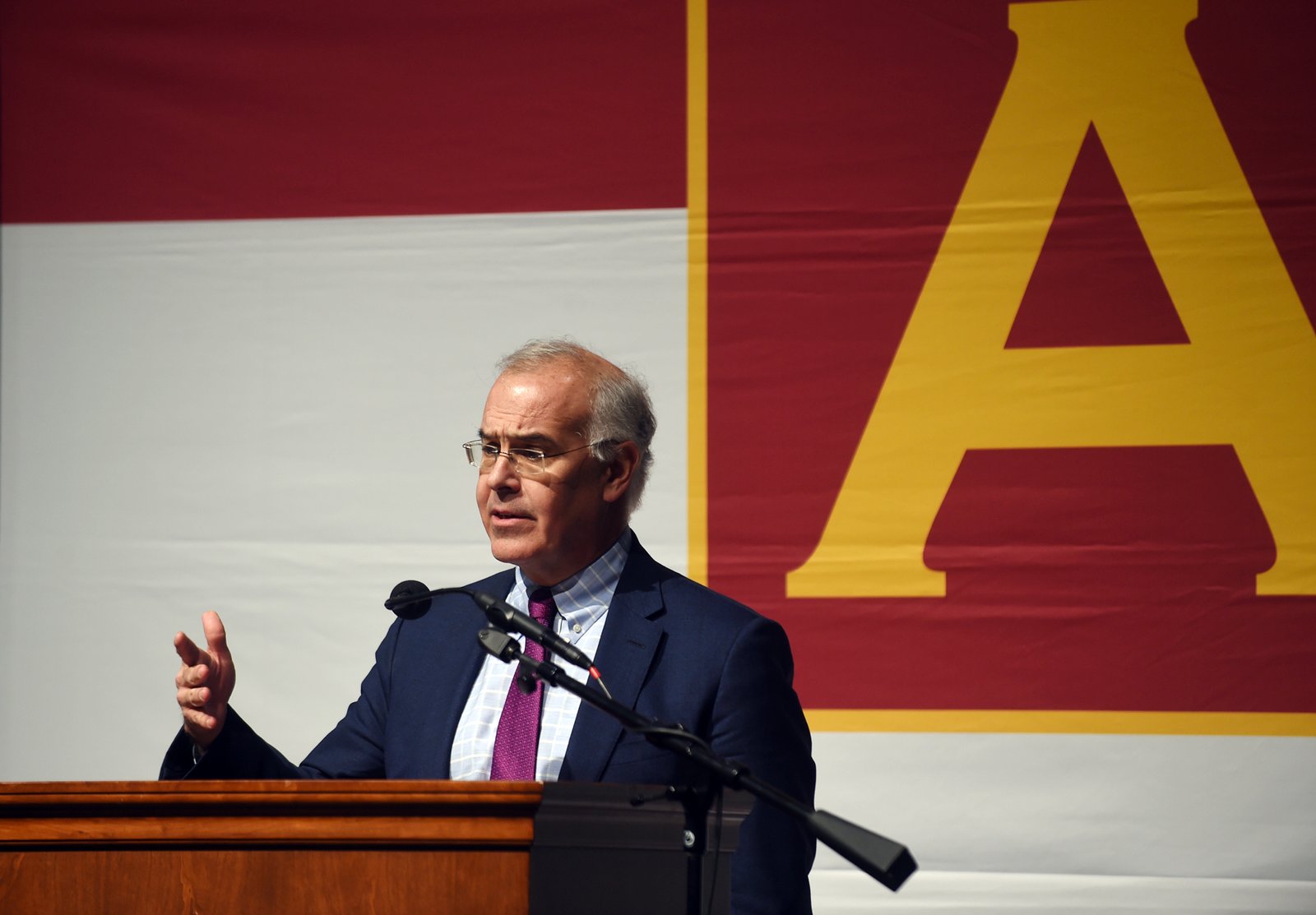


Writing in The Atlantic last week, the columnist David Brooks — the kind of Whiggish moderate conservative rendered politically homeless and functionally irrelevant by Donald Trump’s takeover of the Republican Party — explained that he is very worried indeed.


With mounting horror, the veteran pundit recounted watching not only the growing authoritarianism of the current administration, but also the abject failure of America’s democratic institutions to rein it in, despite “drawing on thinkers going back to Cicero and Cato.” (Pop quiz for history buffs: Who here knows exactly how effective Cicero and Cato were at preventing tyranny?) While hand-wringing that the brutal instincts Trump represents could endure long after his time in office concludes, Brooks writes that “For the United States, the question of the decade is: Why hasn’t a resistance movement materialized here?”
It is ironic that Brooks’ plaintive cri de cœur was published only days before the latest mass “No Kings” protests, which he offers only the briefest acknowledgment; it is probably safe to assume that millions of Americans did not take to the streets simply because David Brooks told them to. Yet his screed is enlightening, although probably not in the manner he intended.
“Will enough Americans rise up to reverse the tide of populist authoritarianism?” Brooks asks. “The Filipinos did it under Marcos. One morning the autocrats woke up and were no longer in control; the marchers were. That needs to happen here.” America needs a mass movement of resistance, and thankfully, Brooks is here to tell us exactly what it should look like.
The longtime New York Times opinion columnist writes longingly of a bygone alliance between populists and progressives that was “economically left, socially center right, and hellbent on reform.” A contemporary version of this coalition would, he claims, have “the benefit of scrambling outdated 20th-century categories of left and right,” and would reject “the Trumpian idea that we are sentenced to an endless class or culture war.” By an amazing coincidence, the kind of mass movement America needs and Brooks prescribes would align precisely with the ideological orientation of every superannuated centrist dweeb who disdains Trump but finds the allure of, say, democratic socialism or defending trans rights to be equally repellent.
Brooks goes on to argue that his hypothetical movement should “shift public sentiment” (gee, what an original notion), “create a competing cascade of mini-dramas” (i.e. draw attention to bad things that are happening) and practice “brave, disciplined and dignified” nonviolent resistance (including, interesting enough, boycotts — a tactic that Brooks strangely never mentions with regard to Israel).
Some may find all this confusing, not least the countless activists and protesters across the United States who have spent the past year (as well as Trump’s first term) doing everything they possibly can to shift public sentiment and draw attention to the horrors and injustices the administration has inflicted, and whose efforts have been overwhelmingly brave, disciplined, dignified, and nonviolent. Apparently, this isn’t good enough for Brooks, although that’s hardly surprising — few actually existent mass movements have lived up to his high standards.
In 2016, amid the burgeoning Black Lives Matter movement, Brooks took the time sternly wag his finger at high school football players who took a knee during the national anthem; at the height of Occupy Wall Street, he dismissed its participants as “milquetoast radicals” with no credible ideas; and perhaps most memorably, in 2003, Brooks anticipated that the “American Bush haters” would “lose self-confidence and vitality” before finally backtracking in the face of the Iraq War’s inevitable triumph.
It should be obvious why Brooks, one of that criminal misadventure’s most prominent media boosters, disparaged an anti-war movement which threatened the project in which he had invested so much. But one of the peculiarities of the age of Trump is that the threat he poses to America itself has forced the kind of stalwart moderate and centrist pundits, who, as a rule, do not like, trust, or support protest movements, to grapple with their necessity — a task they tend to approach with a baffling and completely unearned confidence.
Few actually existent mass movements have lived up to Brooks’s high standards.
As campus occupations against Israel’s genocide in Gaza took off last year, Jonathan Chait condemned this terrifying nationwide outbreak of young people sitting down as “the fanatic adherents of an illiberal and unjust program,” and when Trump dispatched thousands of National Guard troops to Los Angeles to quash anti-ICE protests, Tom Nichols hectored those activists courageous enough to put their bodies in harm’s way that “the most dramatic public action the residents of Southern California could take right now would be to ensure that Trump’s forces arrive on calm streets.” Yeah, that’ll show ’em.
To his extremely limited credit, Brooks is not wrong in believing that America needs a mass movement of resistance — arguably, it already has one, albeit in a form that Brooks and his cohort generally disdain. It is also not unreasonable to imagine a fruitful union of populism and progressivism, though why Brooks cannot or will not imagine that this successful movement could be both socially and economically left is for him to answer.
But contrary to Brooks’s wishes, one cannot simply copy and paste historical struggles onto our weird and particular present, not least because there is so little precedent for victory. Writing of the anti-war movement in the time of Vietnam, Kurt Vonnegut recalled: “It was like a laser beam. We were all aimed in the same direction. The power of this weapon turns out to be that of a custard pie dropped from a stepladder six feet high.” Veterans of many other protest movements will recognize this grim reality all too well; the United States is so profoundly resistant to the lasting effects of mass movements that a cynic might wonder if it’s a feature, rather than a bug, of its design.
Unlike Brooks, I will not presume to dictate what an anti-Trump resistance movement could look like or what tactics it should pursue. What I will say is that I cannot imagine why the hell such a movement would look to someone like David Brooks for advice. The ideological current to which he belongs laid the groundwork for Trump, while its subsequent efforts and vaunted institutions have failed at almost every turn to defeat or even obstruct the forces he represents. Nevertheless, Brooks and his fellow travelers will persist in the delusion that mass movements require and are desirous of their guidance and wisdom, because any that emerged without it would only confirm their own irrelevance.
With that in mind, any protester considering their next move could probably do worse than to pick up a copy of The Atlantic, if only to do the opposite of whatever it suggests.


