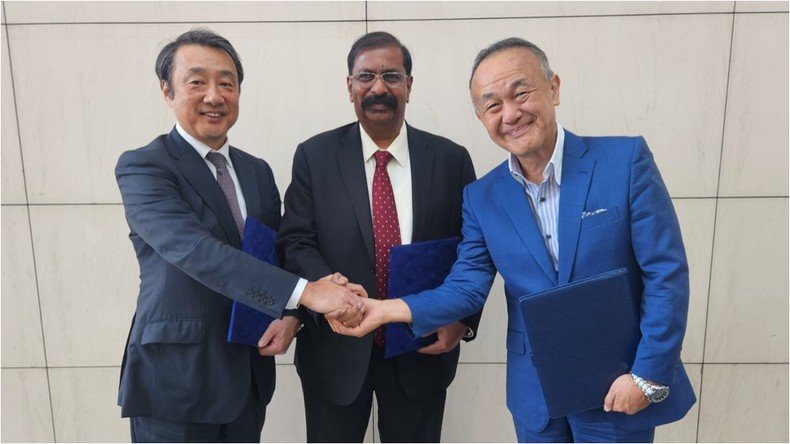
The deal, which aimed to encourage wider Japanese corporate participation in Africa’s petrochemical market, was announced this week during the Tokyo International Conference on African Development in Yokohama and marks a major diversification move for Dangote Industries.
Under the memorandum of understanding facilitated by consulting firm, AAIC Holdings, Dangote will leverage feedstock from its 650,000-barrel-per-day refinery in Lagos to produce high-value petrochemical products.
Yoshinori Andou, Senior Managing Executive Officer of Mitsui Chemicals; Devakumar V. G. Edwin, Vice President of Dangote Industries Limited; and Susumu Tsubaki, Representative Director of AAIC, represented their respective companies at the signing of the Memorandum of Understanding (MOU).
According to details released by S&P Global, Japanese partner Mitsui Chemicals revealed that the venture will focus on producing resins, plastics, and fertilizers, with the company providing the required technology and expertise.


Dangote’s strategic expansion in energy
The new partnership provides a strategic entry point that allows him to add value to crude oil processing while positioning Nigeria as a future hub for industrial raw materials.
The facility, already capable of producing around 900,000 tonnes of polypropylene annually, is expected to be the largest of its kind in Africa.
Designed to manufacture 77 different high-performance grades of polypropylene, the plant has a turnover of $1.2 billion and is strategically positioned to meet the rising demand of downstream plastic processing industries in Africa and beyond
Analysts note that the partnership has both local and global implications.
Globally, it places Dangote in competition with established petrochemical giants, while giving Mitsui Chemicals access to Africa’s largest economy and one of the world’s fastest-growing consumer markets.
By turning refinery output into diversified industrial products, Dangote is not only strengthening his energy empire but also reinforcing Nigeria’s ambitions to move up the value chain in global trade.
The success of this venture could set the stage for Africa’s largest refinery complex to become a driver of industrial transformation across the continent.