
The Council for Scientific and Industrial Research (CSIR) has successfully demonstrated a broadband underwater data communication system to Armscor, which aims to develop fast and reliable acoustic underwater data transfer for naval operations.
The CSIR achieved near-perfect transmission and data rates exceeding 240 kbps during a demonstration of the latest version of the system at the CSIR’s underwater acoustic testing facility, the organisation said in its latest 2024/25 annual report.
“This technology aims to transmit data, such as sonar images, over distances of up to 500 metres, enhancing the capabilities of the South African Navy during naval operations. Researchers implemented multiple-input multiple-output technology, utilising multiple transmitter and receiver transducers to improve the broadband underwater data communication system. This technology provides greater transmission bandwidth, allowing for enhanced signal reliability and increased data rates. In addition to software development, new mechanical and electronic hardware was developed for two buoy-mounted, stand-alone transmitter and receiver systems,” the CSIR stated.
Rapid wireless underwater data transfer is becoming ever more crucial, it noted, particularly for autonomous underwater vehicles – modern devices capable of mapping the ocean floor, inspecting underwater structures and ensuring the safety of waterways.
Researchers also explored live video streaming techniques for the system during the demonstration.
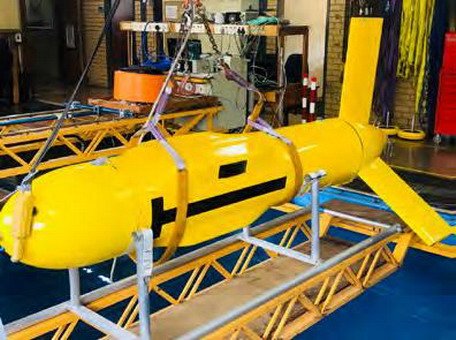
Also on the naval front, the CSIR recently installed its sonar demonstrator into a new towfish as part of efforts to ensure that the South African Navy benefits from technological advancements that enhance safe underwater operations.
The towfish supports rapid deployment and testing in real-world aquatic environments, the Council said. “The synthetic aperture sonar demonstrator captures high-resolution acoustic images of the seafloor. The South African Navy uses different sonar systems, such as multibeam and side-scan sonars, to navigate and detect underwater threats. These systems support obstacle avoidance, underwater reconnaissance and mine detection. They rely on advanced hardware and software and require extensive expertise for operation, maintenance and platform upgrades.
The CSIR has improved the sonar system by developing proprietary acquisition and processing software that leverages high-performance single-board computers equipped with cutting-edge graphics processing unit technology. This enables the rapid processing of sonar data to produce final images in near-real-time. As a result, the CSIR is advancing toward real-time image formation with sonar systems.”
The Council noted that optimal sonar systems are essential for submarines and surface vessels to operate safely and effectively at sea.