

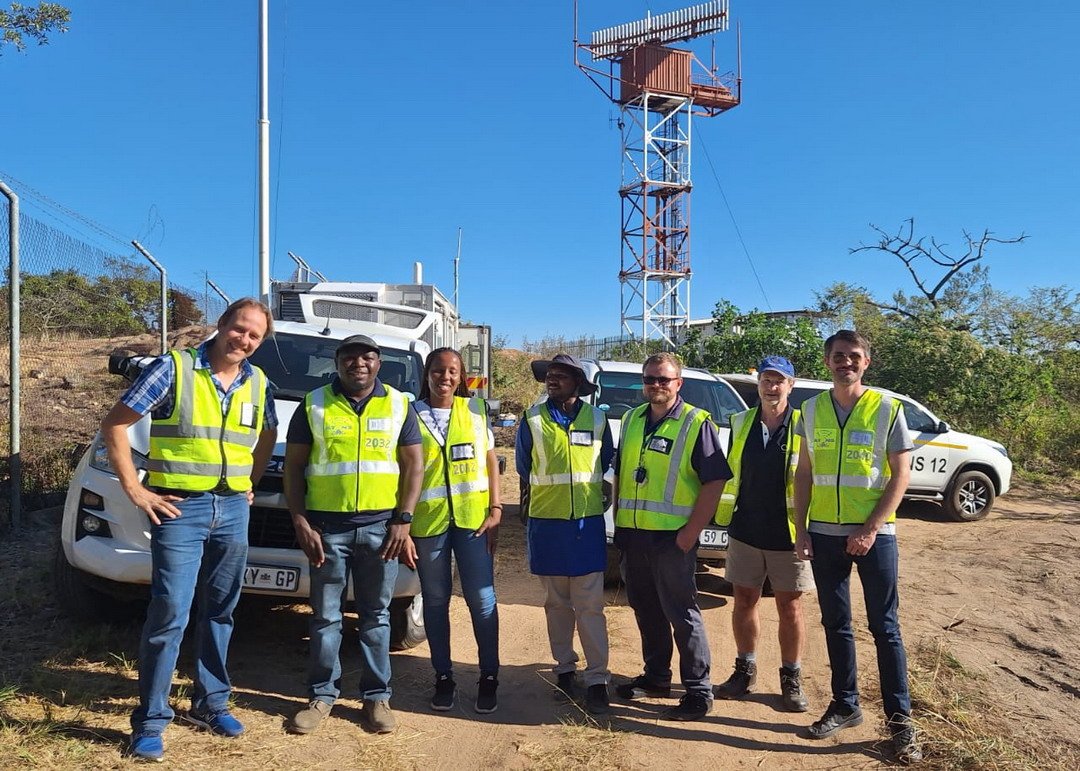

The Council for Scientific and Industrial Research (CSIR) is one of the world’s leading organisations developing passive radar, and has recorded major progress commercialising the technology through a license agreement with US-based Adler Aerospace.
Speaking at the recent CSIR Annual Roundtable, Executive Manager of the Council’s Defence and Security Cluster Sipho Mbhokota said the agreement with Adler Aerospace means they will be able to license the CSIR’s passive radar technology elsewhere in the world.
Adler Aerospace – which specialises in unmanned aerial vehicle (UAV) and counter-UAV technologies – is offering the StealthNet passive radar system from the CSIR, which is ideal for early warning or covert surveillance. “With 24/7 hemispherical coverage, instant deployment, and the ability to detect diverse targets while resisting jamming, StealthNet is the smart, cost-effective choice for tactical and strategic operations. Ideal for both stand-alone and meshed network configurations, it delivers cutting-edge performance at a fraction of the cost of traditional radar systems,” the company said.
StealthNet uses FM and Digital Audio Broadcasting (DAB) emitters to detect targets at up to 300 km for commercial airliner size targets, 120 km for light aircraft, 80 km for fighter aircraft, and up to 50 km for smaller unmanned aerial vehicles (UAVs).
As passive radar uses emissions from other emitters for target detection, it is much cheaper than active radar, requires less maintenance (no moving parts), is easily deployed, does not require regulatory approvals to operate, and is covert. Two to three receiver nodes are needed at a minimum to detect and track targets.
Dr Motodi Maserumule, CSIR Group Executive for the Advanced Production and Security division, said passive radar is ideal for airport security, particularly against UAVs – because it’s passive, it is difficult for people flying offending UAVs to detect it. The interest in the technology is quite vast, he said, with the technology promising to have an expansive impact.
Mbhokota said the CSIR hopes to launch a passive radar air traffic control product within the next couple of months. “There is a huge market and we are looking to target Africa as they are struggling with airspace control,” he said.
Mbhokota added that the CSIR recently attended the ADEX aerospace and defence exhibition in South Korea in October, and met with prominent players that are very much interested in its passive radar technology, so much so that demonstrations were carried out.
Locally, the CSIR is working with Air Traffic and Navigation Services (ATNS) to trial passive radar at Kruger Mpumalanga International Airport. ATNS and the CSIR signed a Memorandum of Understanding (MoU) in May 2017 on the deployment of passive radar system technology for civil aviation operations, and renewed this in April 2023.
The CSIR has collaborated with local companies Peralex and Lochtron, as well as academic institutions (the University of Pretoria and University of Cape Town) on passive radar. Armscor has also provided funding support for passive radar research and development.
With the CSIR leading technology development, ATNS has provided technical know-how on system configuration to meet Air Traffic Management (ATM) technical standards requirements, in line with the International Civil Aviation Organization Standards and Recommended Practices (ICAO SARPs).
Over the last eight years the CSIR’s passive radar system has been rolled out to multiple sites in the North-Eastern part of South Africa, including one site on the roof of the CSIR’s buildings in Pretoria, another at the University of the North West (Potchefstroom campus), a third at Emalahleni (Tshwane University of Technology campus), one at Hartebeeshoek and another at OR Tambo International Airport. In 2024, passive radar technology was installed at Kruger Mpumalanga International Airport.
The CSIR has obtained funding from the Technology Innovation Agency (TIA) to mature passive radar for air traffic control. “With the generous funding support from the Technology Innovation Agency, this endeavour aims not only to mature and commercialise passive radar technology but also to foster innovation and technological advancement within South Africa,” the CSIR said.
The CSIR is looking at multiple applications for passive radar, including air traffic control, border security and unmanned aerial vehicle detection around airports. It has even tested passive radar at the coast and discovered that it can detect surface vessels like harbour patrol boats – small boats were detected at ranges of 4-5 kilometres during tests carried out in 2014 in the Western Cape. Tests at the CSIR have also seen the system detecting road traffic.
Peralex, meanwhile, has successfully used passive radar stations in the Northern Cape to monitor air traffic for the Square Kilometre Array (SKA) radio telescope in what is one of the first commercial applications anywhere in the world for the technology.


