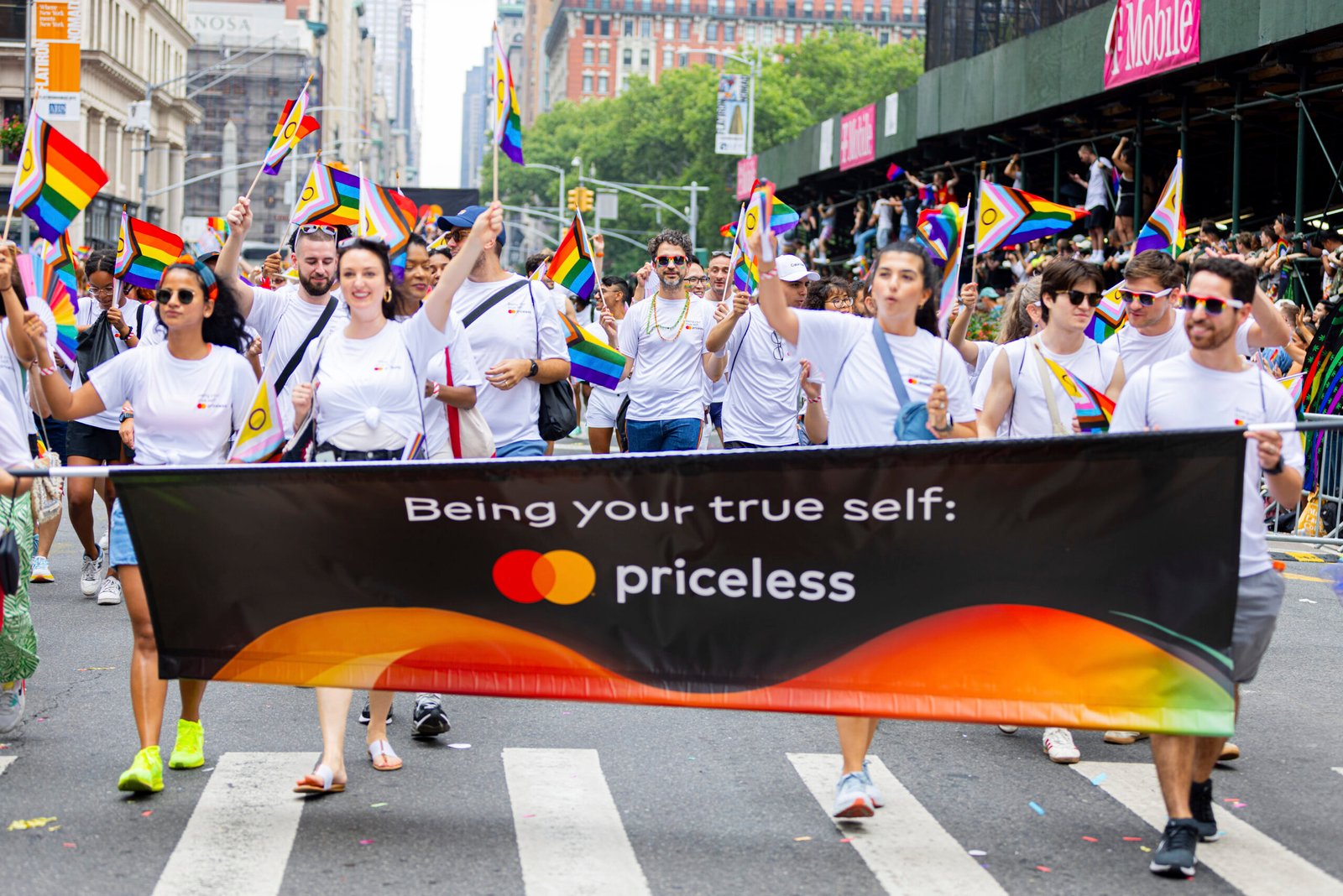

Photo: Hailstorm Visuals/Sipa USA via AP Images
As Pride month kicks off under a hostile federal government that takes its cues from a homophobic and transphobic far-right movement, the typical steady drip of rainbow-painted logos and feel-good news has been replaced with a stream of coverage of corporations pulling their sponsorship dollars from LGBTQ+ Pride events. This sudden withdrawal presents a material problem in queer circles, as advocates struggle to plan the increasingly bloated festivals that corporate cash has enabled in recent years.
It’s also an opportunity.
The corporate exodus has been swift and financially devastating. According to one Associated Press report, NYC Pride is staring down a $750,000 budget gap. San Francisco Pride is short $200,000 to $300,000. KC Pride in Kansas City lost half its annual budget, about $200,000. Anheuser-Busch alone left St. Louis Pride $150,000 poorer. WorldPride D.C., which was set to be a lavish affair, is out nearly $260,000. And numerous other Prides report sponsorship drops of 40 to 50 percent.
But it’s far from clear that that money was doing much to advance the interests of LGBTQ+ people. What started as a remembrance of the fury and desperation of the Stonewall riots has slowly been sanitized and co-opted into a series of stale, borderline apolitical affairs. Over the course of the 1990s and early 2000s, companies began dipping their corporate toes into LGBTQ+ pride events. Then came the post-Obergefell gold rush after 2015, when the landmark Supreme Court case legalized gay marriage and brand activism hit its peak.
Suddenly, every toothpaste and telecom company wanted a float in the parade. No corporation, no matter its line of business or its track record, was considered too amoral for inclusion.
Fast forward to 2025, the political winds have shifted — proving it all the more essential to revive the authentic, full-throated culture of protest that once characterized Pride. The Trump administration has pursued an aggressive anti-LGBTQ+ agenda, including spurious orders against private entities’ DEI policies and frontal assaults on the rights of trans people. The National Park Service erased the word “transgender” from the website for the Stonewall National Monument. At the state and local level, conservative activism to roll back progress on LGBTQ+ rights has reached a boiling point. Over 588 anti-LGBTQ+ bills have been introduced in state legislatures so far this year. More than 50 of them have already been passed into law.
All of a sudden, the rainbow logos that corporations loved rolling out on the first of June are seen as a massive political and even legal risk. The performative allyship has morphed into silence. Good.
Corporate support was a cynical marketing ploy to tap into the perceived disposable income of LGBTQ+ Americans.
Corporate support was never about genuine solidarity. Instead, it was largely a cynical marketing ploy to tap into the perceived disposable income of LGBTQ+ Americans, who represent roughly a trillion and a half dollars in annual buying power and have a higher propensity to spend than most other demographics. After spending June pushing rainbow products, corporations go back to business as usual on July 1, often funding the very politicians now empowered to strip us of our rights. Longtime Pride sponsor Anheuser-Busch, for example, has a documented history of donating hundreds of thousands of dollars to anti-LGBTQ+ politicians, including Florida’s Ron DeSantis, architect of the infamous “Don’t Say Gay” bill. Comcast, another formerly dependable pride sponsor, has poured money into the campaigns of figures like Sens. Marsha Blackburn, R-Tenn., and Pete Ricketts, R-Neb., both known for their anti-LGBTQ+ stances.
This was never allyship; it was a highly lucrative protection racket. Corporations’ money bought social legitimacy on all sides at a fraction of the cost of most feel-good advertising campaigns.
The money wasn’t just hypocritical — it actively damaged the character of Pride. What were once fiery political marches have become drab and soulless affairs. The need to be brand-friendly sanitized queer expression and pushed any semblance of real human rights activism to the margins. This phenomenon was made clear on several occasions last year, when pride demonstrations in cities like Denver, Boston, and Philadelphia were roiled by protests against the genocide in Gaza and calls for Pride organizers to reject donations from large corporations complicit in the violence — calls that were ultimately rebuffed. The aesthetic of Pride shifted from homemade signs and risqué outfits to an endless stream of corporate logos, turning what were once human rights marches into mobile billboards.
The influx of corporate cash, and the fundraising efforts involved in raising it, has also elevated those more palatable to corporate sponsors to prominent and influential positions within LGBTQ+ communities. Within the broader LGBTQ+ nonprofit world, leadership increasingly mirrors the profiles of the corporate donors they court. That’s no coincidence. Corporate giving comprises as much as 15 to 20 percent of the funding these organizations receive in a given year and amounted to over $40 million in 2022. The pursuit of that cash has left organizers stuck in a doom loop of prioritizing fundraising and palatable messaging over any kind of meaningful confrontational activism.
This devil’s bargain with big business has devastated our community’s ability to be good allies to those suffering from corporate abuses.
Crucially, this devil’s bargain with big business has devastated our own community’s ability to be good allies to those suffering from corporate abuses. How vigorously can an LGBTQ+ organization in Columbus, reliant on a hefty sponsorship check from Walmart, critique that corporation’s rampant employee abuse or the systematic practices it uses to squeeze distributors and destroy smaller competitors? When PepsiCo, a company now scaling back its NYC Pride support, is simultaneously embroiled in controversies over forced labor and devastating water exploitation, does their past generosity buy them silence or a gentler critique from LGBTQ+ advocates who might otherwise join environmental and labor activists in demanding accountability?
Or consider Citigroup, a bank with a rap sheet of predatory lending accusations that played a starring role in the 2008 financial crisis, which is now also scaling back Pride support. What, aside from their money, justified welcoming them into the tent in the first place? And what about tech giants like Meta, whose social media monopoly and increasingly predatory algorithms have spurred homophobic and transphobic hate and pushed a generation of young people — and especially LGBTQ+ young people — into mental health crises? Will their newfound coziness with the right spur LGBTQ+ people to not just cut ties, but reconsider the role Big Tech is playing in the unmooring of our society and mobilize against it? (None of the corporations mentioned in this article responded to The Intercept’s requests for comment on their charitable practices or past controversies.)
The corporate retreat from Pride in 2025 will be painful, especially in the short-term. Some events will be canceled. Fewer baubles will be passed around. And people will face a fresh wave of anxiety over seeing the business community withdrawing at the same time the government is weaponized against us.
But this is a necessary wake-up call. It creates an opening to rebuild Pride from the ground up. Already, grassroots giving has helped fill some of the gaps major pride organizations are facing. Pride can once again be funded by and accountable to the community it serves, centered on the ongoing fight for a more holistic form of liberation, and unafraid to bite the corporate hands that were never actually feeding us.