


As the 16th Conference of the Parties or COP16 draws to a close, UN negotiators have cracked open the door to Indigenous Peoples and local communities seeking to influence the global plan for stopping the destruction of biodiversity. But Indigenous leaders from some of the world’s most biodiverse countries called the announcement a mere nod to the significant body of evidence that supports their demands.
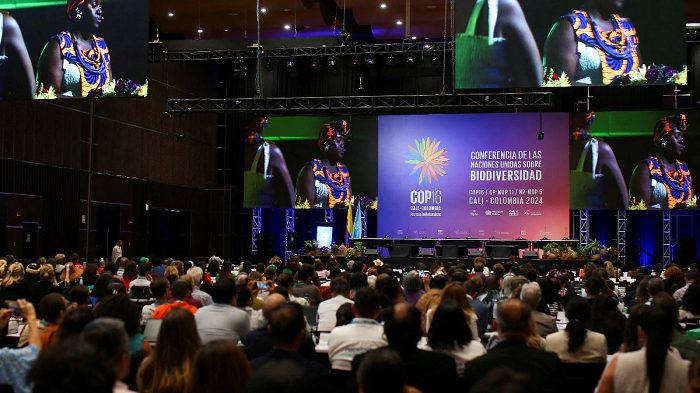
COP negotiators agreed to adopt the hard-won programme of work that relates to Indigenous Peoples and local communities. But the delegates stopped short of approving the creation of a subsidiary body that would allow organisations representing the communities to influence the implementation of the Kunming-Montreal Global Biodiversity Framework.
“We welcome this first step in recognition of our role in protecting most of what remains of biodiversity, but there is still much work to be done before we have a level playing field,” said Joseph Itongwa, Coordinator, Network of Indigenous Peoples and Local Communities for the Sustainable Management of Forest Ecosystems (REPALEF), Democratic Republic of Congo. “We need the subsidiary body to be approved now, before we leave Cali. We can work out the details between now and the next biodiversity COP. But there is no time to lose.”
The decision is supposed to come later today, when negotiators will release their final text and bring the conference to an end.
Friends in high places
During the course of the UN conference, scientists, top UN officials and more than 16 national governments spoke in favour of the subsidiary body to support Indigenous peoples and their demands, within the Convention on Biological Diversity (CBD).
At an official press briefing at the COP this week, UN Secretary General Antonio Guterres called Indigenous peoples “guardians of our nature,” noting that their traditional knowledge ‘offers essential insights for biodiversity conservation, yet they are too often marginalised or threatened.”
Guterres called for the establishment of this body “to ensure Indigenous voices are heard throughout policy-making processes…’Peace with nature means peace for those who protect it,’” he said.
Indigenous leaders at COP warn of need to heed the science
During their long days in Cali, Itongwa and other Indigenous leaders have called on UN negotiators to act on evidence suggesting that Indigenous and local communities are vital to addressing climate change, biodiversity loss, pandemic risk, threats to food security and the extinction risk that endangers thousands of species.
“If our rights are not strongly defended in every relevant target of the biodiversity framework, our people will be kicked off our lands to benefit powerful interests seeking to enrich themselves, whether their goal is conservation or development,” said Cristiane Julião of the Pankararu people in the Brazilian Northeast and a leader with the Articulation of Indigenous Peoples of Brazil (APIB).
UN climate scientists already have shown that Indigenous communities and their territories are at risk of displacement from investments aimed at reducing climate emissions.
“There can be no funding to promote so-called green solutions if they do not respect our rights,” said Dinamam Tuxá, of the Tuxá Peoples of Brazil, a lawyer and executive coordinator of APIB. “My own community was displaced to build a hydroelectric plant, and I know firsthand how green solutions can turn red when done violently, displacing and causing harm to our communities, disregarding our role as guardians.”
“Without our presence as participants, investing our knowledge and our ability to monitor and protect our lands, there is no guarantee that the COP’s goals can be achieved, putting all of humanity at risk.”
DSI tied to traditional knowledge cannot escape its roots
Concerns regarding the use of genetic resources based on traditional knowledge rate high among the Indigenous leaders who attended the COP, particularly when the resources are turned into digitised genetic sequences or DSI (Digital Sequence Information) “that almost exclusively benefit rich economies.”
“Indigenous people are not opposed to DSI, but we have not been properly briefed on what it means and the extent to which its management will be based on our values,” Julião said. “Yes, we must fairly and equitably benefit from the sharing of our knowledge, but this is not a question of money alone. Regardless of the form those biodiverse genetic resources take, however science transforms them, there must be recognition that they came originally from uses that have evolved over centuries, guided by spiritual forces that science cannot explain.”
Protected areas need their protectors
A paper commissioned by the High Ambition Coalition in 2020 suggested that expanding protected areas to cover 30 percent of the planet by 2030 would require increasing “the area recognised as lands of Indigenous Peoples and local communities by between 63% and 98%, depending on the scenario.”
The authors also concluded that communities occupying those lands – as central holders of rights and knowledge – should be involved strongly “in the decision-making processes about whether an area should be formally protected at all (based on the principle of Free Prior Informed Consent).”
But such language is currently missing in Target 3 of the Convention, which seeks to conserve 30 percent of the Earth’s land and seas by 2030.
“As of now, there is no indicator for Indigenous territories and for ensuring our land rights and free, prior and informed consent,” said Oswaldo Muca Castillo, general coordinator of OPIAC, the organisation that represents the Indigenous Peoples of the Colombian Amazon. “We demand that this debate remain open for the next biodiversity COP in two years. You can’t talk about us and say we are the best protectors and then leave our role and our rights out of the text of the agreement.”
Place rights of communities at centre of all relevant biodiversity targets
Amid some uncertainty regarding what the final outcome would be, Indigenous leaders from Africa, Latin America and Southeast Asia called on parties to the CBD to recognise the role of communities and the vital need for their rights and participation to be included in all relevant biodiversity targets.
“States cannot achieve the biodiversity goals they have set forth without respecting Indigenous rights and supporting our work, and yet, governments continue to favour industry and agriculture, while failing to enforce or recognise our rights. Humanity will pay the price,” said Monica Ndoen an indigenous woman leader from Rote, East Nusa Tenggara, Indonesia, and currently the Special Envoy to the Secretary-General of Aliansi Masyarakat Adat Nusantara (AMAN).
According to the world’s top biodiversity scientists, Indigenous peoples and Afro-descendant and other local communities outperform other managers of carbon-rich ecosystems that are vital to the battle against both climate change and biodiversity loss.
“Indigenous lands have proven to store the most carbon and represent some of the most biodiverse regions in the world,” said Kleber Karipuna, Indigenous leader of the Karipuna people of Brazil; executive coordinator for APIB, and representative of COIAB, the organisation coordinating the Indigenous organisations of the Brazilian Amazon.
“Our communities have lived on these lands and kept them whole. We appreciate the interest in keeping our territories intact to address both the climate crisis and the biodiversity crisis. But for our role to be effective, our rights must be respected.”
Earlier this week, Joseph Itongwa took part in a session where researchers cited the role of deforestation in fuelling spillover of viruses in the wild into domestic animals and eventually infecting humans.
Looking out at an audience of public health experts, Itongwa invited them to advocate for the land rights of Indigenous Peoples and local communities as a health solution.
“We are ready to be of service,” Itongwa said. “Science says we are the best at protecting forests, which allows us to prevent climate change and biodiversity loss. And now we know we can also protect human health.”


