

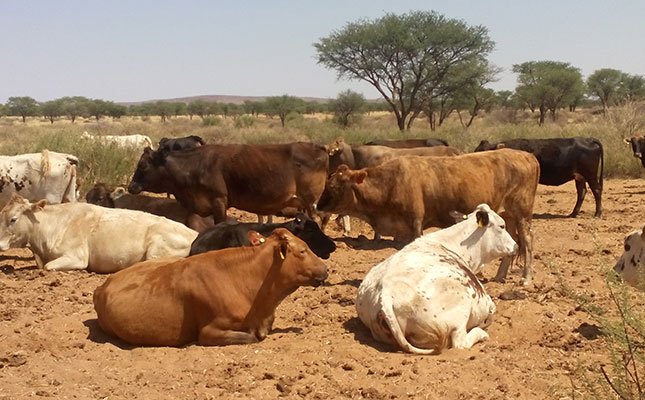
South Africa’s escalating foot-and-mouth disease (FMD) outbreak has now been formally classified as a national disaster under Section 23 of the Disaster Management Act (No. 57 of 2002).


– ADVERTISEMENT –
On paper, the move signals urgency. In practice, it raises sharper questions about control, accountability and capacity, and whether government is stepping in to strengthen the response, or centralising authority without solving structural weaknesses.
The classification, signed by the National Disaster Management Centre, places primary coordination responsibility on the National Executive. But it is not a declaration of a national state of disaster under Section 27. That distinction matters.
There are no automatic emergency regulations; no immediate compensation framework; and no funding package announced alongside the declaration.
So what exactly changes?
A serious signal, but what follows?
By classifying FMD as a national disaster, government acknowledges that the outbreak has exceeded provincial containment capacity. The livestock sector, a critical contributor to food security, rural employment and export earnings, is under pressure.
AgriSA has welcomed the declaration. In a press release dated 12 February, CEO Johann Kotzé described it as recognition of the “serious biosecurity threat facing South Africa’s livestock sector” and the “profound economic, food security and trade implications of the outbreak”.
But Kotzé’s support is conditional.
“AgriSA’s expectation is that this step creates the enabling regulatory environment required for a better coordinated national response,” he said in the press release.
In other words, the declaration must unlock operational effectiveness, and not simply add another reporting layer.
Kotzé warned that farmers across affected regions are already facing “significant financial strain” due to movement restrictions, delayed market access, and escalating biosecurity costs. The economic consequences, he said, extend beyond the farm gate into small towns and value chains dependent on livestock activity.
Yet the declaration itself contains no immediate financial safety net.
The capacity question: theoretical vs practical
For TLU SA, the declaration makes sense in principle, but implementation remains the real test.
“Theoretically, the disaster declaration is the right thing to do,” TLU CEO Bennie van Zyl told Farmer’s Weekly. “If the right controls, the right mechanisms, the right state support from a variety of departments are relocated to such a disaster situation, there should be more capacity to address the crisis.”
But then comes the question that haunts the industry: does that capacity exist?
Van Zyl pointed to broader concerns about state competence across municipal, provincial and national structures. Deploying police or the defence force for movement control may strengthen enforcement, he argued, but it does not automatically improve veterinary response or vaccine roll-out.
“The crisis is now,” he said. “There is no time for opinions next week. We need to get vaccines into cattle as soon as possible.”
TLU SA has long argued that greater private-sector involvement should be formally enabled under Section 10 provisions, allowing industry expertise and logistical capacity to supplement state systems in a regulated manner.
“We want to do it in a regulated way, but we must bring joint national capabilities to the table,” Van Zyl stressed.
Farmers welcome it, but don’t call it a game changer
In an interview with Farmer’s Weekly, Dr Theo de Jager of the Southern African Agri Initiative (SAAI) described the declaration as “a small step in the right direction”, but not the breakthrough some might portray it as.
“Most farmers would welcome the declaration,” he said. “But this is not the game changer.”
Unlocking resources from departments such as police, defence or traffic authorities may assist with movement control, De Jager noted, but it does not address what he calls the core problem: vaccine procurement and distribution capacity.
He questioned whether centralised state procurement is the most effective model under current conditions.
“If President Cyril Ramaphosa really wanted to announce a game changer, he should have announced that the state would do oversight, that they would monitor every dose that comes into the country and report to the World Organisation for Animal Health, like Brazil did before regaining its FMD-free status,” De Jager said.
He argued that government should consider delegating the packaging, importation and storage of FMD vaccines, as well as application logistics, to the private sector under strict monitoring. 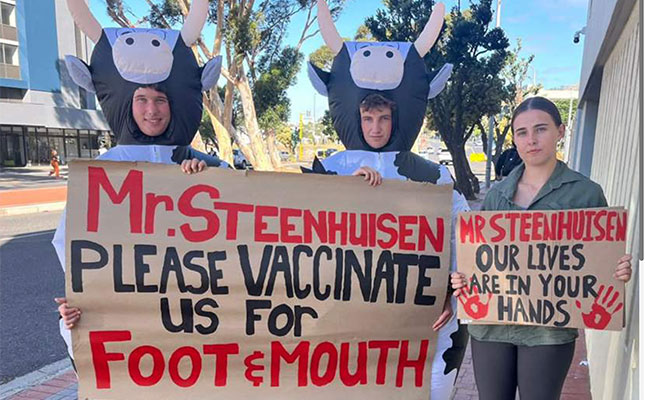
At the heart of SAAI’s criticism lies a trust deficit. De Jager pointed to previous delays in strain submissions to international reference laboratories, confusion around vaccine approvals, and perceived inconsistencies in engagement with industry experts.
Farmers, he said, struggle to see how the same structures that presided over earlier missteps can now deliver rapid containment without reform.
Central command vs industry experience
For years, organised agriculture has operated as an operational partner in outbreak response, disseminating biosecurity protocols, coordinating communication and supporting surveillance efforts.
The national disaster classification shifts the centre of gravity toward cabinet-level coordination.
That could streamline decision-making and elevate urgency. But if centralisation sidelines experienced industry networks, or fails to address veterinary staffing, vaccine supply and traceability gaps, it risks becoming administrative rather than transformative.
Export pressure and market reality
The declaration also sends signals to trading partners. On the one hand, it demonstrates political seriousness. On the other, it confirms that the outbreak has escalated.
Export markets measure credibility through transparency, rapid containment and institutional reliability.
Without clear benchmarks for vaccination targets, staffing expansions, and procurement timelines, the industry remains in a state of managed uncertainty.
The real test
The disaster classification can become:
- A turning point that accelerates coordinated containment
or - A bureaucratic overlay that increases compliance burdens without strengthening veterinary capacity
AgriSA has committed to engaging government and reviewing regulations as published. TLU SA calls for urgency and regulated private-sector participation. SAAI questions whether centralised procurement without reform will deliver action with the speed required.
All three organisations, despite differences in tone, converge on one core issue: capacity.
For farmers on the ground, the immediate reality remains unchanged: more compliance; more movement control; and more uncertainty.
What has changed is the political temperature. The outbreak is no longer a provincial management issue, but a national governance test. And the livestock industry will measure this declaration not by its wording, but by the speed at which vaccines move, veterinarians deploy, and export confidence returns.
Get trusted farming news from Farmers Weekly in Google Top Stories.
➕ Add Farmers Weekly to Google
✔ Takes 10 seconds · ✔ Remove anytime



