

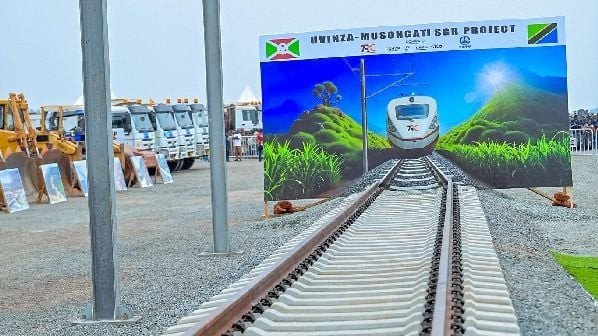
The foundation stone was laid on Saturday by Tanzanian Prime Minister Kassim Majaliwa, marking a milestone in regional integration and transport modernization.
Prime Minister Majaliwa assured citizens that work would begin on schedule, stressing the railway’s potential to transform regional trade and travel.
“Once completed, passengers will be able to travel from Musongati to Dar es Salaam in a single day. Currently, cargo trucks take up to 96 hours to reach Bujumbura from Dar es Salaam. With the railway, that journey will be reduced to just 20 hours,” he said.
Burundian President Évariste Ndayishimiye described the SGR as a long-awaited dream for his country, highlighting its role in unlocking mineral wealth and boosting connectivity.
“Many asked how we would transport the minerals. This railway is the answer,” he said, adding that the line will enhance cross-border trade, lower transport costs, and link landlocked Burundi to global markets through Dar es Salaam.
A key transformative feature of the project is the sharp cut in transit time and costs. Tanzania’s Transport Minister, Prof. Makame Mbarawa, noted that shipping a 20-foot container will drop from $3,800 to about $2,000. He added that a single train will carry up to 3,000 tonnes of cargo, compared to just 30 tonnes by road.
Another Major Chinese-Backed Project in Africa
Construction is being spearheaded by China Railway Group Limited (CREC), one of the world’s largest contractors and a dominant force in China’s construction sector.
Over the years, CREC has built a strong presence on the continent, executing large-scale transport and development projects in countries such as Angola, Mali, Nigeria, and Senegal.
According to Lin Xiaotong, a representative of CREC, the cross-border line will be built to the 1,435 mm international standard gauge with full electrification and is expected to be completed by 2030.
Regional analysts say the project could reshape East Africa’s logistics landscape by reducing dependence on expensive road transport and significantly cutting delivery times.
For Burundi, one of Africa’s most isolated economies, the SGR promises better market access and new opportunities for industrial growth, particularly in exploiting its vast nickel reserves.
For Tanzania, it strengthens its strategy to modernize national transport and consolidates its role as a transit hub linking landlocked neighbors to the Indian Ocean.


