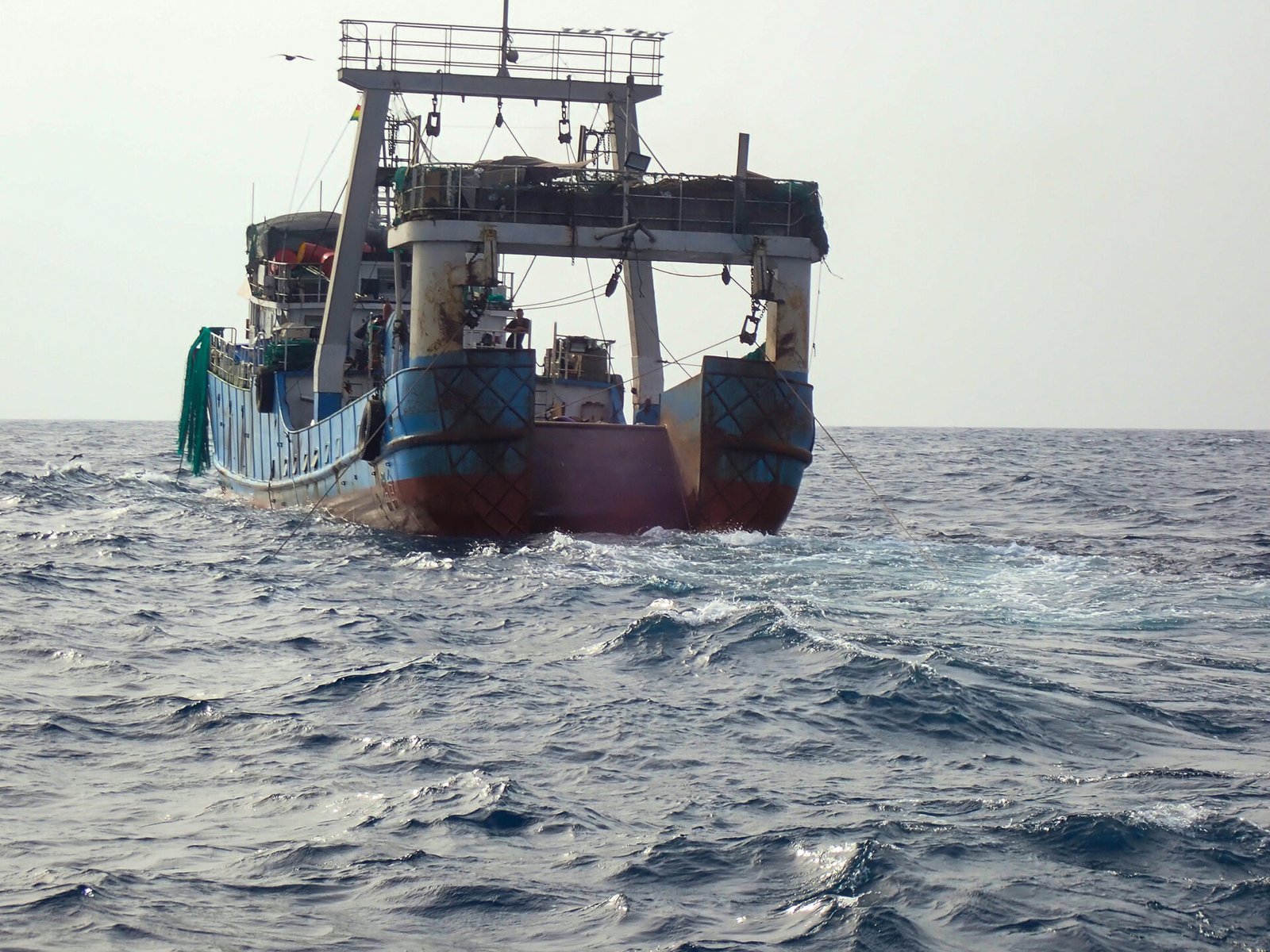
Chinese-owned vessels continue to threaten fisheries and livelihoods in Ghanaian waters, despite the country’s successful crackdown on transshipment at sea — a form of illegal, unreported and unregulated (IUU) fishing known locally as saiko. A new investigation has found that Chinese industrial trawlers in Ghana are modifying their nets to deliberately and systematically target small, juvenile fish.
By catching undersized fish, the trawlers undermine the sustainability of marine populations in the region’s ecosystems, threatening the livelihoods of communities that rely on fishing to survive. By freezing the small fish into blocks and selling them to local fishermen, Chinese companies have created a secondary revenue stream.
In a February 4 report, the Environmental Justice Foundation estimated that as much as 60% of fish caught by trawlers are undersized pelagic fish, which are easier to catch than deep-water species.
“The use of illegal fishing gear by trawlers results in large volumes of bycatch, known locally as logo fish — juvenile and undersized fish, including small pelagic fish like sardinella and chub mackerel, and species of little to no commercial value, which are either discarded or sold to coastal communities for profit,” the report stated.
Only artisanal fishers are allowed to catch pelagic fish in Ghana’s open waters. In investigating the country’s fishing industry, the foundation has reported that about 90% of its industrial trawling fleet is owned by Chinese corporations using local “front” companies to register as Ghanaian and circumvent the law. As these large commercial vessels continue to haul in logo, they deprive local fishing communities of revenue. The average annual income of Ghana’s 100,000-plus artisanal fishermen has dropped by as much as 40% per canoe in the past 15 years or so, according to the foundation.
China operates the world’s largest distant-water fishing fleet and is the world’s worst illegal fishing offender by far, according to the IUU Fishing Risk Index. Eight of the world’s top 10 companies engaged in illegal fishing are from China. Chinese fishing ships notoriously engage in bottom trawling, dragging a huge net along the ocean floor, indiscriminately scooping up all manner of marine life. The practice kills juvenile fish, leading to declining fish stocks, and destroys ecosystems critical to the survival of marine life.
Operators of the Chinese trawlers have incorporated the trade of frozen slabs of logo into their business model to maximize profit, EJF chief executive officer and founder Steve Trent said.”
“While the transshipments at sea have all but stopped, frozen fish slabs continue to be bought from the trawlers at port,” he wrote in a February 9 article for Oceanographic Magazine’s website. “This systematic extraction is accelerating the collapse of Ghana’s small pelagic fishery, undermining artisanal livelihoods, raising local fish prices and deepening inequality across coastal communities.
“Compounding the damage, a significant share of profits appears to flow to foreign, primarily Chinese, beneficial owners, draining value from Ghana’s economy at a time of mounting social and ecological crisis.”
In its investigation, the foundation interviewed 58 trawler crew members and 87 fishers, processors and sellers. It found that 70% of interviewed crew members admitted to fishing with a modified net intended to prevent the escape of small pelagic fish and maximize bycatch.
It also estimated that between 53% and 60.5% of all fish landed by trawlers are bycatch, which far exceeds the 15% bycatch allowance authorized by the Ghanaian government.
Ghanaian President John Mahama promised better days ahead when he signed the Fisheries and Aquaculture Act on November 21, 2025. It expanded the inshore exclusive zone, the waters reserved for artisanal fishers, from 6 nautical miles to 12.
“This area will serve as a sanctuary for rebuilding fish stocks, protecting biodiversity and ensuring a long-term ecological balance of our ocean,” he said in a speech in Accra. He added that the country’s National Blue Economy Strategy will be “built on six key pillars: Blue wealth, blue health, blue knowledge, blue finance, blue equity and blue safety and security.”
Emmanuel Arthur, secretary to the chief fisherman in the coastal town of Apam, said that if the law is implemented effectively, it will give marine ecosystems and communities like his a chance to rebuild.
“Everyone remain calm and go back to the olden ways of fishing practices our forefathers used … what they used to feed their kids, so that we can all support the ban on saiko,” he told the foundation. “The community can lead normal lives without saiko. They can go about their normal fishing practices without any issues or problems.”