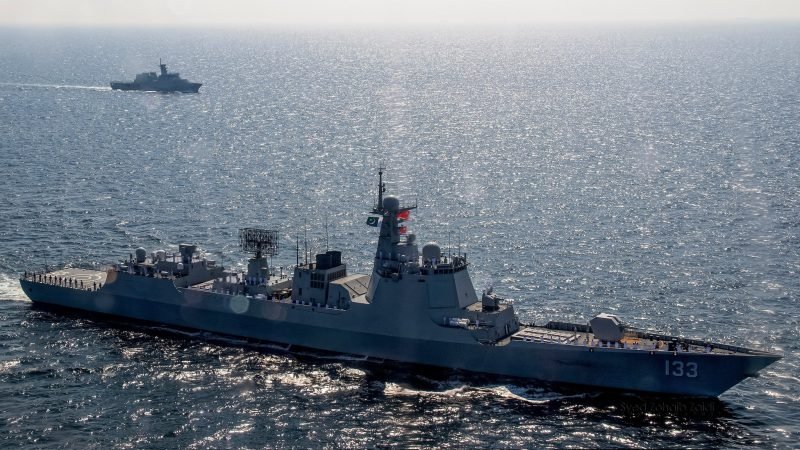
The Chinese People’s Liberation Army Navy (PLAN) guided-missile destroyer Baotou (133) arrived at the Port of Mombasa, Kenya, on October 18, 2025, for a five-day technical stop. The visit, which includes replenishment and equipment maintenance, marks the first time in nearly six years that a Chinese naval vessel has docked in the East African nation, signaling a notable re-engagement in the port.
The Baotou is a key component of the 47th Chinese naval escort taskforce, which is nearing the end of its long-duration deployment to the Gulf of Aden. According to China’s Ministry of Defence, the crew will conduct equipment inspections and prepare for subsequent tasks. The stop also serves a diplomatic function; the ship’s company will participate in courtesy calls with the Kenyan military, as well as cultural and sports exchanges.
This port call is the first by the PLAN since December 2018 and serves to reinforce the strong, ongoing relationship between Beijing and Nairobi. Kenya operates a range of Chinese-manufactured military hardware, including VN-4 armoured personnel carriers used by its police forces. The visit also carries economic resonance, as Chinese state-owned enterprises have been deeply involved in financing and constructing upgrades to the Port of Mombasa itself, a key node in the Belt and Road Initiative.
The 47th task force, which departed China in mid-December 2024, is on the concluding leg of its counter-piracy mission. After approximately ten months on station, the task force is preparing to hand over its responsibilities to its successor. The full taskforce composition is representative of a standard PLAN escort flotilla: the Baotou, a Type 052D destroyer; the Honghe (523), a Type 054A guided-missile frigate; and the Gaoyouhu (904), a Type 903A combat replenishment ship.
While the mission is formally centred on anti-piracy operations, the threat of Somali piracy has been at a historic low for several years. The mission has evolved into a persistent, blue-water presence for the PLAN. It provides invaluable long-range operational experience, protects vital sea lines of communication (SLOCs) for Chinese commerce, and serves as a visible projection of China’s maritime power in the Indian Ocean, supported by its logistics base in Djibouti.
The relief force, the 48th naval escort task force, is already en route. It set sail from a military port in Qingdao on October 11, 2025. This flotilla consists of the guided-missile destroyer Tangshan (122), the guided-missile frigate Daqing (576), and the supply ship Taihu (889). The Tangshan is a Type 052DL, an extended variant of the Baotou class, featuring a longer flight deck to accommodate new anti-submarine warfare helicopters.
The presence of Baotou itself is noteworthy. Commissioned in 2021, it is a modern Type 052D destroyer, referred to by NATO as the Luyang III-class. With a full-load displacement of approximately 7,500 tons and a length of 160 meters, the ship is a highly capable multi-role platform. It is powered by a combined diesel or gas (CODOG) propulsion system, enabling speeds up to 30 knots.
Often described as the Chinese equivalent to the U.S. Navy’s Aegis-equipped destroyers, the Type 052D is built around its Type 346A “Dragon Eye” active electronically scanned array (AESA) radar system. Its primary armament is a 64-cell Vertical Launch System (VLS), which is split between fore and aft launch modules.
This VLS is versatile and can deploy a mix of ordnance, including HHQ-9 long-range surface-to-air missiles, YJ-18 supersonic anti-ship cruise missiles, and CJ-10 land-attack cruise missiles. For terminal defence against incoming threats, the Baotou is equipped with layered systems: an HHQ-10 short-range missile launcher and a Type 1130 11-barrel 30mm close-in weapon system (CIWS).
The stop in Mombasa serves as both a logistical necessity for a crew returning from a long deployment and a clear diplomatic signal. The selection of a high-end air defence destroyer for an anti-piracy task force demonstrates the PLAN’s intent to use these rotations for comprehensive operational training. The visit to Kenya reinforces its political, economic, and military partnerships in a region critical to global maritime trade.