



China turned down Pakistan’s request for a nuclear second-strike capability earlier this year in return for a military base in the strategic port city of Gwadar.
The request was made during bilateral talks over the Chinese base interest, Drop Site revealed, citing sources.
According to the investigative outlet, Islamabad had already “privately” promised Beijing the facility in return for economic and military assistance.
The assistance has been framed as insulation against a potential US backlash in response to the decision.
It includes modernization of Pakistan’s military and intelligence capabilities to keep pace with traditional rival India.
Pakistan has strong economic ties with both the West and China and has sought to strike a delicate balance between the two.
Over a period of time, however, China has been projected as a more “natural ally” of Islamabad, necessitating greater integration with Beijing.
China is already Pakistan’s biggest monetary lender and defense supplier.
However, Islamabad’s latest request for a “second” nuclear strike capability has not gone down well with Beijing, according to Drop Site.
The chief concern over such a move is becoming a party to nuclear proliferation and potentially violating international laws.
China is classified a nuclear weapon state (NWS) under the Nuclear Non-Proliferation Treaty (NPT), which bars it from transferring nuclear weapons, technology, and material to a non-NWS state.
Despite possessing a proven nuclear arsenal, Pakistan is a non-NWS country as it is not a signatory to the NPT.
A violation of NPT could draw sanctions and economic and diplomatic consequences.
Nuclear ‘Second-Strike’ Capability
A nuclear “second-strike” capability is assured retaliation to a nuclear first strike. It is a perceived deterrence to an adversary’s attempt to win a war with a decisive first nuclear strike.
“Second strike is designed to call a bluff and check a threat,” Drop Site quoted military technology expert Kelsey Atherton as saying.
“If a country devotes significant resources to not just a nuclear arsenal, but a nuclear arsenal that can still be put into use even if some of it is destroyed, then the stakes of a first strike become too high to contemplate.”
Pakistan’s quest for the second-strike capability has been reported soon after India’s recent testing of a submarine-launched nuclear capable ballistic missile (SLBM).
The 3,500-kilometer- (2,175 miles) range K4 SLBM was tested from the newly-commissioned INS Arighat, which is the country’s second indigenous nuclear ballistic missile submarine.
An SLBM is considered the most reliable “second-strike” capability as it remains hidden from adversaries’ sensors for a longer duration, unlike the other branches of the nuclear triad: land-based nuclear missile and air-launched assets.
The K4 is capable of striking all of Pakistan and most of China. A longer-range K5 is also expected in the coming years with a range of 5,000 kilometers (3,107 miles).
Another mode of second strike could be a hardened underground silo, which could withstand even a nuclear strike.
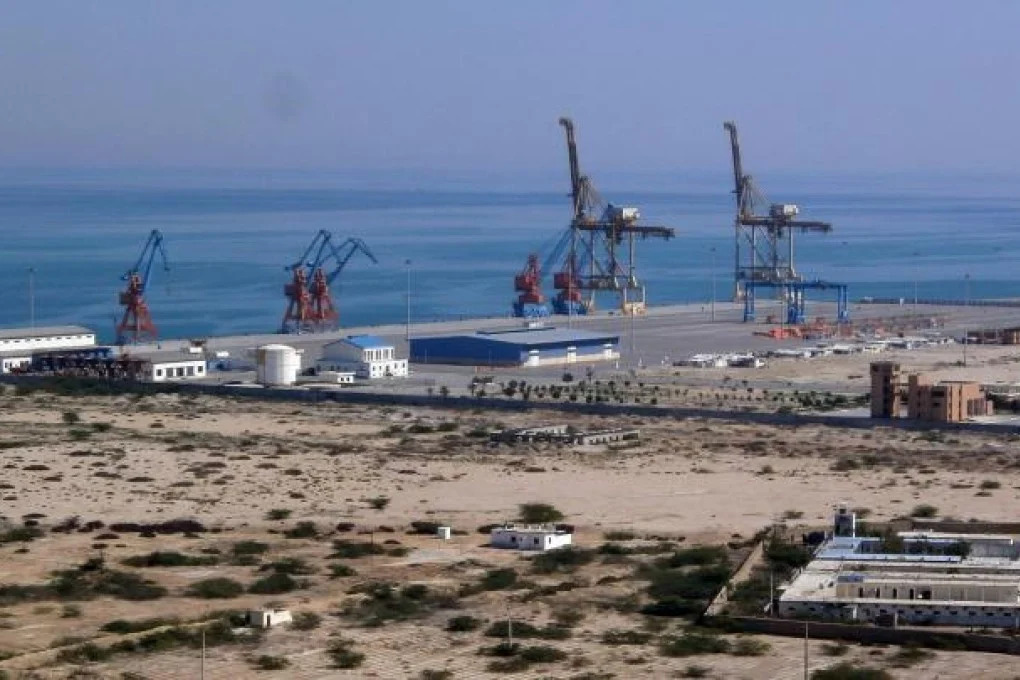
Gwadar
China is investing billions in the South Asian country’s infrastructure as part of the China–Pakistan Economic Corridor, a key component of the larger Belt and Road Initiative.
The Gwadar deep-water port is at the end of a 3,000-kilometer (1,864 miles) land corridor connecting China’s Xinjiang province to the Arabian Sea.
The corridor is designed to allow Chinese trade to bypass the vulnerable Malacca strait, a narrow sea lane between Malaysia and Indonesia, which could be blockaded by the US Navy during a conflict.
Not just an alternative to the Malacca choke point, a militarized Gwadar could allow China to impose its own blockades on Western energy shipments in the Middle East as a tit-for-tat move.
The city lies in the restive Balochistan province, which has been beset with protests and militant attacks for years.
A large part of the backlash is against the China–Pakistan Economic Corridor, which is perceived to be aiding the siphoning off of the province’s natural resources.
Many Chinese nationals working on the project have been killed and injured in militant attacks, straining relations between the two strategic allies.



