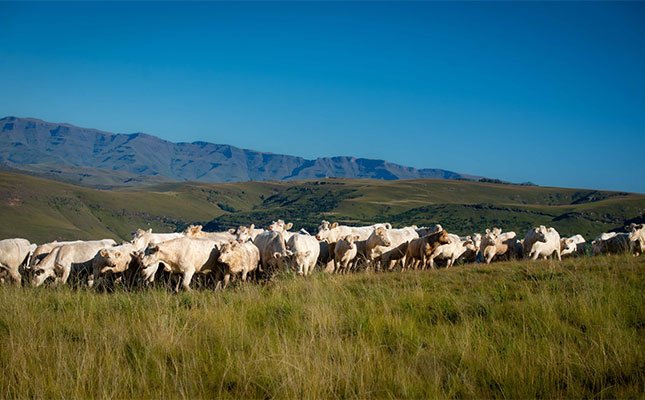
Fairbridge Agri, a mixed farming operation on the slopes of the Southern Drakensberg in the Eastern Cape, has used Charolais bulls for terminal crosses since the stud’s inception in 1979. Owner Delwyn Roberts explains their approach.


– ADVERTISEMENT –
Fairbridge Charolais was established by Roberts’s father, Bun, in Maclear and forms part of a system that includes a Brangus stud, Dohne Merino flock, and arable farming. Cattle are the main focus, with roughly 70 Charolais females used to raise bulls for the commercial herd.
Charolais bulls are mated to Brangus cows to unlock strategic benefits in a production system carefully managed for timing, genetics, and resources.
Production and management
Roberts highlights the challenges of farming between 1 250m and 2 650m above sea level: “Our properties are dotted along the Drakensberg and are largely inaccessible by vehicle.”
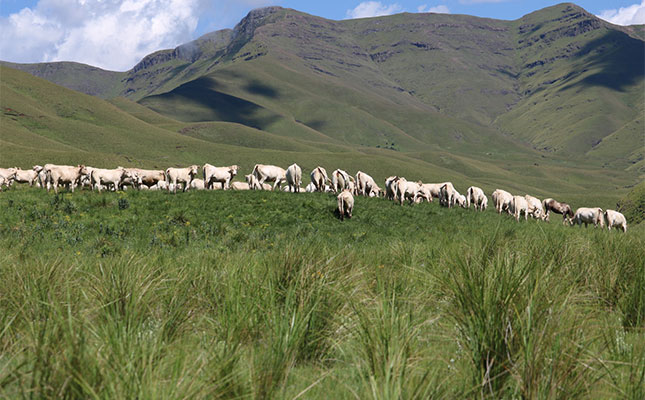
Annual rainfall ranges from 800mm to 1 200mm.
“People complain about drought, but you don’t understand how devastating it is for livestock when it rains day in and day out. They really suffer,” he adds.
The sourveld region produces high-quality spring pastures from September to December. Lick programmes start in January, with protein added via urea and built up to a full winter lick by April as rain subsides.
Production licks are fed in July and August to keep cows in optimal condition for September calving. Commercial cows are bred to Brangus bulls during the first two months of the breeding season, then to Charolais bulls in the final month to time calving strategically.
“We don’t have any calving issues with Charolais-cross calves, even though the mothers calve on veld at the end of the season, when they’re in peak condition and are expected to produce the largest offspring.
“We use Charolais as a terminal cross, as the dilution factor clearly marks the last calves born. The resulting hybrid vigour produces a heavy weaner,” explains Roberts.
Retained heifers are selected from early calvers, adding further selection pressure.
To derive maximum benefit from spring grazing, calves are backgrounded on veld until early December, when prices generally peak.
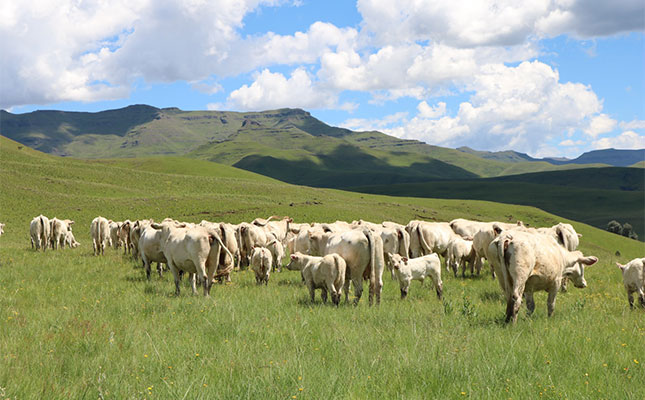
“This is where our Charolais cattle come into their own. We find that the feedlots are prepared to pay a premium for Charolais-cross calves, regardless of the proportion of Charolais in the parcel.
“As an experiment, we put Charolais bulls onto Nguni cows, and they produced uniformly yellow calves without spots, with the cows weaning up to 60% of their weight. The uniform colour is produced by a dilution factor that is unique to Charolais genetics.”
Breeding strategy
Although the South African Charolais breed is relatively small, it draws on extensive genetics from France, its country of origin, where 1,5 million breeding cows produce 20% of the nation’s beef.
More recently, Canadian genetics, which add a polled factor, have grown in popularity. Fairbridge Charolais cows are artificially inseminated annually to access this pedigree, complemented by young bulls from the herd and bulls purchased from other South African breeders.
The idea is that a minimum of three bulls are needed to make sound selection decisions.
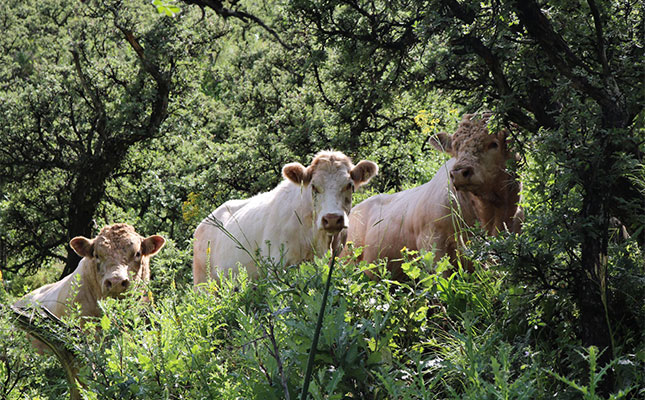
“The breed’s prepotency lets us run a relatively small herd that produces enough bulls for our purposes,” explains Roberts.
“The mountainous terrain, combined with virulent redwater and gallsickness, requires well-adapted bulls, and we see fewer losses with locally bred bulls.”
Charolais in south Africa today
The Charolais is a broad-muzzled, moderate-boned animal that adapts well to all grazing conditions. They aren’t selective grazers and distinguish less between increaser and decreaser grasses, which means they clean up a camp better than smaller-muzzled animals.
“In our experience, after years of feedlotting C-grade stock on-farm, Charolais slaughter more than 52%, compared with about 45% for smaller indigenous breeds,” says Roberts.
He feels the breed continues to move in a positive direction. “Charolais were typically larger-framed animals with heavy bone structure. The modern Charolais is fertile, calves easily, and adapts well to most conditions.”
For more information phone Delwyn Roberts on 078 835 7321.