– Advertisement –
As the global climate crisis worsens and the push for net-zero emissions grows, carbon offsetting is becoming more important.
Once seen as a side idea, it is now a key part of global climate finance.
In Nigeria, this movement is fast gaining ground.
For example, international investors, development agencies, and private companies are now expressing interest in buying carbon credits from local forest reserves, community farmlands, and conservation sites.
The Nigerian Government sees carbon trading as a crucial path to climate finance and sustainable development.
Specifically, the National Council on Climate Change (NCCC) estimates that Nigeria could earn over 2.5 billion dollars annually through a well-regulated carbon market.
Consequently, in October 2023, Nigeria launched its Emissions Trading Scheme (ETS), a crucial step in establishing a domestic carbon market that aligns with Article 6 of the Paris Agreement.
The ETS is part of the broader Nigeria Emissions Trading Framework (NETF) and seeks to regulate the sale of carbon credits by setting up rules, registries, and enforcement mechanisms.
The policy, unveiled by the NCCC, was widely lauded as a landmark in mobilising climate finance for Africa’s most populous country.
In line with this, the government signed several memoranda of understanding with international partners and began building national registries to manage transactions and ensure compliance.
However, critics say this focus on market incentives overshadows the deeper structural changes needed to tackle climate change at home.
Beneath the growing excitement, concerns are emerging over transparency, fairness, and the very idea of commodifying Nigeria’s nature in a global carbon marketplace.
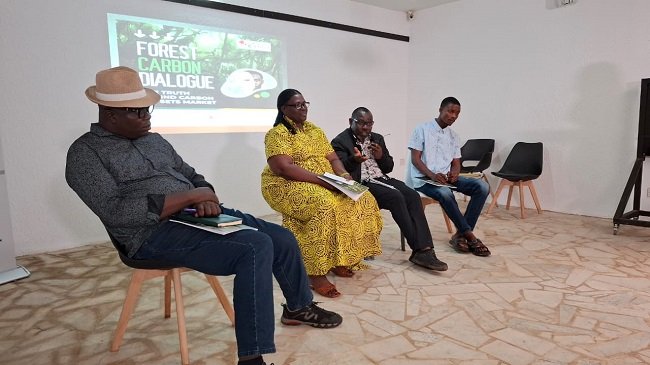
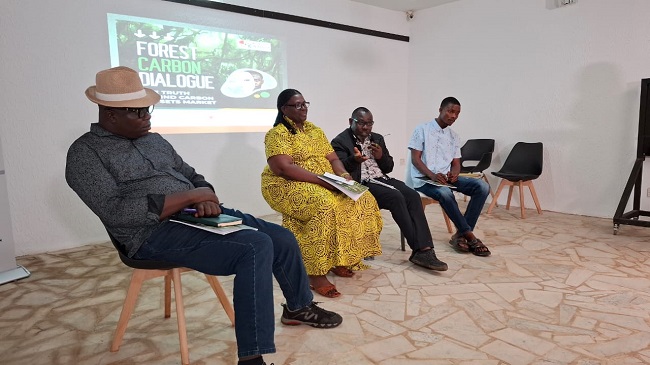
Recently, a Forest Carbon Dialogue was convened in Benin by Health of Mother Earth Foundation (HOMEF).
It brought together legal scholars, community advocates, farmers, and youth to critically examine carbon offsetting and trading in Nigeria.
Environmental justice groups, civil society organisations, and community-based advocates are raising red flags.
The gathering, themed “Beyond Carbon Offsets”, featured thought-provoking discussions on climate justice, the commodification of nature, and the risks of carbon colonialism.
They interrogated the ethics, legality, and implications of carbon trading, especially as forest-rich states like Edo, Cross River, and Bayelsa increasingly attract international offset developers.
HOMEF, one of Nigeria’s foremost ecological think tanks, considers the proposed carbon offset scheme fraught with ethical and practical concerns.
In his opening remarks, Dr Nnimmo Bassey, Executive Director of HOMEF, strongly criticised the idea behind the carbon market.
According to him, “The idea that carbon pollution can be outsourced or traded like a commodity trivialises the urgency of real climate action.
“Offsets are simply a distraction.
“They offer corporations in the Global North a license to pollute, while shifting the burden to poor communities in the South.”
Carbon offsets, in simple terms, are actions taken to compensate for greenhouse gas emissions.
Companies or countries pay for activities such as tree planting or forest conservation that supposedly absorb an equivalent amount of CO₂ from the atmosphere.
These credits are then traded or sold to “neutralise” emissions.
Nevertheless, critics argue that this market-based mechanism is dangerously flawed and susceptible to manipulation.
The dialogue further dissected the growing interest in Nigeria’s nature-based assets as a source of carbon credits, a move encouraged by the government through its ETS.
While the scheme promises climate finance and support for reforestation, HOMEF’s convening exposed a gap between policy narratives and grassroots realities.
One of the most forceful arguments at the event was the lack of transparency and community inclusion.
Speakers noted that communities are often asked to surrender land use rights through contracts they neither understand nor negotiate.
For instance, Israel Orheka, a panelist during the dialogue, traced the origins of the carbon market to the Kyoto Protocol, faulting its framework for excluding the voices of directly impacted communities.
“We were never part of the design. That’s why we are resisting it. Any solution that is not co-developed with us is a solution imposed against us,” he said.
He stressed that documents are often presented in English, filled with technical terms, and misrepresented as tree planting projects that will bring jobs.
However, years later, affected communities discover they can no longer farm or access sacred sites.
Participants also raised concerns about land grabbing.
They feared that carbon offset schemes disguised as conservation could strip communities of ancestral lands for up to 30 years, the typical duration of such projects.
Bassey warned, “We cannot allow carbon colonialism to replace crude colonialism.
“These forests, wetlands, and mangroves are not empty, they are home to livelihoods, culture, and memory. Turning them into carbon sinks for foreign companies is not climate justice”.
He also revealed that Nigeria has already lost over 90 per cent of its forest cover, with many so-called protected areas facing threats from illegal logging and mining.
He cited massive land grabs in Niger, Delta, and Cross River states, some as large as a million hectares, signed off under the guise of carbon projects.
“These deals don’t benefit our communities. In Mozambique, families were paid just 100 dollars for seven years to watch over trees.
“For the next 99 years, they were barred from farming or accessing forest resources. That is carbon slavery,” he said.
In his own views, Mr Cadmus Atake-Enade, HOMEF’s Programme Manager, Community and Culture, emphasised that every form of extraactivism affects our forest and livelihoods.
“Every form of extra activism affects our forest and livelihoods,” Atake-Enade said.
Other speakers, such as Rita Nwaka of Environmental Rights Action (ERA), challenged the idea that monoculture plantations are equivalent to forests.
She noted that forests are more than trees; they provide food, medicine, livelihoods, and cultural identity.
Therefore, she insisted that communities, not corporations, should be the rightful custodians.
She also condemned reports of militarisation and gender-based violence in areas affected by REDD+ and carbon trading projects, recounting stories of women harassed and even shot during peaceful protests.
Ultimately, the participants called for greater investment in agroecology, renewable energy, youth-led green innovation, and legal support for communities resisting unjust carbon deals.
They urged the Nigerian government to prioritise genuine emission reductions, especially in oil and gas, rather than rely on offsets that allow polluters to continue business as usual.
The dialogue concluded with a resolution: Nigeria should pause the approval of new carbon offset projects until a national framework grounded in justice, transparency, and sustainability is in place.
Furthermore, all existing projects should undergo independent audits to assess their impact on local communities.
In conclusion, as Nigeria plans to expand its carbon trading system, HOMEF and its allies have issued a clear warning.
Offsets may bring in money, but without safeguards, they could take away communities’ land, dignity, and future.
By Usman Aliyu, News Agency of Nigeria (NAN)