
Tiktok Youtube Telegram Instagram Linkedin X-twitter
  • Business
  • Markets
  • Politics
  • Crypto
  • Finance
  • Energy
  • Technology
  • Taxes
  • Creator Economy
  • Wealth Management
  • LBNN Blueprints
  • Business
  • Markets
  • Politics
  • Crypto
  • Finance
  • Energy
  • Technology
  • Taxes
  • Creator Economy
  • Wealth Management
  • LBNN Blueprints
  • Home
  • Business
  • Politics
  • Markets
  • Crypto
  • Economics
    • Manufacturing
    • Real Estate
    • Infrastructure
  • Finance
  • Energy
  • Creator Economy
  • Wealth Management
  • Taxes
  • Telecoms
  • Military & Defense
  • Careers
  • Technology
  • Artificial Intelligence
  • Investigative journalism
  • Art & Culture
  • LBNN Blueprints
  • Quizzes
    • Enneagram quiz
  • Newsletters
    • LBNN Newsletter
    • Divergent Capitalist
  • Fashion Intelligence
  • Home
  • Business
  • Politics
  • Markets
  • Crypto
  • Economics
    • Manufacturing
    • Real Estate
    • Infrastructure
  • Finance
  • Energy
  • Creator Economy
  • Wealth Management
  • Taxes
  • Telecoms
  • Military & Defense
  • Careers
  • Technology
  • Artificial Intelligence
  • Investigative journalism
  • Art & Culture
  • LBNN Blueprints
  • Quizzes
    • Enneagram quiz
  • Newsletters
    • LBNN Newsletter
    • Divergent Capitalist
  • Fashion Intelligence

Capturing the immense potential of microscopic DNA for data storage

Simon Osuji by Simon Osuji
July 17, 2023
in Technology
0
Capturing the immense potential of microscopic DNA for data storage
0
SHARES
1
VIEWS
Share on FacebookShare on Twitter

Capturing the immense potential of microscopic DNA for data storage
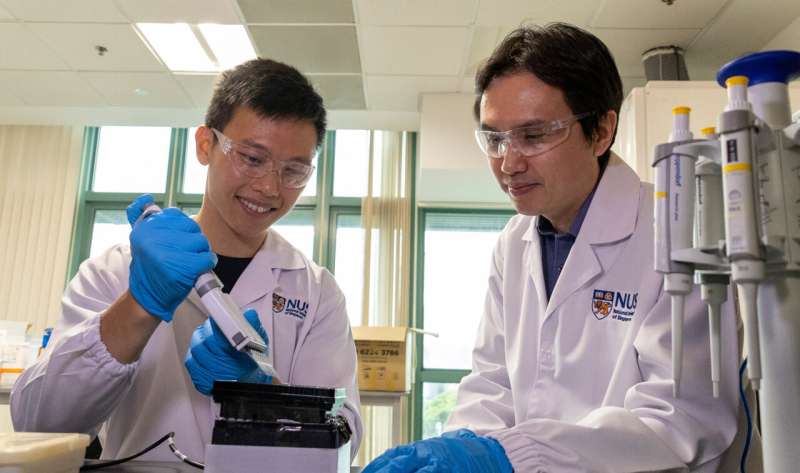
Graduate student Cheng Kai Lim (left) worked with Associate Professor Chueh Loo Poh (right) to develop a novel system which captures and stores images directly into DNA. Credit: NUS College of Design and Engineering

In a world first, a “biological camera” bypasses the constraints of current DNA storage methods, harnessing living cells and their inherent biological mechanisms to encode and store data. This represents a significant breakthrough in encoding and storing images directly within DNA, creating a new model for information storage reminiscent of a digital camera.

Related posts

Govt unveils first treatment facility to eliminate harmful chemicals, protect public health, environment – EnviroNews

Govt unveils first treatment facility to eliminate harmful chemicals, protect public health, environment – EnviroNews

December 19, 2025
Metsera strengthens case for Pfizer buyout with latest study data

Lilly obesity pill, headed for quick FDA review, hits mark in ‘maintenance’ trial

December 18, 2025

Led by Principal Investigator Associate Professor Chueh Loo Poh from the College of Design and Engineering at the National University of Singapore, and the NUS Synthetic Biology for Clinical and Technological Innovation (SynCTI), the team’s findings, which could potentially shake up the data-storage industry, were published in Nature Communications on 3 July 2023.

A new paradigm to address global data overload

As the world continues to generate data at an unprecedented rate, data has come to be seen as the “currency” of the 21st century. Estimated to be 33 ZB in 2018, it has been forecasted that the Global Datasphere will reach 175 ZB by 2025. That has sparked a quest for a storage alternative that can transcend the confines of conventional data storage and address the environmental impact of resource-intensive data centers.

It is only recently that the idea of using DNA to store other types of information, such as images and videos, has garnered attention. This is due to DNA’s exceptional storage capacity, stability, and long-standing relevance as a medium for information storage.
Capturing the immense potential of microscopic DNA for data storage
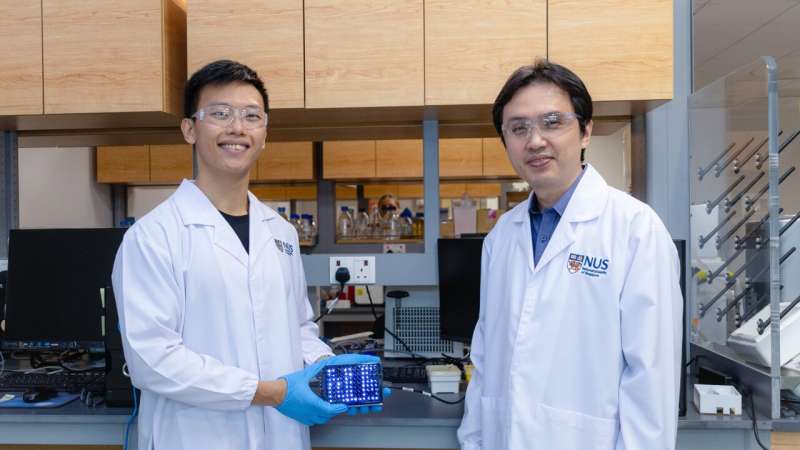
A research team led by Associate Professor Chueh Loo Poh (right) has pioneered an innovative ‘biological camera’ that harnesses living cells and their inherent biological mechanisms to encode and store data. Credit: NUS College of Design and Engineering

“We are facing an impending data overload. DNA, the key biomaterial of every living thing on Earth, stores genetic information that encodes for an array of proteins responsible for various life functions. To put it into perspective, a single gram of DNA can hold over 215,000 terabytes of data—equivalent to storing 45 million DVDs combined,” said Poh.

“DNA is also easy to manipulate with current molecular biology tools, can be stored in various forms at room temperature, and is so durable it can last centuries,” says Cheng Kai Lim, a graduate student working with Poh.

Despite its immense potential, current research in DNA storage focuses on synthesizing DNA strands outside the cells. This process is expensive and relies on complex instruments, which are also prone to errors.

To overcome this bottleneck, Poh and his team turned to live cells, which contain an abundance of DNA that can act as a “data bank,” circumventing the need to synthesize the genetic material externally.

Through sheer ingenuity and clever engineering, the team developed “BacCam”—a novel system that merges various biological and digital techniques to emulate a digital camera’s functions using biological components.

“Imagine the DNA within a cell as an undeveloped photographic film,” explained Poh. “Using optogenetics—a technique that controls the activity of cells with light akin to the shutter mechanism of a camera, we managed to capture ‘images’ by imprinting light signals onto the DNA ‘film.'”


Credit: National University of Singapore

Next, using barcoding techniques akin to photo labeling, the researchers marked the captured images for unique identification. Machine-learning algorithms were employed to organize, sort, and reconstruct the stored images. These constitute the “biological camera,” mirroring a digital camera’s data capture, storage, and retrieval processes.

The study showcased the camera’s ability to capture and store multiple images simultaneously using different light colors. More crucially, compared to earlier methods of DNA data storage, the team’s innovative system is easily reproducible and scalable.

“As we push the boundaries of DNA data storage, there is an increasing interest in bridging the interface between biological and digital systems,” said Poh.

“Our method represents a major milestone in integrating biological systems with digital devices. By harnessing the power of DNA and optogenetic circuits, we have created the first ‘living digital camera,’ which offers a cost-effective and efficient approach to DNA data storage. Our work not only explores further applications of DNA data storage but also re-engineers existing data-capture technologies into a biological framework. We hope this will lay the groundwork for continued innovation in recording and storing information.”

More information:
Cheng Kai Lim et al, A biological camera that captures and stores images directly into DNA, Nature Communications (2023). DOI: 10.1038/s41467-023-38876-w

Provided by
National University of Singapore

Citation:
Capturing the immense potential of microscopic DNA for data storage (2023, July 13)
retrieved 16 July 2023
from https://phys.org/news/2023-07-capturing-immense-potential-microscopic-dna.html

This document is subject to copyright. Apart from any fair dealing for the purpose of private study or research, no
part may be reproduced without the written permission. The content is provided for information purposes only.


Source link

Previous Post

Fans worry as Lady Zamar hints at being suicidal

Next Post

Cell-derived nanocarriers for more efficient and direct intracellular drug release

Next Post
Cell-derived nanocarriers for more efficient and direct intracellular drug release

Cell-derived nanocarriers for more efficient and direct intracellular drug release

Leave a Reply Cancel reply

Your email address will not be published. Required fields are marked *

RECOMMENDED NEWS

Robotaxi pushback grows in Los Angeles as Cruise loses permits

Robotaxi pushback grows in Los Angeles as Cruise loses permits

2 years ago
When Native American art merged with New York abstraction

When Native American art merged with New York abstraction

2 years ago
Researchers at ETH Zurich created a jailbreak attack that bypasses AI guardrails

Researchers at ETH Zurich created a jailbreak attack that bypasses AI guardrails

2 years ago
The D Brief: Israel strikes in Iran; Russia advances in Ukraine; China’s chip chokepoints; Boeing eyes space selloff; And a bit more.

The D Brief: Israel strikes in Iran; Russia advances in Ukraine; China’s chip chokepoints; Boeing eyes space selloff; And a bit more.

1 year ago

POPULAR NEWS

  • Ghana to build three oil refineries, five petrochemical plants in energy sector overhaul

    Ghana to build three oil refineries, five petrochemical plants in energy sector overhaul

    0 shares
    Share 0 Tweet 0
  • The world’s top 10 most valuable car brands in 2025

    0 shares
    Share 0 Tweet 0
  • Top 10 African countries with the highest GDP per capita in 2025

    0 shares
    Share 0 Tweet 0
  • Global ranking of Top 5 smartphone brands in Q3, 2024

    0 shares
    Share 0 Tweet 0
  • When Will SHIB Reach $1? Here’s What ChatGPT Says

    0 shares
    Share 0 Tweet 0

Get strategic intelligence you won’t find anywhere else. Subscribe to the Limitless Beliefs Newsletter for monthly insights on overlooked business opportunities across Africa.

Subscription Form
© 2023 LBNN – All rights reserved.

Privacy Policy | About Us | Contact

Tiktok Youtube Telegram Instagram Linkedin X-twitter
No Result
View All Result
  • Home
  • Business
  • Politics
  • Markets
  • Crypto
  • Economics
    • Manufacturing
    • Real Estate
    • Infrastructure
  • Finance
  • Energy
  • Creator Economy
  • Wealth Management
  • Taxes
  • Telecoms
  • Military & Defense
  • Careers
  • Technology
  • Artificial Intelligence
  • Investigative journalism
  • Art & Culture
  • LBNN Blueprints
  • Quizzes
    • Enneagram quiz
  • Newsletters
    • LBNN Newsletter
    • Divergent Capitalist
  • Fashion Intelligence

© 2023 LBNN - All rights reserved.