

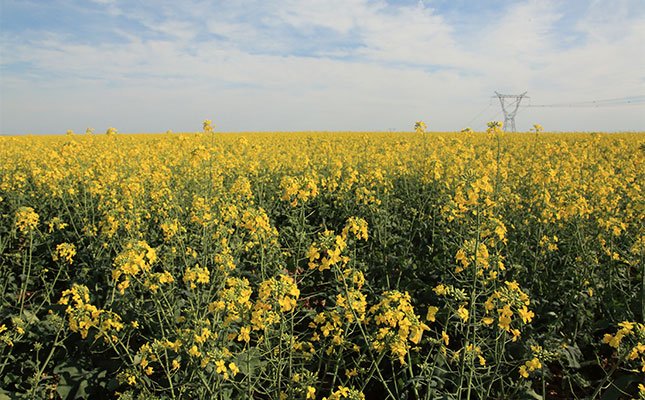
Canola producers under financial pressure this season might be tempted to cut costs by planting farm-saved seed, but this could ultimately increase their losses.


– ADVERTISEMENT –
Speaking at a recent technical information day at the Western Cape Department of Agriculture’s Langgewens Research Farm in the Swartland, Piet Lombard, scientific technician for agronomy, warned farmers against saving canola seed for replanting.
“A couple of years ago, some producers were forced to retain seed due to shortages, but under normal circumstances, this is not advisable,” he told Farmer’s Weekly.
Lombard explained that most commercially available canola cultivars are hybrids. These are produced by crossing specific ‘mother’ and ‘father’ lines to combine desirable traits such as yield potential, vigour, and disease tolerance.
“When you plant farm-saved seed from these hybrids, the next generation no longer has the same genetic combination, and you lose the uniformity and the yield advantage that you paid for in the first place,” he explained.
Even treating retained seed with fungicides will not compensate for the genetic segregation that occurs in the second generation, he added.
Research conducted at Langgewens compared six hybrid cultivars with farm-saved seed from those same cultivars. The results showed yield reductions of between 17% and 20% when farm-saved seed was planted.
Lombard said average canola yields in the Western Cape were about 1,8t/ha last year, while the break-even level was approximately 1,5t/ha. Therefore, a yield reduction of nearly 20% could push a producer from a marginal profit into a loss.
He added that the situation is often compounded by the fact that farmers who retain seed usually do so because they are under financial strain.
“In those cases, they also tend to cut back on fertilisation and crop protection to save money. That further reduces yield potential and increases the risk.”
Crop rotation is equally critical. With wheat producers under pressure after average yields of about 2,8 t/ha fell short of the 3,1 t/ha break-even level in some areas, farmers may consider expanding canola plantings – or even planting canola on canola – to improve cash flow.
According to Lombard, this is another costly mistake: “It does not matter what crop it is – wheat on wheat, maize on maize, or canola on canola. International research, as well as our own trials, consistently show that yields decline when the same crop is planted in consecutive seasons.”
In the case of canola, the crop also removes high levels of nutrients from the soil, which increases fertiliser requirements for the canola crop itself and subsequent crops in the rotation.
Under tight financial conditions, Lombard urged producers to focus on proven agronomic principles rather than short-term savings that could erode profitability even further.


