



Daniele Lantagne, a research professor at the Feinstein International Center at the Friedman School
Every day, we release clues about our health through our toilets, sinks, showers and tubs into the wastewater system. The COVID-19 pandemic spurred the rapid rise of wastewater testing, which helped health officials across the United States spot outbreaks early. Wastewater testing offers a real-time, non-invasive way to estimate how many people may be affected by a health condition in a community. But this powerful tool only works where modern sewer systems exist – even though the next pandemic could begin anywhere. To help fill this gap, researchers from the Gerald J. and Dorothy R. Friedman School of Nutrition Science and Policy at Tufts University, Cummings School of Veterinary Medicine at Tufts University, and Tufts University School of Medicine teamed up with international collaborators to see whether wastewater testing could work in places without modern plumbing. In a new study published in PLOS Water, the team showed that they could detect signs of disease in wastewater flowing through open channels in two urban neighbourhoods and a poultry market in West Africa. Daniele Lantagne, a research professor at the Feinstein International Center at the Friedman School and the study’s senior author, recently discussed why making wastewater surveillance more accessible matters.
What is wastewater surveillance, and how does it work?
Most people first heard about wastewater surveillance during the COVID-19 pandemic, when it helped public health officials track outbreaks. But the idea has been around much longer. For example, the Global Polio Eradication Initiative has used it to confirm that countries are free of polio, and even law enforcement has tapped it to trace illegal drug production. Today, across the United States, sewage from many cities and towns will flow into a single wastewater treatment plant. Giant pipes carry this wastewater in, and special devices can take small samples from these pipes every few minutes.
Health officials may have only tested for the virus that causes COVID-19 at first. But now many regions also test for viruses that cause flu and RSV, and other pathogens.
What problem were you trying to solve in your new study?

Cote d’Ivoire
laboratory staff set
up a passive sample
of water runoff from
cleaning poultry at an
urban market
In wealthier countries like the United States, wastewater testing works because we have pipes and treatment plants that collect sewage in one place. That makes it easy to sample and test the water. But around the world, more than 3.5 billion people don’t have access to this kind of safely managed sanitation. Waste often ends up in open drains or pits, so the usual wastewater testing methods just don’t work.

Our team wanted to find out if we could make this tool useful in places without modern plumbing and sewer systems. That meant figuring out where to collect samples, what diseases to test for, and how to train local teams to do the work themselves.
So, what did your team find?
We focused on two kinds of high-risk places in Côte d’Ivoire in West Africa: Open wastewater channels from crowded urban neighbourhoods and water used to clean poultry in local markets. We wanted to see if we could detect two major threats: SARS-CoV-2, the virus behind COVID-19, and influenza A, a virus that causes bird flu. Over 12 weeks, we collected samples and had them tested in local labs. Nearly half of the human wastewater samples showed signs of COVID-19, and we found flu virus in some of the poultry wastewater. What’s exciting is that this is one of the first times wastewater surveillance has been used in such low-resource settings. We also trained local scientists and proved that this kind of testing can work – even without expensive infrastructure.
Why does this matter?
Infectious diseases don’t respect borders. If a dangerous virus like Ebola emerges in Côte d’Ivoire, it’s just one plane ride away from another country. As people move into previously remote areas, we’re seeing more chances for new diseases to jump from animals to humans.
Catching those threats early – right where they begin – is the best way to prevent them from spreading. That’s why the U.S. has long invested in public health systems around the world. Wastewater surveillance is another smart tool in that toolbox.
How else should we tap the power of wastewater testing?
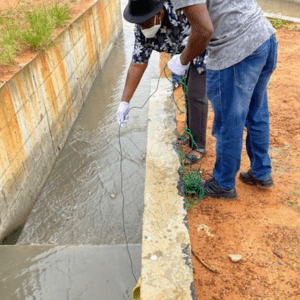
Laboratory staff undergo biosafety training on sampling collection procedures at the
waste discharge area of a rural hospital
We need to keep asking when wastewater testing will make the most impact. It’s especially useful in places where diseases spread silently – when people don’t show symptoms or can’t access testing. For example, Lassa fever, a disease carried by rats in West Africa, is likely far more widespread than we realise. It often looks like malaria, so it’s frequently misdiagnosed. And while many people have mild symptoms, others get very sick with severe haemorrhagic illness – similar to Ebola – and die. Wastewater could help track its true spread. In fact, during our study, we were about to test wastewater from a rural hospital in Côte d’Ivoire, where all the waste flows untreated into a nearby forest. We expected to detect the Lassa virus – which the hospital can’t test for – but the project was cancelled due to federal budget cuts affecting our funder, the U.S. Agency for International Development (USAID). That kind of setback shows why we need more support to prove that viruses like Lassa can be detected in wastewater using low-cost, locally available tools. By Tufts University, originally published by Newsline


