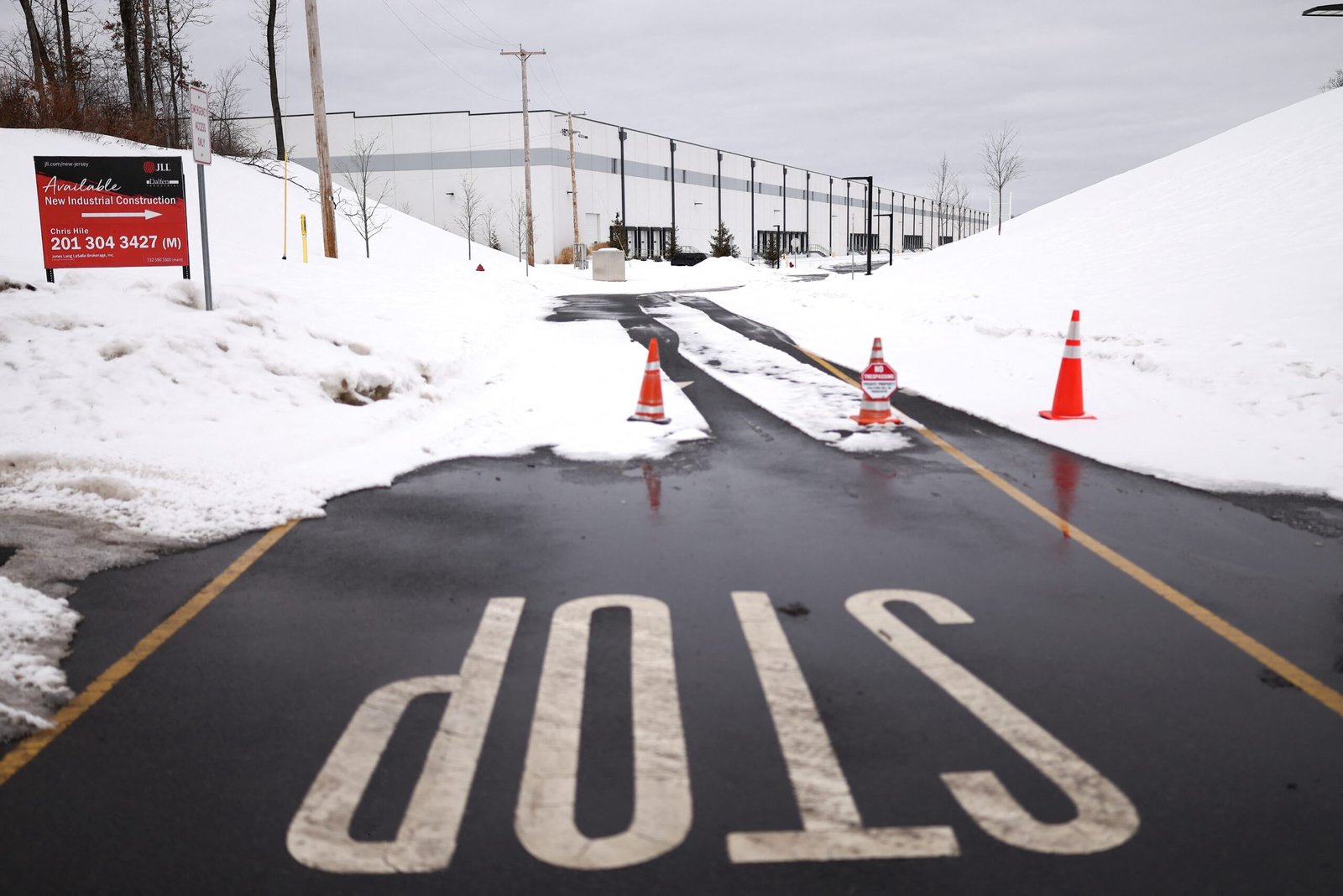

The scale of the Trump administration’s plans to warehouse human beings is hard to fathom. Here’s one way to put it in perspective: On a given day, New York City’s notorious Rikers Island jail complex holds approximately 7,000 detainees. President Donald Trump’s regime, which is currently holding a record 70,000 people in immigration detention, now plans to develop a network of Rikers-sized concentration camps for immigrants nationwide.
The Department of Homeland Security is racing to buy up and convert two-dozen-plus warehouses into mass detention centers for immigrants, some capable of holding up to 10,000 people. According to documents released last week, Immigration and Customs Enforcement expects to spend $38.3 billion acquiring warehouses across the country and retrofitting them to collectively hold nearly 100,000 beds.
“If these mega-camps are utilized to the full capacity ICE intends, they’ll be the largest prisons in the country, with little real oversight,” noted Aaron Reichlin-Melnick, senior fellow at the American Immigration Council. “The federal government hasn’t operated a prison camp inside the United States that large since Japanese Internment.”
When Trump’s border czar, Tom Homan, last week announced that ICE’s “surge” in Minnesota would wind down, it marked a significant victory for the thousands of Minnesotans who have fought back against the federal forces terrorizing their state; resistance forced the Trump regime to change its plans. But nothing is ramping down when it comes to the deportation machine at large. When billions of dollars are spent to turn industrial spaces into detention camps, authoritarian desires meet market logic: The warehouses must be filled.
Local communities are nonetheless pushing back, even in the face of seemingly insurmountable federal forces with unlimited funding, abetted by powerful private interests who stand to gain from this carceral build-out.
As The Appeal reported last week, investors on a recent quarterly earnings call for private prison giant CoreCivic were worried that ICE’s unprecedented detention numbers were still not high enough. “I think people thought we’d be at that 100,000 level,” one caller reportedly said of the number of people currently held by ICE. “We’re at a little over 70,000.”
The Trump administration has made clear that it can afford anything when it comes to the rounding up and brutalizing of immigrants and antifascist protesters.
The company’s CEO stressed the major financial gains made though Trump’s anti-immigrant campaign and assured callers that the drawdown in Minnesota did not, in his view, portend “meaningful changes in enforcement style or approach.” That is to say, the racial profiling, cruelty, and mass roundups will continue, and private prison corporations like CoreCivic and Geo Group, alongside giants of surveillance infrastructure like Palantir, will collectively make billions from DHS spending. What author John Ganz has called “ICE’s function as an employment program for the Trumpenproletarian mob” — now with 22,000 officers — will also continue to be handsomely funded.
None of this is a surprise: When Congress passed Trump’s One Big Beautiful Bill Act allocating ICE nearly $80 billion in multiyear funding, the administration made clear that money would be no object in enacting its project of ethnic cleansing and the expansion of the carceral system for targeted groups of immigrants and opponents. The warehouse purchases and related government contracts have, as The Lever reported, been a boon for Trump-connected real estate brokers and a bailout for “commercial real estate owners, who have struggled to sell their properties over the past year under the weight of macroeconomic headwinds and Trump’s tariff war.”
Economic stimulus based in ethnic cleansing would, of course, be despicable. But the Trump regime can’t even pretend this dizzyingly expensive project serves its own base. Only a small number of interested businesses and parties stand to gain. Meanwhile, as public resistance in both Republican- and Democratic-majority locales has already made clear, everyone else stands to lose. And hundreds of thousands of our immigrant neighbors stand to lose the most.
Trump’s mass deportation plan is estimated by the libertarian Cato Institute to have a fiscal cost of up to $1 trillion over a decade. And the losses? Due to the loss of workers across U.S. industries, the American Immigration Council found that mass deportation would reduce the U.S. gross domestic product by 4.2 to 6.8 percent. It’s money that could be spent improving our collective lives. The $45 billion total budgeted for ICE detention centers is nearly four times the $12.8 billion the U.S. spent on new affordable housing in 2023. The huge budget for ICE mega warehouses reflects the most Trumpian mix: cronyist dealmaking in service of white nationalism.
The historian Adam Tooze has at various points recalled the words of economist John Maynard Keynes, who said in 1942 that “anything we can actually do we can afford.” Keynes was arguing that sovereign governments have extraordinary capacity to mobilize finances; the constraints lie elsewhere. Tooze has stressed that the limits of what a government can “actually do” are political, technical, material, and logistical — and extremely complicated as such. But, he points out, they are not budgetary. The Trump administration has made clear that it can afford anything when it comes to the rounding up and brutalizing of immigrants and antifascist protesters. That, however, does not mean the government can actually do everything it wants.
A number of warehouse owners, facing local backlash and pressure, have already backed out of lucrative sales to ICE. According to Bloomberg, Canadian billionaire Jim Pattison’s company announced that a transaction to sell a 550,000-square-foot warehouse in Ashland, Virginia, “will not be proceeding.” The company made clear that the move was political, saying, “We understand that the conversation around immigration policy and enforcement is particularly heated, and has become much more so over the past few weeks. We respect that this issue is deeply important to many people.”


For ICE, money is no object. But constant and relentless public protest, blockades, boycotts, and local government pressure significantly lessen the appeal for warehouse owners and potential contractors to do this fascist work.
Deals for warehouses near Kansas City, Oklahoma City, Salt Lake City, and Byhalia, Missouri, have also fallen through. In each case, warehouse owners faced protests and mounting pressure. In some jurisdictions, backlash to ICE warehouses have come in the worst sort of NIMBY variety — including complaints from Republicans who do not want immigrant detainees brought to their town en masse. Concerns about water and sewage systems and economic strains in remote areas also abound. But if local self-interest becomes a barrier to the expansion of Trump’s deportation regime, that’s no bad thing, given the urgent need to hold back Trump’s deeply unpopular but otherwise unrestrained forces.
We need every possible limit on what Trump and his loyalists can actually do.