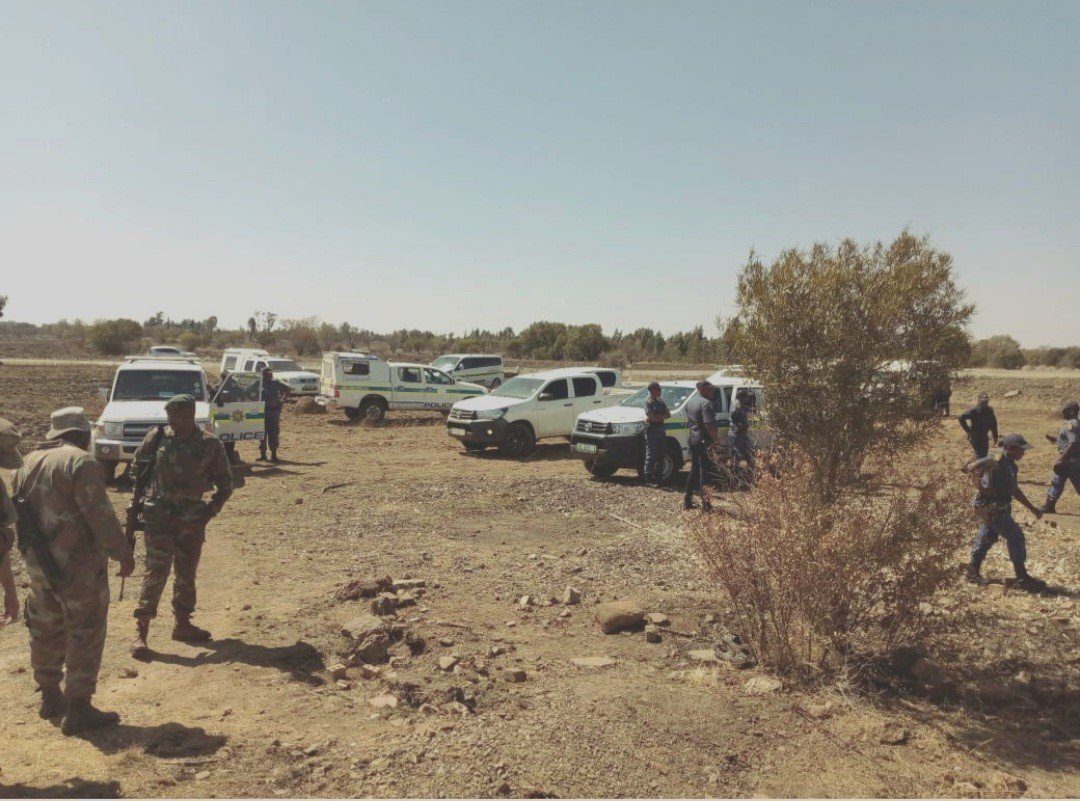

Two Parliamentary oversight committees want senior SA Police Service (SAPS) management to ensure accountability mechanisms and safeguards are in place as soldiers deploy across the country to support the prevention of gang violence and illegal mining.
The year-long deployment, which started on 1 March, was made public known by President Cyril Ramaphosa in his 12 February State of the Nation Address (SONA). It will, as with other internal and external SA National Defence Force (SANDF) taskings, be executed by the Joint Operations Division in terms of Operation Prosper to support government and its entities in ensuring the safety and security of South Africans as well as the country’s infrastructure.
Portfolio Committee on Police (PCoP) chair Ian Cameron, as per a Parliamentary Communication Services (PCS) statement issued post a SAPS briefing to his committee, and the Portfolio Committee on Mineral and Petroleum Resources (PCMPR), noted the deployment will be SAPS led. He is quoted as saying: “it is important to underscore the need to ensure that SAPS members, who are trained to police crime in civilian settings, adhere to high human rights standards. While the deployment is of strategic importance in the short term, strict parameters are necessary to avoid militarised areas”.
The existence of “accountability mechanisms” such as the Independent Police Investigative Directorate (IPID) notwithstanding, both committees are concerned about similar mechanisms applicable to the SANDF and want clarification on this. Enhanced oversight of the SANDF/SAPS joint deployment, including regular funding updates, is also needed.
There is, as yet and as far as can be ascertained, no information available on the SANDF deployment cost and personnel numbers. Soldiers are apparently training at present ahead of deployment to the Cape Flats in Western Cape (where gangsterism is the focal point); the Free State goldfields (illicit mining); Gauteng’s Ekurhuleni, Johannesburg and West Rand districts (also illicit mining); and Nelson Mandela Bay, Humansdorp and Jeffreys Bay in the Eastern Cape (gangsterism). In the North West province, soldiers will help police combat illicit mining in the Platinum Belt as well as the Klerksdorp, Orkney, Stilfontein, Hartebeesfontein and Dr Ruth Mompathi districts.
The PCS statement has it further joint training is necessary to ensure inter-operability between police, soldiers and other law enforcement agencies as well as better collaboration with the National Prosecuting Authority (NPA). This will see prosecutor led investigations resulting in increased conviction rates rather than high arrest figures with low convictions.
Both committees, according to the statement, agree on the urgency of finalising what it called the organised crime implementation model and tabling it in Parliament for scrutiny and oversight of its implementation. They emphasised SAPS and the broader law enforcement apparatus cannot afford further delays in implementing this strategy if organised crime is to be effectively combatted.
As far as the withdrawal of soldiers, at this stage set for 31 March 2027, is concerned a clear exit strategy is needed to ensure this does not result in a resurgence of gang violence and illegal mining is another recommendation along with a reminder the SANDF deployment is a temporary one.
“There must be a clear plan to arrest kingpins, who are the strategic drivers and primary beneficiaries of illegal mining. Arresting low level miners will not have the necessary impact in addressing the scourge,” the statement has PCMPR chair Mikateko Mahlaule saying.
Illegal mining and its prevention is a SAPS tasking in place as Operation Vala Umgodi with, again as per the statement, a comprehensive report to assess its impact and shortcomings expected soon. This, the oversight committees see as informing joint deployment decisions going forward while at the same time they are concerned about reliance on public order policing (POP) units taking on illegal miners. The committees have it POP units lack specialised investigative skills and are deterrent focussed rather than intelligence driven.
In conclusion the committees emphasise intelligence led policing remains essential in the fight against organised crime. “Continued weaknesses in crime intelligence will render the deployment a temporary reprieve rather than a sustainable, long term solution.”