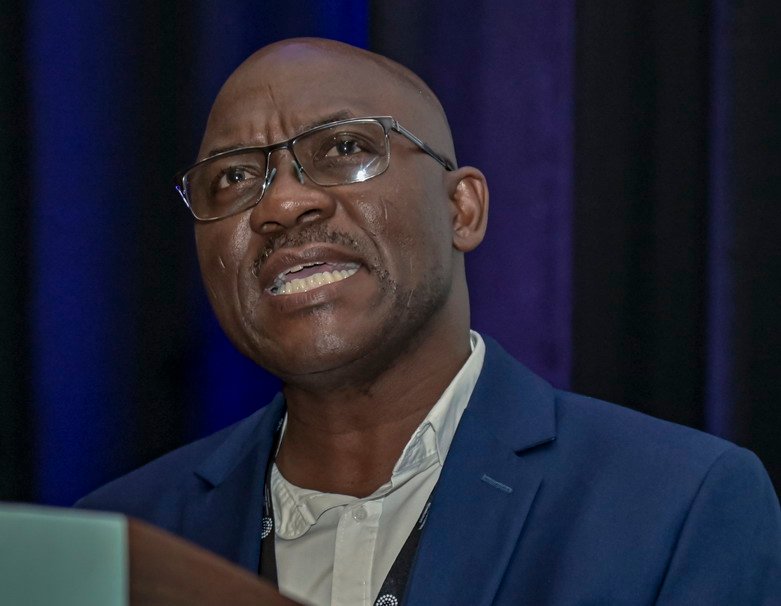

South Africa’s sovereignty and resilience depend on home-grown technology, according to experts speaking at the recent CSIR@80 | G-STIC Pretoria conference.
A panel discussion on “Building national resilience through home-grown technological innovations for safety and security” brought together senior technocrats, academics, and industry figures to explore strategic independence, digital resilience, and barriers that stop home-grown innovation from advancing.
Speakers included Dr Mike Masiapato, Commissioner of the Border Management Authority (BMA); Dr Moses Khanyile, Director of the Defence Artificial Intelligence Research Unit (DAIRU); Dr Mamela Luthuli, CEO of TakeNote IT; and Dr Mthobisi Zondi, CEO and Executive Chair of Sandock Austral Defence (now South African Defence Group).
Together, they described a country at a crossroads: one that must choose whether to rely on foreign partners for critical technologies or commit to building resilient, locally integrated systems to safeguard its security and economic future. Though views varied, the message was clear: South Africa must move beyond conceptual debates toward decisive action to secure borders, protect citizens, and drive economic growth.
Strategic Independence in a Volatile World
Opening the discussion, Zondi strongly argued that national resilience beings with strategic independence. “For any country to project resilience, in the way that it projects defence and military capability, for example, there has to be strategic independence. Strategic independence allows a country to deploy its capabilities on its own volition, without dependence on third-party countries,” Zondi told attendees.
He explained that ‘dependence’ leaves states dangerously exposed. Citing recent conflicts in Ukraine, the Middle East, and the Democratic Republic of the Congo, he cautioned that geopolitical instability could quickly expose nations that overly rely on foreign suppliers. “Geopolitics is so fluid, a person you depend on to supply consumables for security of supply, for example, may not be amenable to do that tomorrow,” he noted.
Achieving independence will require a “whole of South Africa” approach. Defence must be part of the national R&D conversation, not an afterthought. “One of the biggest challenges in terms of defence is that the defence community does not sit at the table where plans and priorities in the government are made,” he explained.
Departments like Trade, Industry, and Competition alongside Higher Education and Defence invest billions in R&D, yet “when it comes to setting up priorities, a strategic map for the next five years for key technologies that are going to be developed for socio-economic purposes, defence is not involved.”
Zondi also urged a shift away from costly “invention” cycles towards pragmatic innovation. “We need to be focusing on innovation, packaging existing technological building blocks and underpinning it with commercial off-the-shelf technology to solve problems that have never been solved before. It’s cheaper, the development cycle is quicker.”
Digital Resilience Over Digital Sovereignty
Khanyile challenged the practicality of digital sovereignty, arguing that South Africa should instead prioritise digital resilience.
“Digital sovereignty does not exist; it is a very aspirational thing. Digital resilience is what we should be talking about.”
Citing intensified global geopolitical fractures, Khanyile also warned that these same fractures extend into the digital landscape and that they will force difficult strategic decisions moving forward.
“In its quest for digital resilience, South Africa needs to decide whether it is going to go East or West for its digital requirements,” he said, adding, “we have been told the East is bad and the West is good, and they have been told the opposite. South Africa is supposedly non-aligned, but one way or another we have to make a commitment in terms of our digital assets and infrastructure.”
He also predicted a future where security forces will rely heavily on technology for everyday policing. “For every human law enforcer, you will have three or four digital equivalents fulfilling that responsibility elsewhere,” he said, highlighting the need for strategic investment, especially in artificial intelligence, to mitigate future dependency.
Confidence and Execution: Time for African Solutions
Luthuli, on the other hand, emphasised self-belief and practical action over dependency on foreign solutions. “We should not be looking East or West. As Africans, we should focus on what works for us and develop our own home-grown solutions,” she argued.
Luthuli argued that Africa’s biggest limitation is not capability, but self-belief. “You can travel anywhere in the world and find a South African behind the technologies we admire and try to replicate at home,” she said. “Our biggest weakness is implementation, we need to start doing things; we conceptualise too long.”
Ongoing Vulnerability and Bureaucratic Paralysis
Masiapato argued that fear and over-caution in government decision-making stifle progress and agility, leading to indecision. “One of the biggest challenges I have observed over my 20 years as a technocrat in South Africa is that we have put ourselves under the bus. Everyone is afraid, if you do not do everything perfectly you will be fired or jailed,” he said.
“Directors are afraid to take decisions and always want to ask a higher official. It makes processes slow, rigid, and ineffective. As a result, we cannot harness the local technologies that already exist in the country,” he explained.
Masiapato specifically highlighted border management as a key vulnerability, citing the 2010 FIFA World Cup, when some potentially dangerous individuals entered and never left. He called for using local technologies, including advanced biometric and surveillance systems, to manage migration securely while facilitating economic and social benefits.