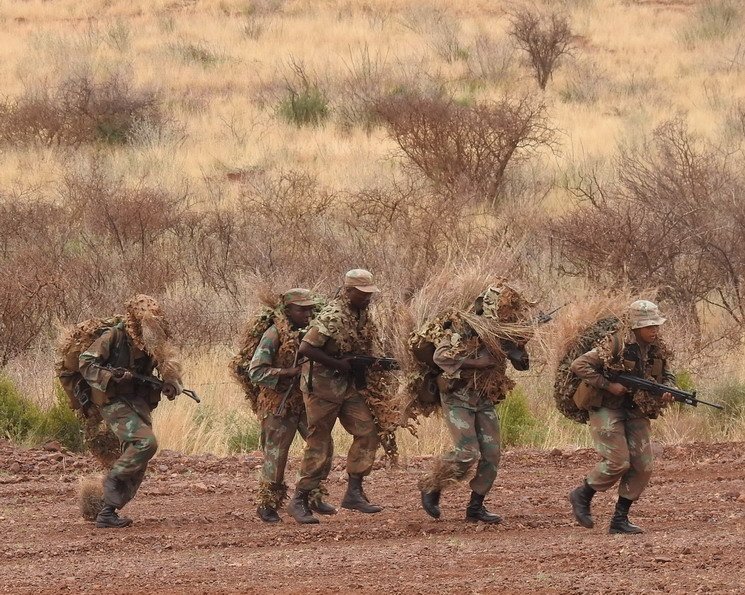

With the SA Army premier exercise – Vuk’uhlome – in full swing at its Combat Training Centre (CTC), this year’s force preparation effort is a brigade level one, as opposed to previous division level iterations.
This was confirmed to this publication by the SA National Defence Force (SANDF) Directorate Corporate Communication (DCC).
The exercise at the 158 000 hectare training area in the Northern Cape started early in September and is set to end with a “distinguished visitors’ day” later this month (November).
DCC has it Vuk’uhlome 2025 is a brigade level exercise involving all SA Army formations. The landward force lists a nine-formation structure ranging from combat elements such as air defence, armour, artillery and infantry through to support in the form of a support formation with intelligence, signals and training in the same general support classification.
Numbers-wise, the dedicated SANDF communication element did not reply to DefenceWeb’s question on personnel deployed to the Northern Cape training area, the largest area-wise in the SANDF, saying Vuk’uhlome is “a security classified military operation”. Additionally, “specific operational details cannot be disclosed to the media in order to safeguard operational security”.
Insight from respected defence analyst Helmoed Heitman on personnel numbers for battalions, brigades and divisions including “complicating factors” takes – to a certain extent – the stated “security risk” off the table.
He has it: “In broad terms a division would comprise several brigades (typically three) plus combat support units (battalions) such as artillery, air defence and engineers as well as combat service support, for example logistic units. A brigade in turn would comprise several armoured and infantry battalions (again, typically three to five) plus combat and combat service support units”.
“In similarly broad terms a division could be anywhere between 15 000 and 25 000 troops or sometimes even more, a brigade anywhere between 4 000 and 10 000 troops. A battalion would typically have between 700 and 1 000 troops, with combat service support units generally smaller.”
His list of complicating factors starts with “some armies use the term division for much smaller formations – essentially souped-up brigades to sound better” before explaining the South African situation.
“The SA Army does not really have a standard brigade type yet, although it seems to have largely fallen back to the old SA Army brigade of three infantry battalions plus one regiment (battalion – we follow the British example) each of armour, artillery, engineers and perhaps air defence, plus combat service support units (maintenance, field workshop, medical) and its headquarters unit supplemented with a signals regiment. At full strength that would take a brigade to around seven to eight thousand troops.”
Other points he raises as “complicating factors” include brigades, in some instances, having no combat service support or even combat support units, with these provided by division.
Going further and possibly complicating matters more is some armies use the term “regiment” for battalions of some corps: examples are armour, artillery, engineers (South Africa does this) whereas others use the term to describe a group of battalions of the same corps –an infantry regiment is one example – similar in strength to a brigade without combat support and combat service support units. The United States (US) and Russian Federation use “regiment” in this sense.
There are also armies – Russia is one example – with small battalions which have limited integral support and logistic capacity and others where battalions are effectively combat groups. They usually comprise sub-units – batteries, companies, squadrons – from several corps.
Vuk’uhlome 2025, according to DCC, will demonstrate the SANDF “commitment to combat readiness, regional co-operation and the highest standards of military professionalism”. On hand to see this commitment at the distinguished visitors’ day will be invited observers from Southern African Development Community (SADC) defence forces, defence and military attaches along with South African Defence and Military Veterans Minister, Angie Motshekga.