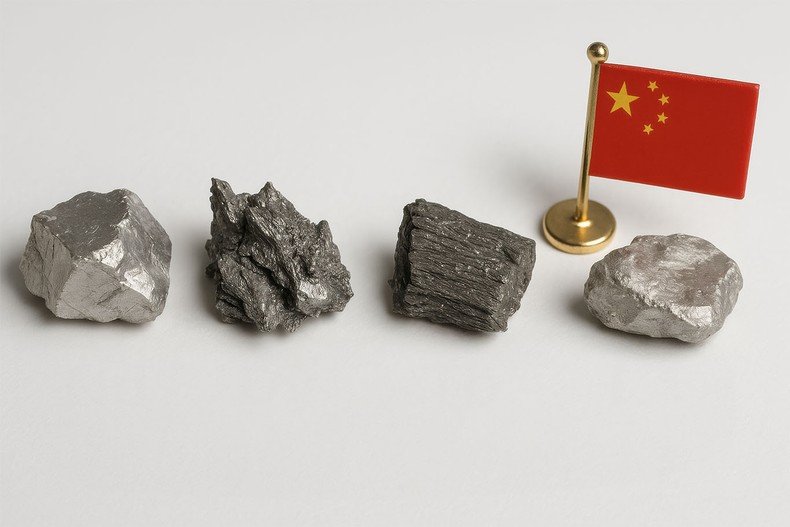
Reporting by the South China Morning Post indicates that U.S. defence reserves of rare earth elements may be dangerously limited, according to sources familiar with the matter.
The minerals are essential components in advanced weapons technologies, including missile guidance systems, fighter aircraft, radar platforms and secure communications infrastructure.
The vulnerability has become more pronounced as military tensions between Washington and Iran have escalated. U.S. strikes that began on February 28 reportedly consumed about $5.6 billion worth of munitions within days, according to Pentagon estimates.
Replenishing those inventories requires steady access to rare earth elements and other strategic minerals, many of which are currently processed or supplied through China-dominated supply chains.


China’s dominance in global mineral supply
China currently dominates the global processing and export of many rare earth elements and other strategic minerals used in defence manufacturing.
Materials such as dysprosium, terbium, gallium and germanium are key inputs in advanced military technologies.
Industry estimates suggest that minerals under Chinese supply or processing chains appear in more than three quarters of U.S. defence platforms, underscoring the strategic leverage Beijing holds over global defence manufacturing.
China has already imposed restrictions on the export of several dual-use materials, minerals with both civilian and military applications, to U.S. military contractors.
Such controls have raised concerns about the resilience of Western defence supply chains and the ability to replenish weapons inventories during prolonged military operations.
Beyond rare earth elements, China also maintains significant influence over other defence-critical minerals.
The country produces roughly 48% of global antimony, a metalloid used to strengthen ammunition alloys, manufacture armour-piercing projectiles and support technologies such as night-vision equipment, infrared sensors and military communications systems.
Africa’s strategic mineral reserves
As Washington seeks to reduce reliance on China-dominated supply chains, attention is increasingly shifting toward Africa, which holds some of the world’s largest untapped reserves of strategic minerals.
Countries including the Democratic Republic of the Congo, Zimbabwe, Namibia, Tanzania and South Africa are emerging as key players in the global critical minerals market.
The Democratic Republic of the Congo accounts for more than 70% of global cobalt production, a key component used in batteries and defence technologies.
Zimbabwe holds some of Africa’s largest lithium reserves, while Namibia and Tanzania are advancing rare earth mining projects aimed at supplying global markets.
South Africa also possesses significant reserves of manganese, platinum group metals and antimony used in advanced industrial and defence technologies.
More recently, Botswana has attracted attention after announcing the discovery of a significant rare earth deposit believed to contain all 15 rare earth elements.
Early assessments suggest the high-grade deposit may also include other strategic minerals such as copper, cobalt, nickel and vanadium, potentially positioning Botswana as a new player in global critical mineral supply chains.
Rising global competition for African minerals
China has spent more than two decades building a strong presence in Africa’s mining sector through infrastructure financing, state-backed companies and long-term mineral extraction agreements across the continent.
The United States is now increasing its engagement with African governments and international partners to secure alternative sources of critical minerals and expand supply chains outside China.
As global demand for rare earth elements intensifies, Africa’s vast mineral resources are becoming increasingly central to global industrial, technological and defence supply networks.