Bola Tinubu has intervened via his lawyer, Oluwole O. Afolabi, in the ongoing Freedom of Information Act (FOIA) lawsuit at the U.S. District Court for the District of Columbia, with a motion seeking to block the unredacted release of records held by the Federal Bureau of Investigation (FBI) and the Drug Enforcement Administration (DEA) on Tinubu.
In the motion filed on September 4, 2025, Afolabi argued that exemptions under the U.S. Privacy Act, and FOIA Exemption 7(c) were grounds to conceal the records from public eyes for privacy reasons, requesting the court to force the hand of the FBI and DEA to withhold the public release of the files. Afolabi’s motion comes 5 months after the had court already ruled that privacy exemptions under the FOIA Act could not be applied in this case, and both agencies should consequently release the unredacted records.
An excerpt from Tinubu’s motion argument reads:
The exemptions and Privacy Act should prevail here because the privacy interests of [Tinubu] outweigh [Greenspan’s] interest in publicising information about Tinubu.”
It will be recalled that the case, instituted in 2023 by American FOIA activist Aaron Greenspan with assistance from West Africa Weekly Editor-in-Chief David Hundeyin, had earlier resulted in the release of 5 batches of the requested documents, with all reference to Tinubu, his family members or associated business entities redacted. On April 8, 2025, Judge Beryl Howell ordered the FBI and DEA to search for and produce all records about Tinubu in their posession, after ruling in favour of Greenspan with a judgment that stated that the agencies could not hide behind Glomar responses or apply FOIA exemptions. According to Judge Howell, keeping such information away from public knowledge using Glomar responses under the excuse of individual privacy exemptions is “neither logical nor plausible.”
Since the judgment however, both agencies have deployed legal gamesmanship and administrative obstruction to delay production of the unredacted files, leading Greenspan to accuse them of “playing politics” and “deliberately delaying” the release of the unredacted drug files as a “favour to the Nigerian President” in a motion filed last month.
In Tinubu’s intervention filing, his lawyer argued: “[Greenspan’s] requests – seeking records about Bola Tinubu – do not fall within the scope of FOIA” […] The purpose of FOIA is to provide access to information on government activities, not to obtain records on individuals compiled by the government.”
Related News: Aaron Greenspan Accuses FBI, DEA of Playing Politics, Deliberately Delaying Release of Unredacted Tinubu Drug Files “As Favour To Nigerian President”
Afolabi argued that FOIA is meant to provide information about government activities, not to expose private details of individuals. Afolabi arugued that the requests by Greenspan “improperly target a private individual” (Tinubu), and that there is no overriding public interest in exposing records concerning past investigations from when Tinubu was not a public official. Given that a summary judgment has already been delivered on the validity of the privacy exemptions in this case, it is unclear how Afolabi’s argument – which effectively asks the court to reverse its own ruling in the same case – will be received by Judge Howell.
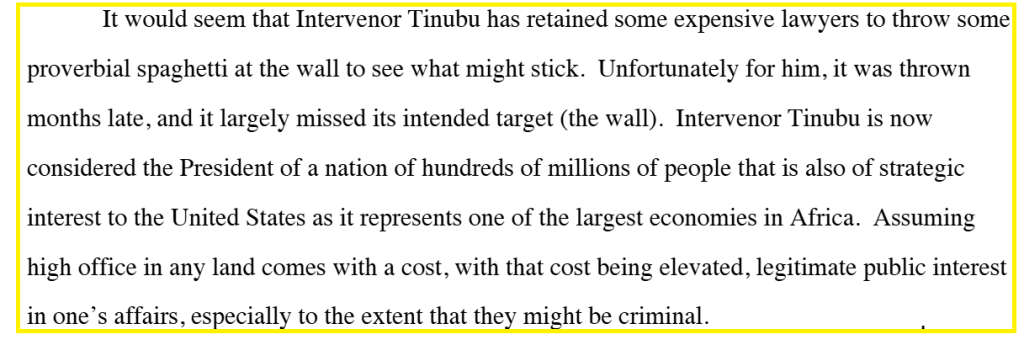
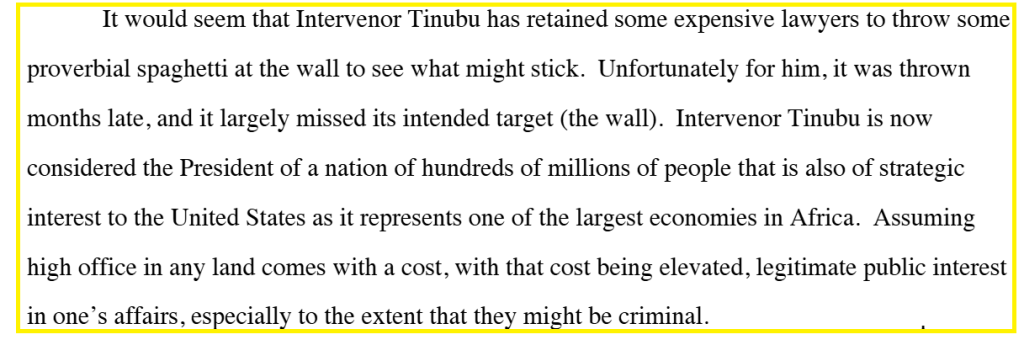
In a motion filed in response almost immediately, Greenspan requested that the court disregard or strike out Bola Tinubu’s motion. An excerpt from Greenspan’s motion filing opposing Tinubu reads:
West Africa Weekly will continue to monitor and update this story as it unfolds. You can read the filing by Greenspan and Tinubu’s lawyers here and here.
About The Author