

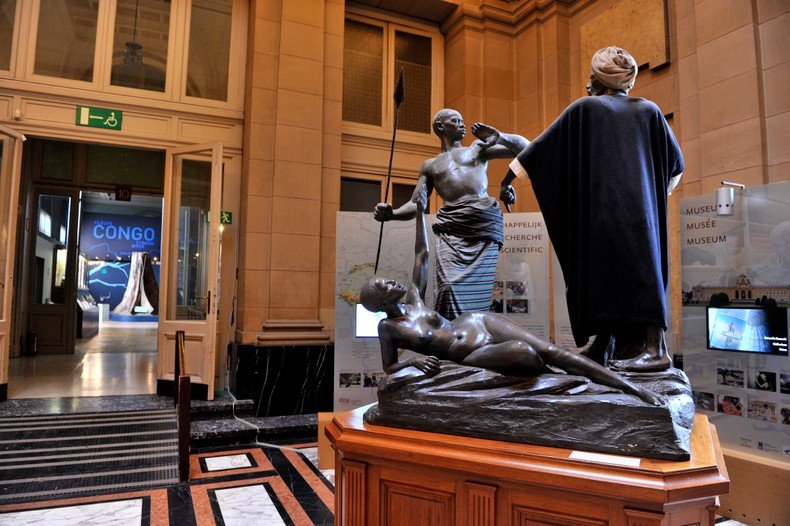
KoBold Metals, a California-based company that raised $537 million in January 2025 to expand its exploration of critical minerals, has requested access to tons of records held in Belgium’s Royal Museum for Central Africa (AfricaMuseum).
These records, created during the colonial era, are regarded as pivotal for tracking critical minerals in the region and their exploitation.
“We scan, we digitise the documents, and make them accessible to the public immediately,” Benjamin Katabuka, Director General for KoBold Metals in DRC, told Reuters.
“This country needs more investment in exploration, and we need the data to be available to the public to make that happen.”
However, the mining company has encountered an obstacle in the form of the AfricaMuseum, which also intends to digitize the historical asset.
“We cannot delegate the management of collections to private companies; it would go against all scientific and institutional ethics,” museum director Bart Ouvry also told Reuters.
KoBold has offered to assist the DRC with digitizing the collection, which spans approximately 500 metres of museum shelves and includes precise records of how the country’s mineral wealth was previously surveyed and exploited.
The company claims it is offering technical and financial help at the request of the DRC government.
However, AfricaMuseum, which is backed by Belgian officials, has refused to hand over the original records, claiming an ongoing project to digitize the archives in collaboration with Congo’s National Geological Service and funded by the European Union.
According to museum authorities, the process could take up to five years, after which the data will be accessible in both Belgium and the Democratic Republic of the Congo under Belgian and European law.


Belgium’s argument against Kobold
An earlier report showed that Vanessa Matz, Belgium’s Science Policy Minister, highlighted that Brussels retains sovereignty of the records until digitisation is complete, urging that the country’s legal and procedural procedures be followed.
She pointed out that archives are expressly excluded from the 2022 Belgian law requiring the return of colonial-era holdings.
A team of scientists began working on the digitisation in February 2026, with archivists expected to follow in March, although officials caution that classifying and fully digitizing the collection may take many years before it is readily available.
Belgium has already agreed to send the archives to the Congolese government once digitalization is completed.
KoBold, on the other hand, has pushed for in-house digitisation to speed its exploratory schedule, as it managed to secure an agreement with DRC to apply for exploration permits in the East African country.
The museum has rejected the proposal, warning that allowing a single private corporation control the process will result in an unfair financial advantage and a conflict with the institution’s public scientific mission.
The head of the museum’s earth sciences department informed Reuters that the museum’s extensive archive, located in Tervuren, just outside of Brussels, contains handwritten, fragile, and incomplete inventories.


