


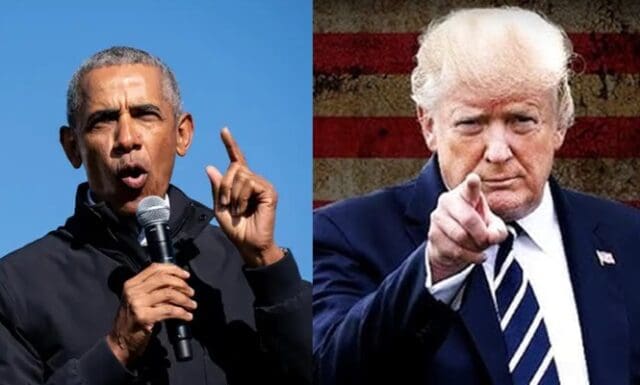
In a political climate charged with tension and drama, former President Barack Obama has stepped into the fray to address the explosive treason allegations leveled by Donald Trump.
As the nation grapples with these contentious claims, Obama’s response not only sheds light on the situation but also reveals deeper truths about political discourse today.
– Advertisement –
Trump made the allegations during an address from the Oval Office on Tuesday, while meeting with Philippine President Ferdinand Marcos Jr., asserting that Obama was guilty of the alleged offense.
Framing the former president as the “ringleader” of a supposed deep-state effort to sabotage his 2016 and 2020 campaigns, Trump doubled down on claims rooted in debunked conspiracy theories and unverified intelligence memos.
The dramatic setting in the formal confines of the Oval Office and the presence of a foreign head of state lent an air of officialdom to the otherwise baseless accusation, further blurring the line between governance and grievance.
The moment captured the current volatility of American political life: a sitting president using one of the most powerful platforms in the world to level criminal accusations against his predecessor without presenting concrete evidence.
Calling the accusations “outrageous” and “bizarre,” Obama’s team dismissed Trump’s claims as a reckless distortion of fact, designed more to inflame than inform.
– Advertisement –
Rather than dignify the charges with a detailed rebuttal, the former president underscored a broader concern: the erosion of truth in public life and the growing use of conspiracy as a political weapon.
In doing so, Obama’s response became less about defending himself and more about defending the integrity of American institutions and democratic norms.
At the heart of the controversy is a renewed attempt by Trump to recast the events surrounding the 2016 election, this time accusing his predecessor of orchestrating an elaborate scheme to undermine him.
Yet multiple bipartisan investigations, including findings from the Senate Intelligence Committee and Special Counsel Robert Mueller, have consistently found no evidence of vote manipulation or treasonous behavior by any U.S. official.
Instead, these probes confirmed what Obama reiterated: that foreign interference did occur, but the core functions of the electoral process remained intact.
Obama’s measured but firm stance reflects a growing divide in how truth and responsibility are treated in modern politics.
While Trump’s rhetoric seeks to galvanize a loyal base by invoking grievance and retribution, Obama’s rebuttal speaks to a more institutional concern, the sustainability of democratic discourse in an era increasingly defined by misinformation and spectacle.


