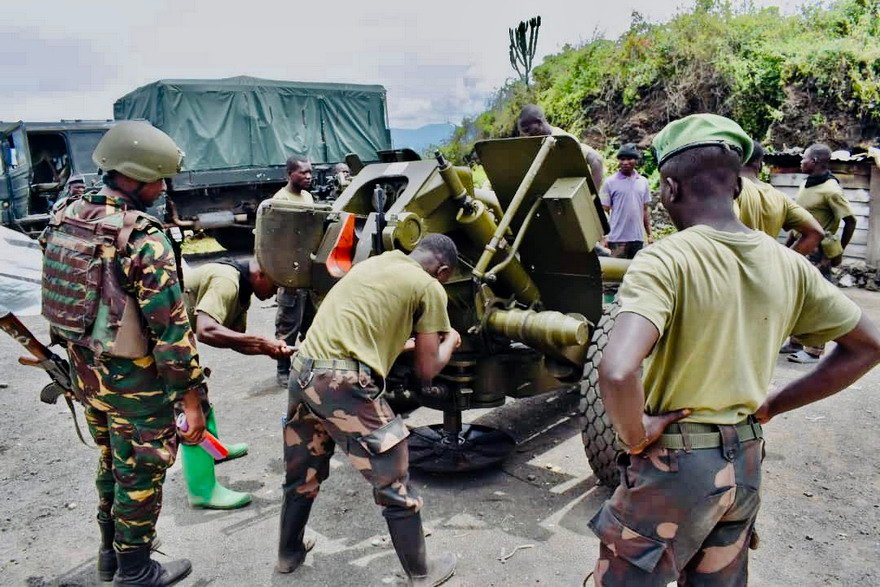

The voice of the Peace and Security Council (PSC) of the African Union (AU) has been added to those worldwide calling for an immediate and unconditional ceasefire in the eastern Democratic Republic of Congo (DRC).
Following its meeting on Friday (14 February), the PSC issued a lengthy communique which, among others, “unequivocally condemns” the activities of M23 (Mouvement du 23 Mars) and its supporters, Allied Democratic Forces (ADF), Democratic Forces for the Liberation of Rwanda (FDLR) and other armed groups; and calls for the immediate and unconditional ceasefire. The continental bloc PSC communique further calls cessation of hostilities and the immediate withdrawal of “all uninvited foreign forces, armed and terrorist groups operating in DRC”.
Echoing the 8 February joint East African Community (EAC)/Southern African Development Community (SADC) summit in Dar es Salaam, Tanzania, finding that there is no military solution to the DRC conflict, the AU PSC urged all parties to prioritise diplomatic and political engagement. The applicable part of the communique reads: “(It, the PSC) calls for immediate resumption of negotiations and dialogue with all state and non-state parties (military and non-military) including the M23 under the frameworks of the Luanda and Nairobi processes”.
Calls for negotiation and diplomatic interaction were made by United Nations (UN) Secretary-General Antonio Guterres at the Dar es Salaam summit and European Union (EU) Vice President and High Representative Kaja Kallas, ahead of a visit to South Africa starting today (19 February).
The PSC communique, issued yesterday (Tuesday, 18 February), urges eastern DRC belligerents to “take advantage” of progress with the Luanda process. Listed are implementation of the concept of operations (CONOPS), including neutralisation of the FDLR (Forces Démocratiques de Libération du Rwanda) as well as “defensive measures/disengagement” of forces from President Felix Tshisekedi’s country.
Another indication of the conflict’s impact on the wider Congolese population came from a UNHCR (UN High Commissioner for Refugees) briefing in Switzerland yesterday (18 February).
“Between 10 and 15 000 people crossed into Burundi over the past few days, fleeing escalating tension and violence in DRC,” spokesman Matthew Saltmarsh told a media briefing in Geneva.
“Most of those arriving are Congolese, mainly from the Bukavu area in South Kivu, where the situation continues to deteriorate. A smaller number of Burundian nationals also returned to their country fleeing clashes.
People are mainly arriving at Gatumba border post close to the largest city, Bujumbura, exhausted and traumatised, many separated from their families with little information on their whereabouts.”
He said there were also reports of “thousands arriving through unofficial border points including along the Rusizi River near Rugombo, with several individuals apparently drowning”.
Saltmarsh called the eastern DRC situation “challenging” adding over 150 000 people had fled the area, mostly from the north and south Kivu provinces.