

Negotiations at the United Nations on a new Framework Convention on International Tax Cooperation are rapidly redefining how countries will tax cross‑border economic activities in an increasingly digital and interconnected world.
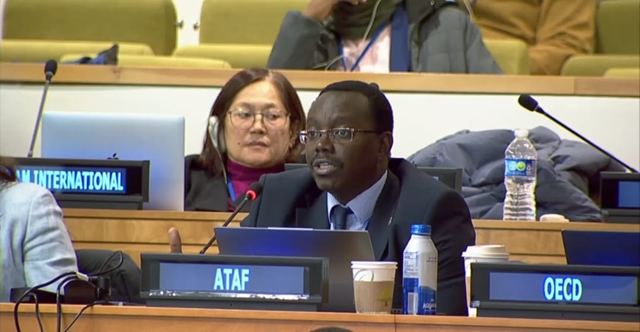
During the Fourth Session of the Intergovernmental Negotiating Committee in New York, the African Tax Administration Forum (ATAF) has taken an active role through a delegation comprising Mr Thulani Shongwe (Head: African Multilateral Cooperation), Mr Anthony Munanda (Head: Domestic Resource Mobilisation), and Mr Emmanuel Eze (Senior Advisor: African Union).
The talks cover several issues with direct implications for African tax administrations, including the fair allocation of taxing rights, taxation of high‑net‑worth individuals, tax‑related illicit financial flows, and new mechanisms for dispute prevention and resolution.
Speaking in the negotiations, Mr Shongwe stressed that international tax rules must reflect the realities faced by developing economies. “Fair taxing rights must reflect the realities experienced by developing countries,” he noted, welcoming the language proposed by Zambia and the Africa Group, which he said, “strikes an appropriate balance between allocation standards and principles for implementation and coordination.”
African officials have also raised concerns that international tax cooperation must not replicate past imbalances in global rule‑making, where standards were largely shaped without meaningful developing‑country input. They stress that new rules on taxing income from cross‑border services must genuinely expand source‑country taxing rights, rather than lock in low returns for African markets where significant value is created. On dispute prevention and resolution, many African countries worry that complex, resource‑intensive mechanisms could disadvantage administrations with limited capacity, and have therefore called for simpler, more transparent procedures that respect domestic legal systems and avoid undue pressure on weaker parties.
A major focus of the discussions is how to tax income from cross‑border services as business models become more digital and operate across multiple jurisdictions. Contributing to work on the relevant protocol, Mr Munanda underlined the need for robust nexus rules that allow countries to exercise taxing rights where economic activity and value creation actually occur. He argued that these nexus factors should take into account elements such as payments arising from a jurisdiction and the location of users, so that global tax rules remain responsive to evolving economic realities.
Beyond the formal negotiations, the ATAF delegation has engaged in a series of technical meetings and bilateral exchanges with international partners and policy institutions in New York. These engagements have included participation in the Special ECOSOC Meeting on Financial Integrity, discussions at New York University on the Framework Convention, a dispute‑resolution meeting with the International Institute for Sustainable Development (IISD), and policy talks hosted by the Permanent Mission of Brazil to the United Nations.
The outcomes of the UN negotiations are expected to play a pivotal role in determining how countries tax cross‑border services, curb illicit financial flows, and manage tax disputes in the years ahead. For African countries, ensuring that their perspectives shape these new rules is seen as critical to protecting domestic revenues and strengthening fair, effective international tax cooperation.


