

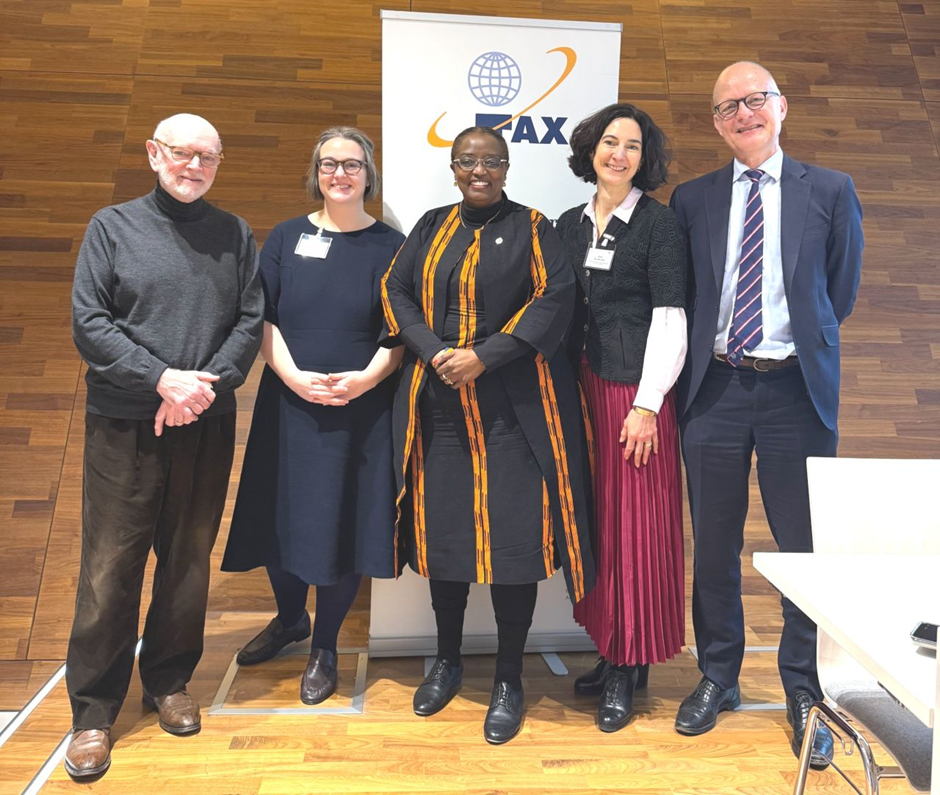
ATAF Executive Secretary, Ms Mary Baine, and ATAF Specialist for Applied Research and Statistics, Mr Ronald Waiswa, participated in the Future of Tax Symposium hosted by the Institute of Austrian and International Tax Law through its Global Tax Centre in Vienna, Austria. The two-day symposium convened leading policymakers, researchers and tax administration experts to examine how tax systems must evolve in an increasingly complex global environment.
Discussions at the symposium explored a wide range of themes shaping the future of taxation, including direct and indirect taxes, personal income and wealth taxation, environmental taxes, the role of technology and data in tax administration, competitiveness, and the future of multilateral tax cooperation.
During the discussions on the future of multilateral tax cooperation, the Executive Secretary highlighted the growing strain on consensus-based global solutions and the practical challenges developing countries face in translating global standards into workable national outcomes.
She emphasised the importance of regional platforms such as ATAF in strengthening inclusive multilateralism by building African consensus, supporting regional coordination, and ensuring that African perspectives are effectively reflected in international tax policy debates, including ongoing discussions under the United Nations Framework Convention on International Tax Cooperation.
In her concluding reflections, Ms Baine underscored that the defining priority for the coming decade will be the development of trusted, data-driven and inclusive tax administrations. She stressed the importance of strong governance, institutional capacity, and collaboration among tax administrations, regional platforms, and global partners to ensure that emerging tax reforms remain practical, implementable, and responsive to the realities faced by developing economies.
During a session on the transformation of tax administration, Mr Ronald Waiswa shared insights from African tax administrations, highlighting how many institutions have undergone a significant shift over the past decade from manual, enforcement-heavy systems to data-driven, compliance-focused, and increasingly service-oriented models.
He noted that while digitalisation initiatives such as e-invoicing systems and digital excise tracking are strengthening compliance management, newer applications of technology are also improving taxpayer services through tools such as pre-filled returns, modern contact centres and AI-enabled virtual assistants. Mr Waiswa emphasised that technology alone cannot deliver results unless it is supported by strong data governance, capable institutions and public trust.
Through its participation, ATAF contributed practical implementation experience from African tax administrations and reinforced the importance of regional cooperation in shaping sustainable and equitable global tax systems.


